

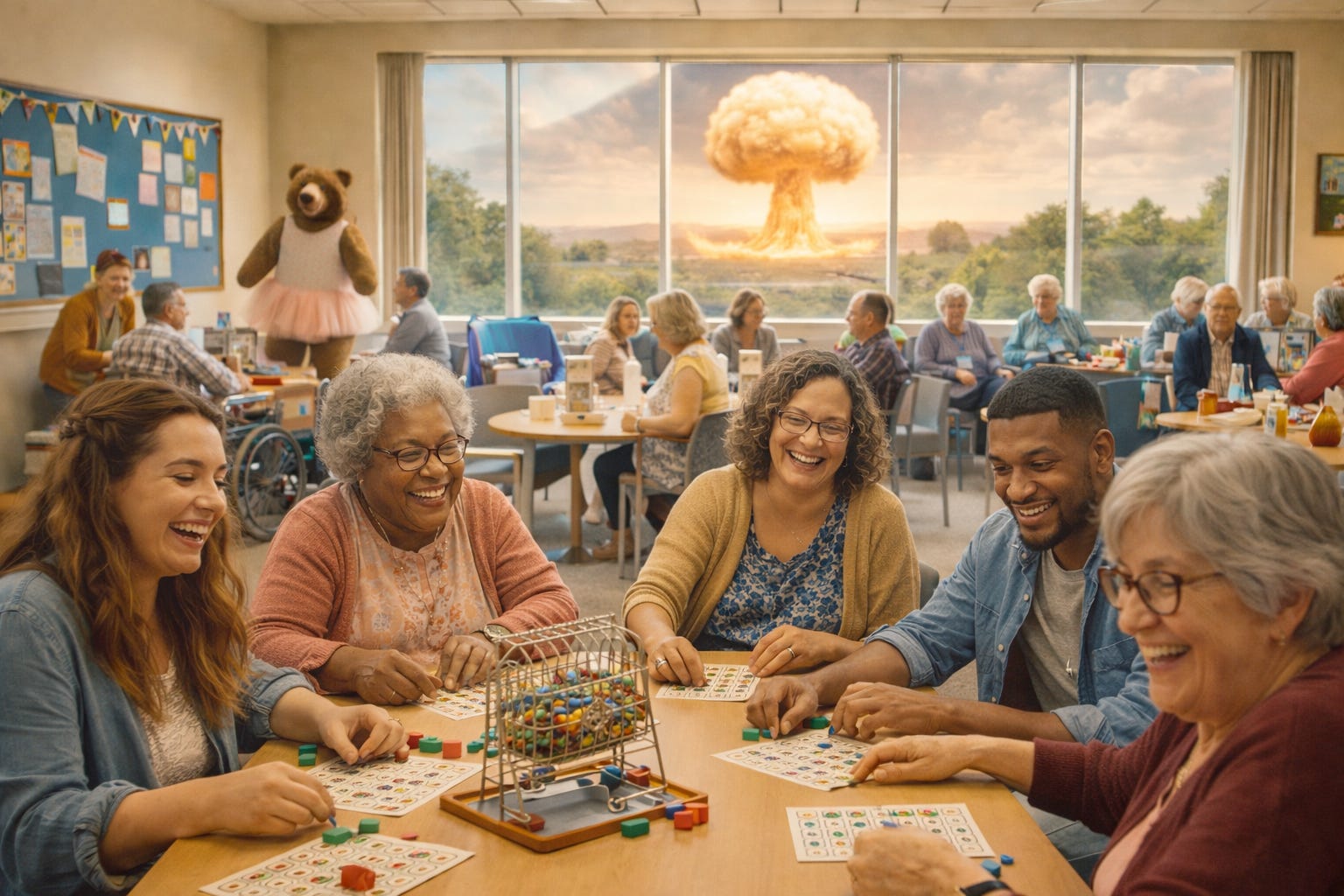
Okay, so I lied, it’s a shitshow. But hey, that’s what you’re here for, and indeed, what we kind of signed up for. Just keep on keeping on. Have fun when you can. The most formidable CEO colleague I ever worked with, Jacky, used to say, “It’ll be alright. And if it’s not alright, it’ll be alright.” That is the best advice I’ve ever had for this game.
So I ended last year with a fairly popular (4000+ readers) review of the year. And now it’s time to draw some of those observations into the future. Not predictions, so much as analysing trends and trajectories. Because honestly, who can possibly hazard a guess about what is going to happen, even in nonprofits, in a world where the US is about to invade Greenland? Stick a fork in me, I’m done.
The thing is, we’re in a very difficult place, which even the Guardian has now discovered. What they have noticed is that, positive as the Civil Society Covenant is, what charities really need is, erm, cash.
It gives a good historical and political perspective as well as a demand for change. But what we perhaps need to further emphasise is that the cultural ‘glue’ of community charity does not appear magically between interventions for diabetes or cancer or parenting workshops. Fund the glue, and then force the state to take back its role in creating interventions to solve problems it creates and maintains, often by refusing to challenge exploitative and antisocial economic forces.
Now is the time to put aside our obsessions with intervention and focus on what voluntarism is really for: bringing together communities and society.
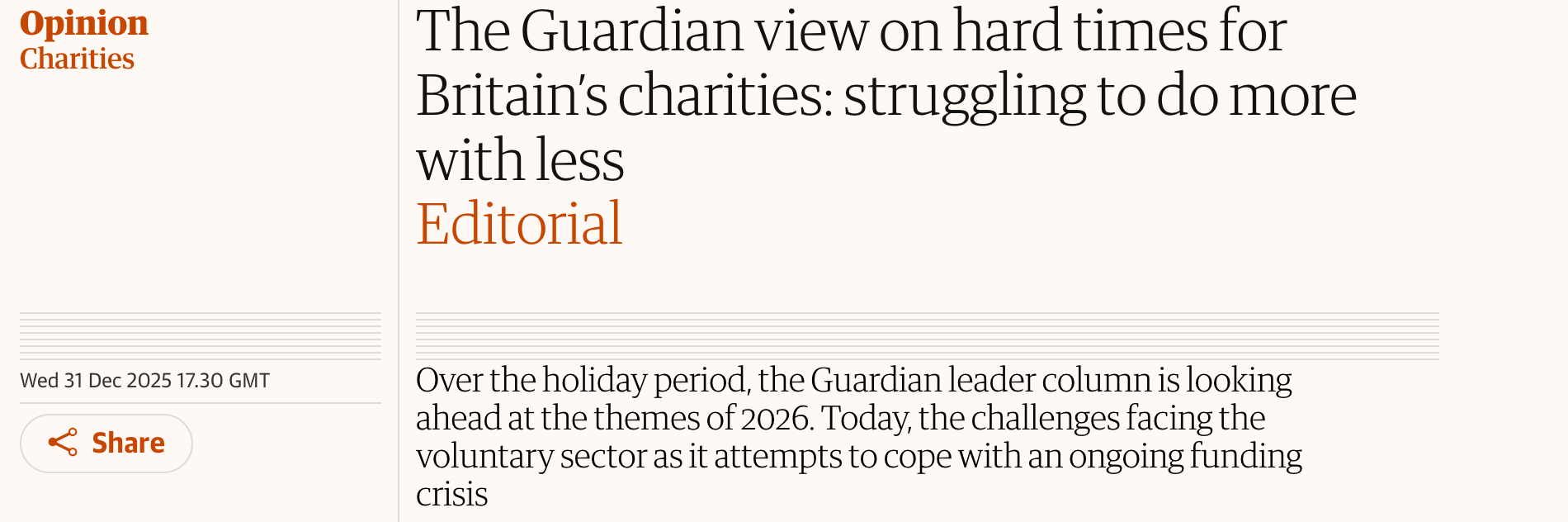
Anyway, nice for us all to be in the Grauniad, innit? It’s like being famous.
DYNAMIC CEOS AND THEIR MASSIVE HARD IMPACT
It’s a new year and the ‘up-for-it’ dynamic hard-ass charity CEOs are setting out their warplans on Linkedin with speeches worthy of Henry V via Chat GPT. They’ve always got a copy of Sun Tzu’s Art of War and the latest Stephen Bartlett crayon-masterpiece in their back pocket.

‘Hard decisions’, ‘tough times’ ‘massive impact’, and ‘dynamic power of charity’ are everything, and you’re sometimes hard pressed to work out if it’s Barry’s Bootcamp, Harvard Business School or a Grindr profile.
The promise is always, ‘This will be a difficult year - this is what you can do.’
But strangely it’s exactly what you’ve been doing for twenty five years, repackaged with all the same mix of solemn-yet-bloodless charity jargon and business babble that seems to be the only way we can speak now.
There is always a list of great sins that ‘we’ must avoid, always written from the perspective of some almighty powers who must be appeased. One such speech I saw this year told us that we will see “reduced tolerance for unclear impact.” Who exactly is doing the tolerating here? Who gets to choose the level of tolerance? Is Daddy watching? Do you secretly enjoy that?
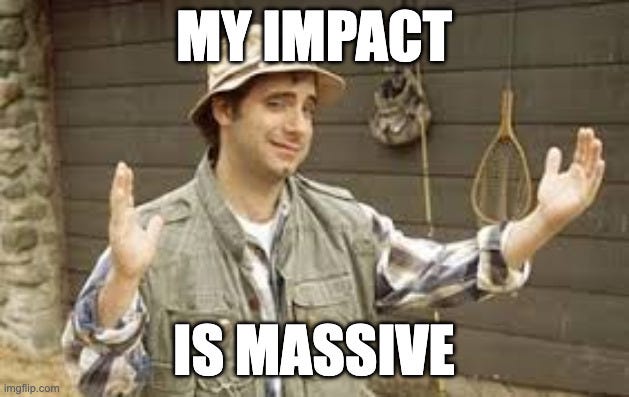
Then we will hear the old saw “collaborate more!” - always especially popular for larger charities who are really saying “don’t compete with us, or we will crush you.” Or perhaps like the Borg: “You will be assimilated….” One very special post even then wheeled out “work smarter not harder.” If that’s the best you can come up with, I doubt smarter is on the agenda. Others tell us that technology will solve our problems. But AI will not unblock that toilet.
Much of this is like being told to levitate through the power of pure thought. What we are doing is packaging endurance and acceptance as change. And it’s the same old prescriptions for the same problems, albeit writ larger and deeper than before.
Isn’t there a future beyond the next funding round?
What I would add is that it may be time for us all to start asking whether, at the start of such a year (that, fortunately, most of us will survive and occasionally thrive through) there might be genuine or deeper change. Perhaps even in another 25 years - which could be a radically different version of the current reality we see. If nothing else, the order of the world is being thrown up in the air.
It’s not going well, have you noticed? But if in the wider economy there is to be what Resolution Foundation calls ‘creative destruction’ (see later), perhaps it’s time to think about what could come after. That goes double for our little corner of the economy and the world.
In so many ways, the current crisis is just business as usual. But wouldn’t you like a sense of a future beyond just that?
This week, I’m going to give you a sense of what I expect to see this year, especially in terms of wider politics and economics, and how that is likely to affect UK nonprofits.
In the following issue, I want to look far beyond the next year and offer some ‘What ifs.’ What ifs are not about predicting the future - they are about imagining possibility. And it’s remarkable how much nobody wants you to think about that.
A reminder:
“Not everything that is faced can be changed, but nothing can be changed until it is faced.”
— James Baldwin

The economy
This year, we have to remember that we’re not the only ones in a recession. Before people pile in and tell me the definition of a recession, come off it: look outside.

The Resolution Foundation, Torsten Bell’s economic think tank which is sort of what passes for centre-left-ish if you squint, is going for the glass half-full approach. But even if this glass is half full, it’s a reminder you need to ask what’s in the glass before you drink it.
“Experts have warned for several years that Britain has been held back by so-called “zombie firms” – companies which barely make enough money to cover their costs but just about stay in business – preventing the allocation of resources to more productive sectors of the economy. […]
The Resolution Foundation said there were early signs that Britain’s productivity growth was being boosted by “creative destruction”, whereby newer and better firms, products or processes replace older, less-efficient, ones. Adoption of artificial intelligence technologies could also be playing a role, it said.”
But there is a problem here: market capitalism’s survival of the fittest takes no account of the value of a business beyond its financial value.
For example: the Costa coffee (yes, owned by Coca-Cola, but a franchise, remember) in Catford, rammed every day for ten years but apparently unable to make sufficient profit, has just closed. The community cinema went last year, as did all four pubs, all because they were financially ‘underperforming’. But these ‘zombie’ businesses were not crowding out alternative, stronger businesses. Not least, nobody else can afford the rent. And the impact of their loss to the community is vast. Furthermore, the loss of those businesses impacts the wider local economy - the death spiral of the high street continues. What replaces them is usually zombies of even greater putrescence - more money-laundering phone shops or ‘club venues’ that strangely never open.
All of this can be reflected at a larger, national/ macro-economic level as well. The underperforming productive economy will continue to be replaced by an AI bubble and more and more financialised zombie speculation and private equity firms. What is really ‘productive’ here? We should also note that the death of all these ‘zombie’ businesses, as the report makes clear, means unemployment - bad for charities who look after poor communities. We risk dead zones of social fabric, with more and more people falling into greater poverty.
So even the case for a clearout for private enterprise is far from clear-cut.
Zombie charities?
But what of charities then?
The idea that ‘zombie’ businesses going under is ‘creative destruction’ is also often used to argue for the death of many struggling charities, by charity hawks and, essentially, those who are doing well. Are there zombie charities who just need a well-judged headshot to bring the tender mercies of oblivion?
We;ve been here before. People who go under are not necessarily the ones who are not needed. Sometimes they are just unpopular causes. Sometimes they fall foul of the desire to fund only targeted interventions - community centres, for example. And sometimes, they just have a run of bad luck, often following a run of good luck (time for a ‘break’ from all the big funders at once). I’m still reeling from the loss of the only UK charity for LGBT older people - dropped like a stone by its parent charity and cut adrift by all its funders at the first sign of trouble. That was desperately needed.
Let’s be clear. Charity business strategy is a big part of my day job. (I’m a Marxist who finds business really interesting.. Like Engels…) If I’m being brutally honest, there are a few charities which are absolutely zombies whose time has long past. I can think of organisations who have spent literally 10 years of not just dwindling resources and finances, but also, dwindling effectiveness, and indeed, usefulness. The financial and the ‘impact’ are intertwined, but there is often a particular kind of death spiral in which complaints about lack of income conceal the fact that other things are very wrong. Youth charities, for all the desperate need, are often problematic here. Years of dwindling attendance and a failure to change has combined with the lack of income in a self-reinforcing spiral for many. That ends in disaster.
So, much as I want to offer encouragement, I always encourage perople to ask themselves: as you approach the new financial year, is it really worth it? We can never take out personal needs entirely, and it’s scary to lose a job, but a graceful exit is much better than a crash and burn with staff (including you) heading off to government compensation schemes for their redundancy pay. But people can be incredily resistant to hearing this.
At the same time, we can celebrate the resilience of what former Lloyds Foundation CEO Paul Streets calls not zombies, but ‘cockroaches’. Small charities, he famously said, are like cockroaches - you can’t believe they’re still there, every year, surviving beyond all expectations.

So, if things are a nightmare this year again, you probably need to work out whether you’re a zombie or a cockroach.
I expect more charities to close but I suspect more and more will start shrinking services instead. And they should. Meanwhile, those doing well will do well - that is the ongoing pattern. The larger and most government-focused charities will either hoover up, or go under. Much of that will depend on their location and the particular poilitial stripe of their local authority or relationship with the NHS.
Meanwhile, with some of the big grantmakers reopening, there may be hope for some - but many have pivoted. Is the funding matched to the needs? Are you the new chosen ones…? And can you get through the front door when the queue is this long?
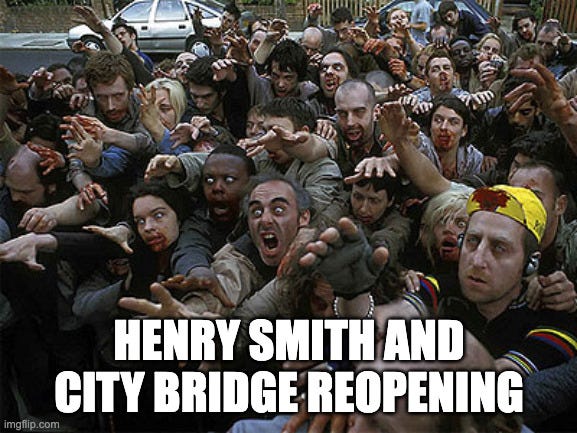
Other 2026 predictions: key trends
Politics and power
Expect significant turmoil with May elections testing Labour’s position as anti-migrant rhetoric follows Reform rightward. Starmer is unlikely to survive those elections unless there is a surprisingly good result for Labour. In this crazy world, the latter is still not unthinkable. But more likely, there will be a huge crash and we will see someone else in charge until the next election. Who? There are no good options. Meanwhile, if more Reform councils appear, bad things will happen for a wide range of services for people who rely on charities. The old pattern of increasing need, dwindling public services, and charities without resources will play out even stronger than before. You can also expect anti-DEI and anti-migrant sentiment to infect commissioning as it has in the US.
At the same time, politically, it’s far from certain that Reform’s resurgence will continue - for one thing, their clear fecklessness is becoming more and more apparent, and if they do win more councils, that will be difficult to ignore for all but those who literally vote for them because they’re nutcases. The Greens may do well, or it may be still disappointing. The Lib Dems will stay the party of ex-Headteachers and librarians. Some claim the Tories are in a final closure stage. I’m not so sure: we thought that in ‘97, and people forget very quickly. So the question, then, is where will people turn? One danger may be that they turn away from party politics - and to different kinds of political action. Everybody I know expects more civil unrest this year.
Meanwhile, in the charity world, the Civil Society Covenant is likely to face its first real tests of tolerance for challenge of the Government, as migrant rhetoric, and indeed, likely cuts to welfare, directly impact charitable missions. How brave charities feel will be a big decider. With a new Charity Commission regime, there is testing to be done.
On this note, I think we should be braver. But I also realise how dangerous openness is for charity leaders: what I have recently found is that CEOs who speak out politically (on a clearly personal basis, even) are not so much at risk from funders, as at risk from their own trustees. This tells us a lot about how trustees work to contain discourse in the sector.
Culture wars
On that front, I’m expecting the culture wars to intensify in the charity sector, particularly around trans inclusion and who counts as “deserving” of support. Make sure you join Kevin’s Third Sector Against Transphobia group. And look, you don’t have to be a radical trans activist (whatever that is) to think it’s just mean and shitty to boot out some poor kid from their Brownies group because somebody has decided they’re too ‘manly’. Just don’t be horrible.
A previously quieter far-right wing in the charity sector is already becoming more visible - that includes people raising extremist anti-migrant views openly. The danger, conversely, is that a true anti-authoritarian left wing, beyond pronouncements about deserving ‘vulnerable’ people and DEI industry talk, has been very effectively silenced over the last 15 years.
The rise of Christian Nationalism (really ethno-nationalism) should be of concern to Christian charities (and indeed, the rest of us). It will be all too easy to find boards being infiltrated as they have been so effectively in the US.
I highly recommend this video by the brilliant and adorable Tom Nicholas.
Community and society
Libraries, cinemas, pubs, shops, all manner of social spaces closing, is probably driving more people into the arms of the far right as they become more afraid and distrustful of others. What the far-right in the US has realised long ago is that they can offer the sense of comfort and camaraderie that people are losing in their communities in an age of ‘bowling alone’. The latest discovery by the Guardian and indeed some funders is that community centres and other types of third spaces (including in the private sector) are vital. But I fear we can expect more talk about shared community spaces without actual funding - the eternal expectation that if you fund interventions, community glue will miraculously transsubstantiate around it. Promises of Government investment will be backed only by money already earmarked long ago.
The further rise of strategic grantmaking is only exacerbating the decline of whole-community support and development. Whether some of the larger funders can pivot meaningfully to support this will be the make or break. But it can probably only happen if multiple funders collaborate strategically, and if funding is not only short term or project focused, or indeed, capital only. We do not need another white elephant communiy asset in the bottom of a tower block that nobody can afford to do anything in. And no, children’s parties or a barely-open cafe will not pay for it.
As I write, trying to find somewhere to have a coffee in Catford instead of the now closed Costa, I decided to go to the cold, inhospitable new community/ social enterprise ‘not just a pub’ which the council has given to a shake-and-bake community ‘regeneration’ CIC. They were the first to post on Facebook that those who lamented the loss of Costa could come and support a real community venue. That’s something, I thought, and turned up. D’oh! They’re closed in the daytime all week…. Of course, they got capital funding, and then zero revenue funding for a from-scratch new venue with uncertain purpose. Sigh.
Let’s be clear: the new social clubs and so on that are opening and developing need to make sure they have a purpose. Community centres without community activities are just empty spaces. Libraries without books are just empty spaces. Socila enterprise coffeee shops with horrible food and coffee that are never open are just empty spaces. There is no way to avoid revenue funding for 99.9% of ventures with any kind of social goal.
Economic trends
And on that note, there has been a clear increase in talk about social finance recently, and the development of the Office for the Impact Economy (seriously, for what, now…?) is part of this. It is certainly no coincidence that such talk comes at a time of massive charity sector collapse, as indeed it it did in the Big Society crunch of 2010-11. Social finance for actual businesses and private enterprises seems to me to be a potential positive - so many of the basic social fabric businesses we need are now incresibly high risk and need patient capital banks refuse, especially in poorer areas. But the push towards further social finance for genuinely charitable projects has the opposite effect, as we saw the last time. This creates capital projects with no revenue funding, or underfunded ventures on ridiculous timescales doomed to fail within two years. The failures are then used to justify further cuts or refused further lending for similar work. ‘People just don’t want it. It can’t work.’ But charities are charities for a reason. They cannot just fund themselves - otherwise, they can just be businesses.
This article is well worth a read. I don’t necessarily agree with it all - I think the grey area might actually be exactly where it is most helpful (for example, funding low-profit but high community regeneration value retail, leisure or hospitality ventures with truly patient capital). But in spirit, it squares very closely with my own experience.

The ‘impact’ data lust in the sector seems to be continuing, with ever more talk about having to ‘demonstrate real impact’. And yet, I do think I am seeing (and I hope, in some way modestly supporting) a growing schism between those believing in perfect data and total surveillance, versus those who favour doing good stuff because it’s the right thing to do. Clearly neither approach alone is helpful. But ask yourself, what still needs to be statistically proven about most charity work? And in that case, what is the point of simply proving it again? And who really wants this data? What change will it actually unlock? What are we doing with this data apart from putting it in a database and wondering why it still doesn’t tell us anything of value?
Technology
I imagine funders will be using AI to sift applications by year’s end. We’re also seeing a burgeoning of ‘innovative’ fundraising databases from fundraisers who fear the collapse of the bid-writing market. They’re right to worry! But how many more databases do we need? One good one would be a start.
More generally, especially around AI, I’m seing more predatory sniffing around from private sector rip-off merchants who see charities as easy marks. Beware people using pretend ‘donations’ to lock organisations into subscriptions for later enshittification. The last charity tech boom was 2010-11; economic drivers suggest another is coming. It achieved very little and saddled a lot of charities with systems that never worked and wasted millions of pounds.
In an age of enshittification and data piracy, you should also watch for systems hoovering up all VCS data across the UK. When these businesses have your data which they are helpfully organising for you, what are they doing with it? Many fundraising databases seem to be now using the research you input as a fundraiser to crowdsource their own databases and trade their own services. What is remarkable is that this is exactly how a collaborative, crowdsourced service like Jo Jeffery’s The List works. But in a classic turn around of capitalist extraction and techno-feudalism, some companies have learned from this and used them same model to extract value and generate profit for themselves.
Charities need computer-literate ethics and healthy cynicism. Being luddites is stupid. Being credulous and inviting in predators is equally so. Charities need to develop their own skills and knowledge - enough at least to know when they are getting a good or bad deal.
As for the wider world of technology: is that AI bubble really going to burst? I’m not sure now. One of the things that is becoming more and more clear is that so many people have a vested interest in not blinking first. Why would anyone be the one to start selling off in a fire sale? Why would anyone pull the plug on credit to these massive ventures when they know that in itself would damage their own assets? Perhaps what we are seeing is the final absolute triumph of fake money and fake assets. Maybe our whole economy at this stage is basically a load of Bored Ape NFTs - and people have just agreed not to let this one die. In the case of NFTs, those were after all ‘memestock’ - and sold mostly to credulous/ defrauded individuals, not banks or major investors.
As for replacing people with AI: I know a friend working in qualitative research for a major bank has just seen her team of 75 people made redundant and replaced by AI. We’ll see how it goes. What I might say is that the kind of qualitative research done in commercial settings is really the kind of stuff that lends itelf to automation.
Certainly, middle management losses and cuts in marketing, research, and coding will happen. And yet, my sense is that people will quite soon discover that there are things humans can do that AI can’t. But first, they will indeed have to learn that. It may be a few years for the full learning to take place, and in the meantime, a lot of people with good jobs and good degrees are going to find themselves picking fruit.
So much more to say here, but I have to start proper work. Expect more predictions and analysis of trends as time goes on….
General news
Sackler Trust
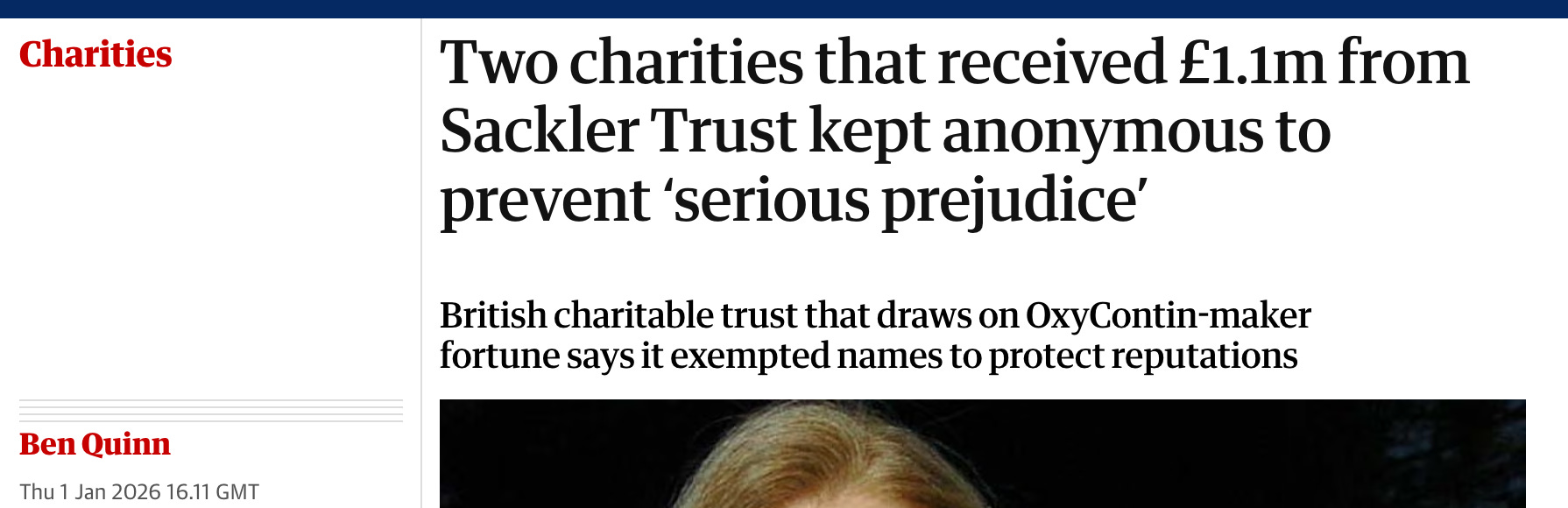
This is so interesting: where once charities would be asked to keep their donors secret, now donors are being asked to keep their recpients secret. Hilarious. Of course, it doesn’t really make any difference to the laundering of reputations since even the headline guarantees a virtuous sparkle.
What is worrying, however, is that this comes alongside a wider rise in anonymous donations. In the US, foundations, and increasingly the UK, donor-advised funds, give hundreds of millions to extreme-right think tanks and cultural associations, often without any information on where that money was directed. Dark money has its own dangers.
And what of taking money from Sackler? Would I take their money…? Would you…?

I’m honestly not sure I know…. I think I would advise small charities to just cash the cheque and pray for the death of capitalism.
Have a read of George Bernard Shaw’s ‘Major Barbara’. Don’t know if the film has the same message.

Meanwhile, more bad news for Stonewall, whose reserves, at £100,000, are now lower than those of any of even the smallest charities I currently work with (eg. one with a £200k turnover...) I have a bad feeling here….
“Stonewall’s income and expenditure both declined by more than £2m year-on-year to £4.74m and £5.65m, respectively, in 2024-25. Corporate donations to the charity more than halved in 2024-25 to £143,000 while programmes income declined by 48% to £254,000. The charity’s events income fell by 42% to £331,000 while fees from organisations subscribing to its various programmes declined by a quarter to £1.82m. A Stonewall spokesperson said it underwent a “significant period of transformation and change” in 2024-25.”
See more at: https://www.civilsociety.co.uk/news/stonewall-reports-44-redundancies-and-drop-in-reserves.html#sthash.HCweLuzQ.dpuf
Internet nonsense
If small d*ck energy was a job advertisement
I actually worked with people like this in my first CEO job….
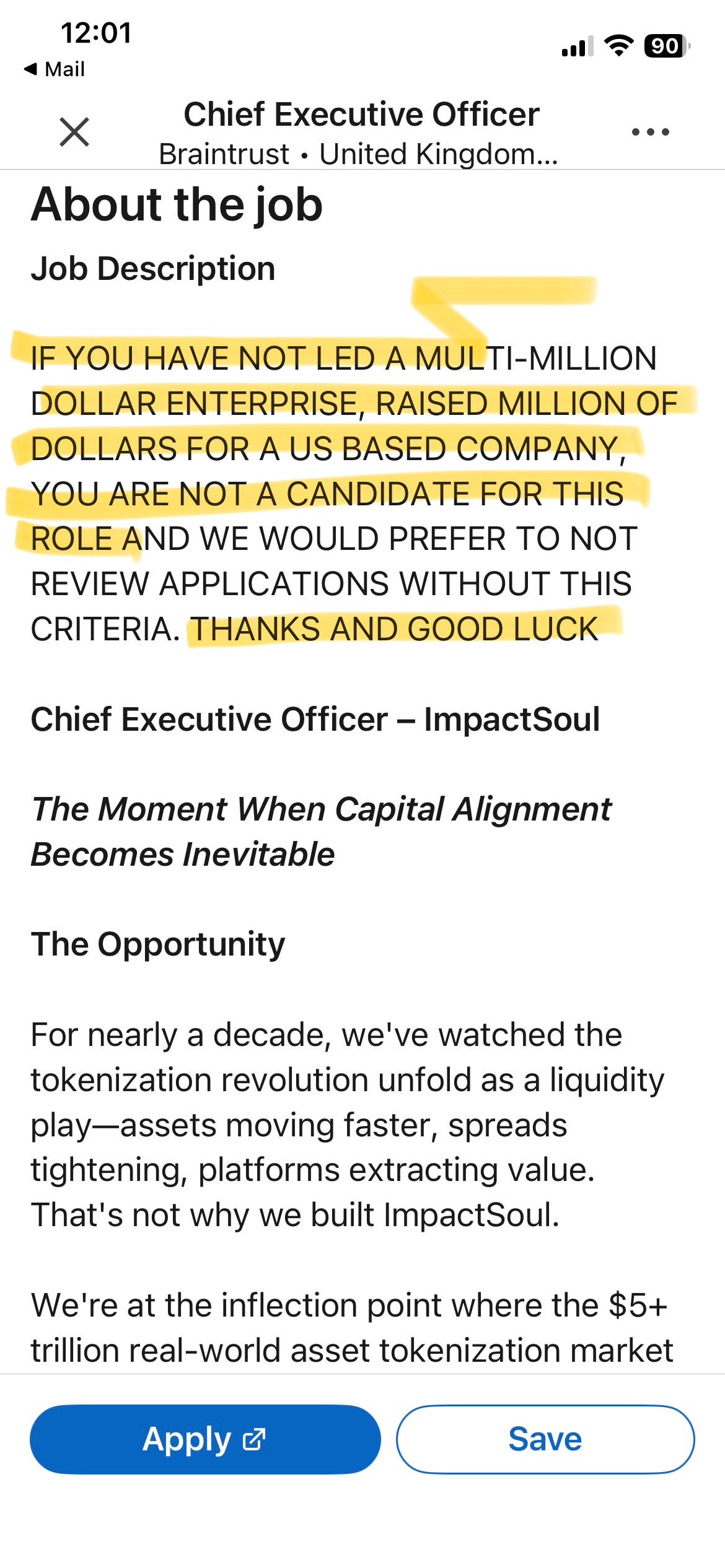
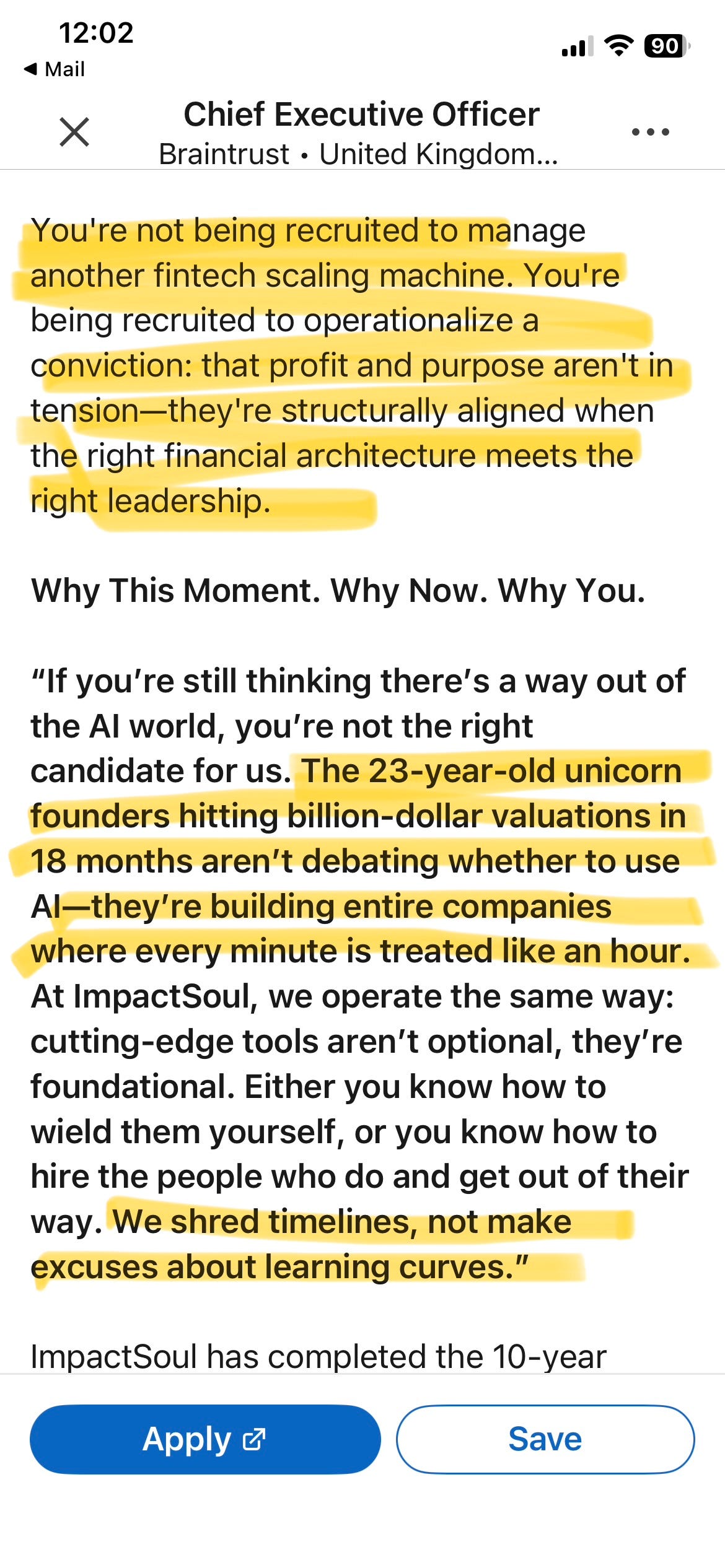
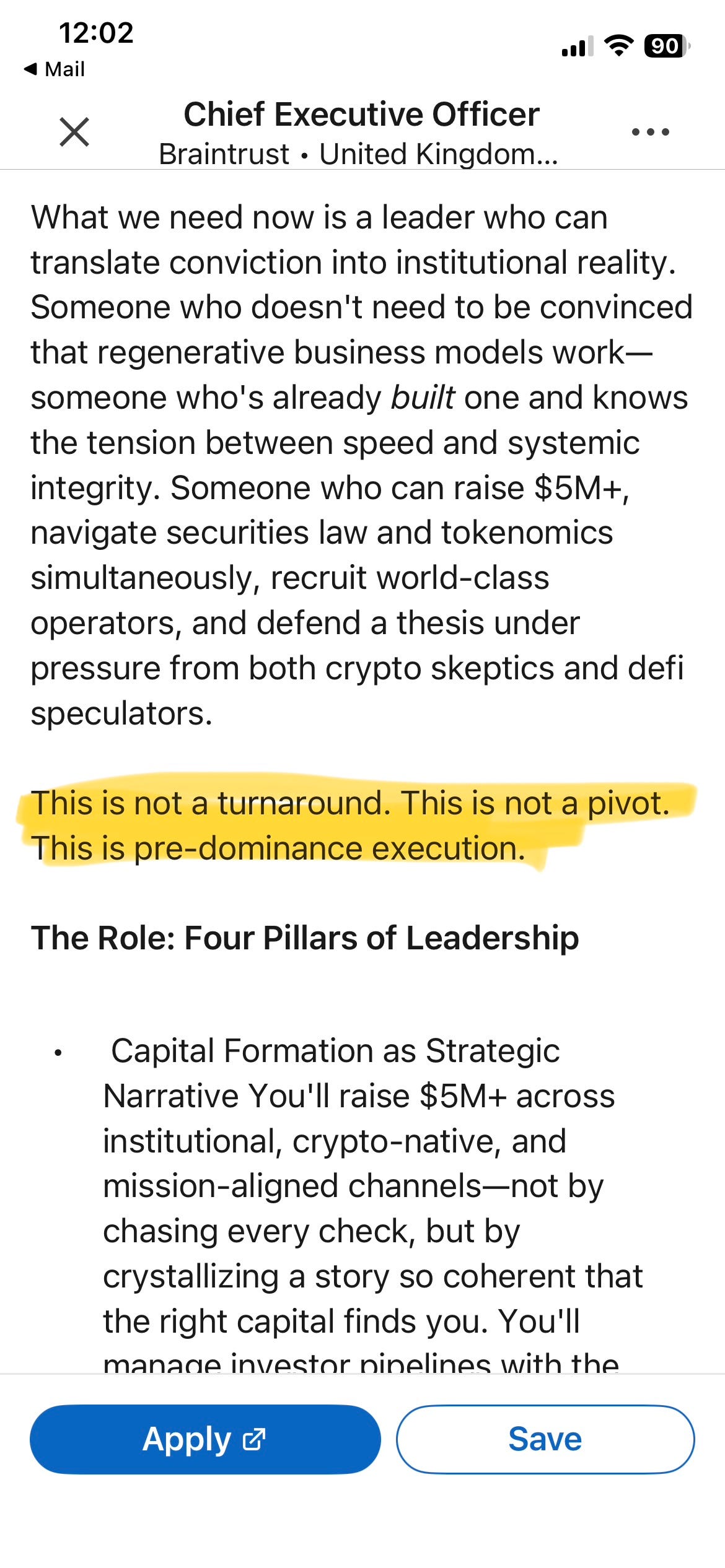
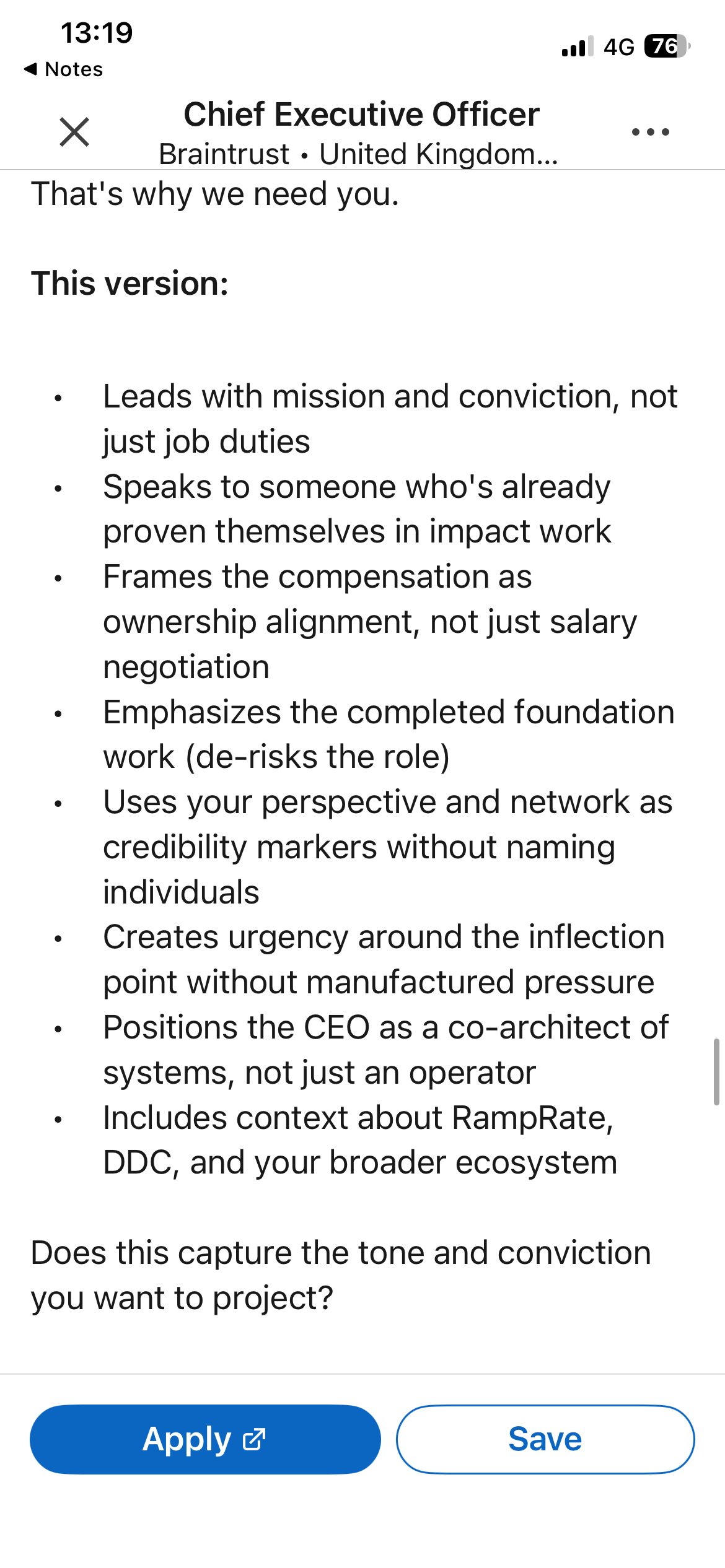
They even left the Chat GPT options in at the end.
Godspeed, guys.
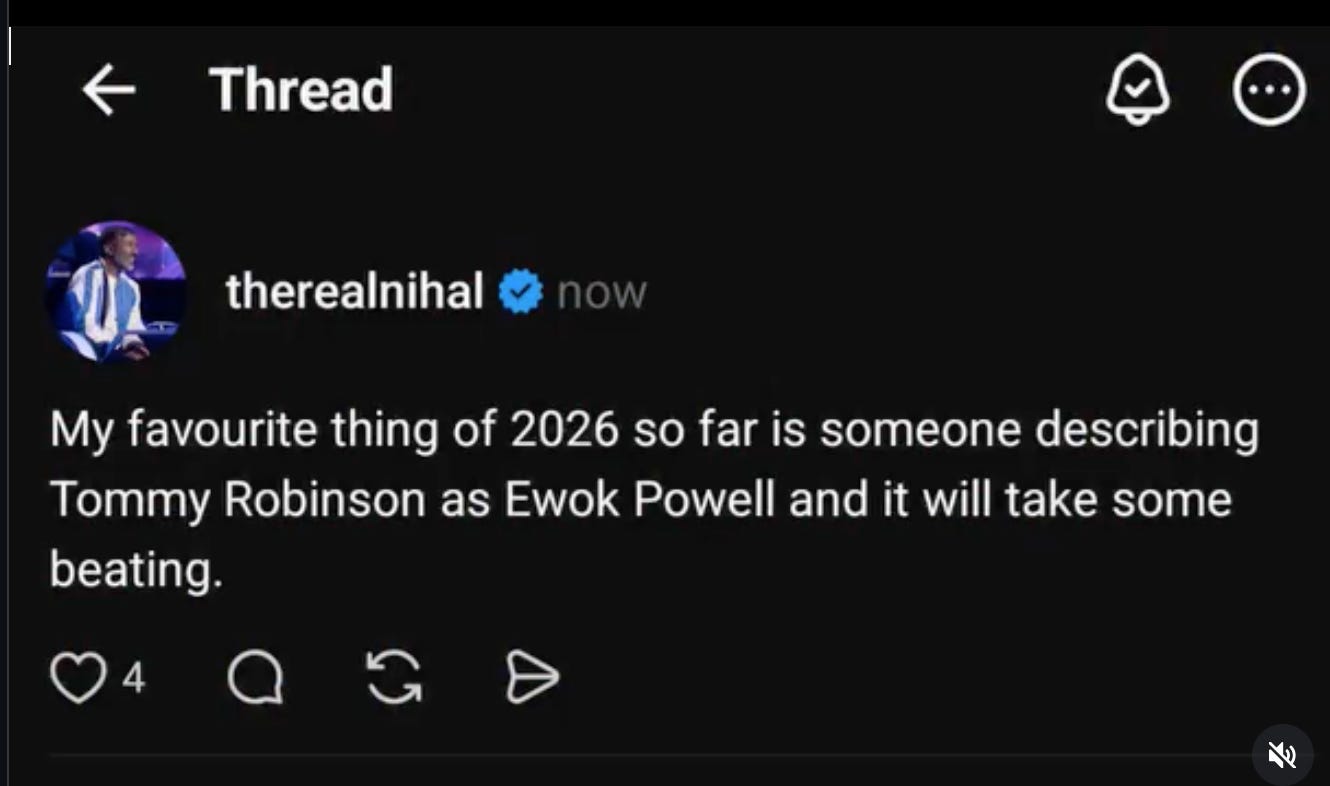
Stephen Yaxley-Lennon
Love this=>
Zack Polanski
And finally…
Barely Civil Society is about making the nonprofit world braver.
Here are three ways to help.
Subscribe!
Barely Civil Society is a reader-supported publication. To receive new posts and support my work, consider becoming a free or paid subscriber.
Share!
Thanks for reading Barely Civil Society! This post is public so feel free to share it.
Support!
Buy me a coffee and keep me anxious and crabby. Although now Costa has gone, I’ll be having to go back to a lunchtime can of Merrydown from Londis.

Send me a message
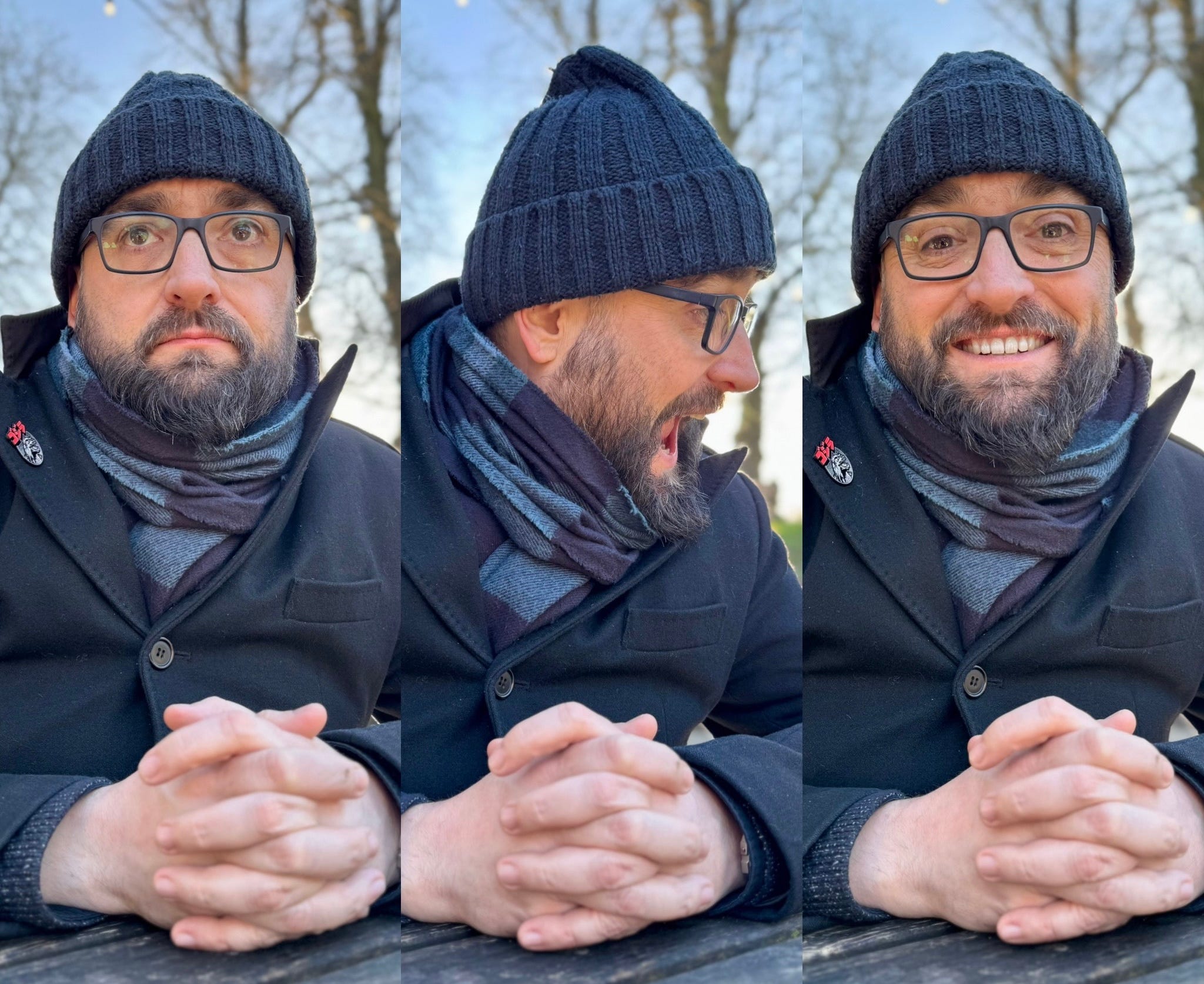
The messages people send me every couple of weeks are my favourite thing. Drop me a line and say hi! What made sense to you? And what didn’t? (Be nice.)
Work with me!
Check out my day job webpage. No politics, just 25 years of knowledge and expertise.
Or don’t. See if I care.