

Hello, and welcome to an odd mixture of self-deprecating humour, political analysis, and white hot memes, all themed around the incredibly niche subject of the nonprofit sector in the UK. I know, I’m really selling it. This was drawn from a two day research trip to the Third Sector conference. Skip to the ‘Civil Society Under Attack’ bit if you want to avoid the personal nonsense.
Today:
Would you like to write for Barely Civil Society?
Introduction
Last week I turned up to the annual Third Sector conference, held at the Royal Society of Medicine.
Unusually, I had been invited, so this time there was no need to climb through a third floor toilet window over the sinks. I tried that once at a social enterprise conference in 2011 and I got coke all over my trousers. It was a funny time.
Even weirder, I was to be on a panel. I did initially think they had meant to invite the other Alex Evans whose many invitations I erroneously get all the time.
What would I say? When Susan Sarandon and Tim Robbins turned up to present the Oscar for Best Editing in 1993, they decided to talk about the internment of Haitian refugees with HIV at Guantanamo Bay. Former Spartacus, and ‘Cold dead hand’ NRA member Charlton Heston said “It's like being invited to something and then pissing on the rug”.
They were banned for life, so the rug was a no-go, but I thought I could maybe do the equivalent of a fart in a lift. In fact, I think that was why I was invited. I am always happy to oblige.
Furthermore, never one to turn down free food, I stayed for the whole two days, unlike the big ticket headliner CEOs who turned up for their panel and left, presumably in a helicopter or a black limo.
I spent much of the two days with people looking at my name badge and saying ‘Barely Civil Society, what is that?,’ but the BCS moniker was better than ‘Alex Evans, Non-profit Consultant at Alex Evans Consulting’. This appeared behind me on the final panel and drew confusion, including literally a guy who had written “Alex Evans Consulting?” in his notebook, which he later posted on Linkedin.
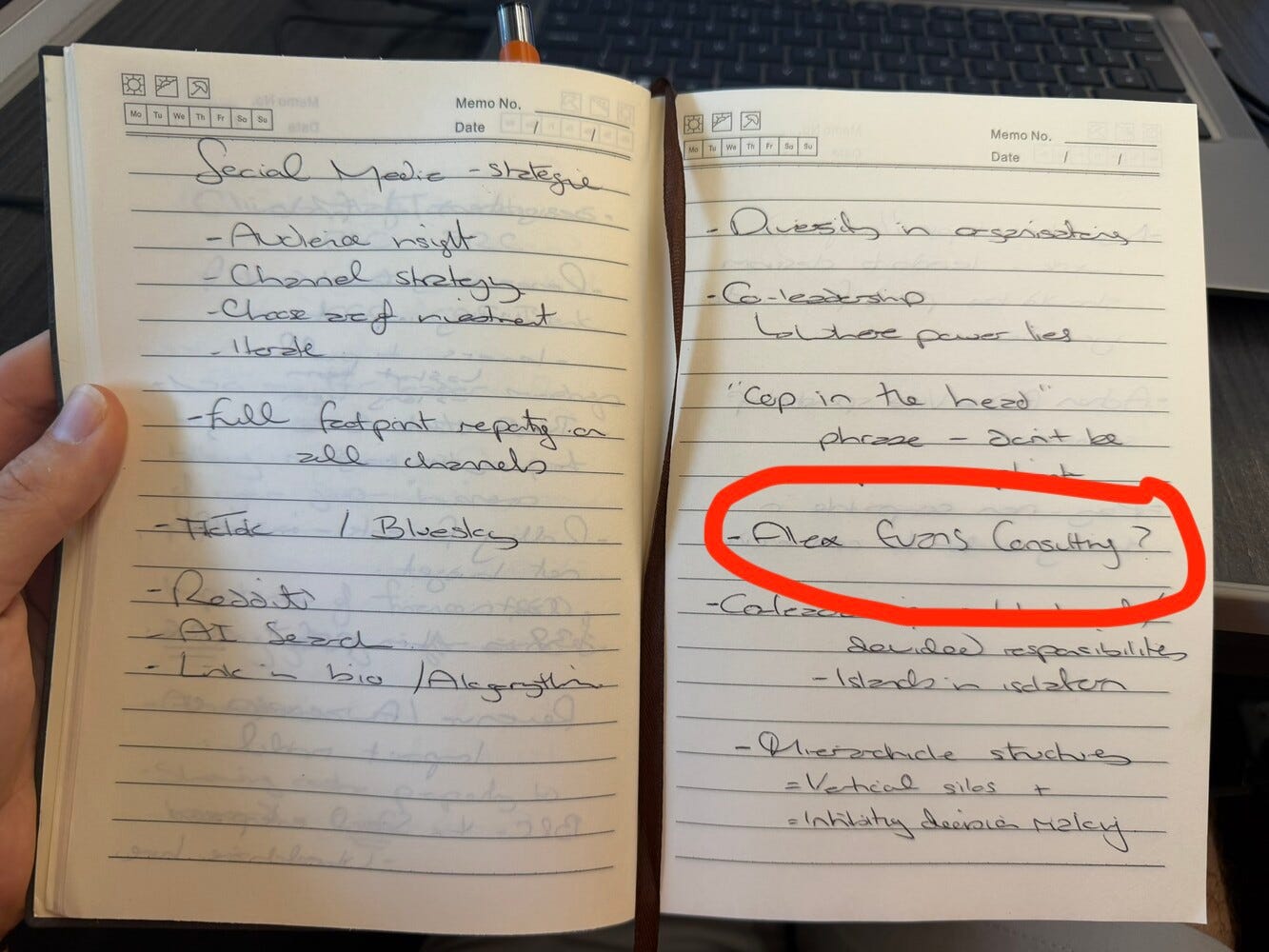
I know mate, same...
But enough of this frivolity. I stayed, not because of a desire to hear about how to improve governance (have a board portal and fire your interim CEO when they disagree with you), how to do better fundraising (have a marketing department the size of San Marino), or how to do better finance (listen to your finance director, who knows everything, according to the finance directors on one panel), but to get a sense of where nonprofit politics are in the UK.
This is always difficult - trade conferences are mostly about industry. The day-to-day of doing what you do, but better. That indeed is why people get the time off work to go, and get the several hundred quid to attend. But those bigger, whole-world, why we are here, questions can be harder to find. And yet, those did come through.
Yes, Civil Society Is Under Attack
What came across most strongly was a sense of deep threat and fear, especially from charities supporting causes in any way exposed to the ‘culture wars’. It was clear that many charities are having to support staff who are fearful for their safety. And that there are sustained attacks on civil society itself, which may begin in the sphere of discourse and end in real physical as well as mental harms. The perils of social media as a place to drive hatred and attacks on charities was a repeated theme. But this was not just on specific causes - what comes across is that, for some, there is a deep antipathy towards civil society itself. This is being driven largely by right-wing politicians, but also online cultures driven by US fascist think tanks, Russian bots, and Christian Nationalists. None of them are very fond of democracy, and civil society, as we were reminded several times, is a fundamental part of how liberal democracy is supposed to work.
Dame Julia Unwin from the Charity Commission was sensible, sophisticated and said the right things, in as much as there was a strong sense of anything the Commission can say. There was a useful reminder that they do not report to the Government, but to Parliament - an interesting distinction, even if, of course, the reality of how that works may be less meaningful than the specifics. What she did say was that they saw their role as one of protecting charities. That is powerful and important, I think. I do think their comms need to catch up with that.
There was a constant refrain throughout the rest of the day of ‘solidarity’, but every single person who mentioned it also noted that charitable status often prevents it. The tightness of missions and charitable objects means you can only speak out or campaign on issues directly related to your charitable mission. That is a serious problem for any solidarity.
Will Pluralism Unite Us?
NCVO’s speech was energetic, and intended to be rousing, but it was hard to see what exactly they were rousing us about. That really sums up NCVO. One of the themes was about civil society being louder and more strident.
Look, cards in the table, I really struggle with NCVO because of the Linkedin post by the previous CEO which claimed that the Government should involve the voluntary sector to make sure that its cuts to disability benefits were made ‘humanely’, as if we were going to help euthanise tragic animals, and not that we ought to prevent them being euthanised. I thought that spoke to its lack of innate values. (The post was swiftly removed, and I need to get over it, I know.)
But I increasingly see the pluralism of NCVO without a true sense of values as their burden, but also one I think is self-imposed. [EDIT: literally the day I write this, they launched their new strategy which apparently talks about ‘backbone’ and not letting the Government off the hook. Intriguing and hopeful. I look forward to reading, sort of.]
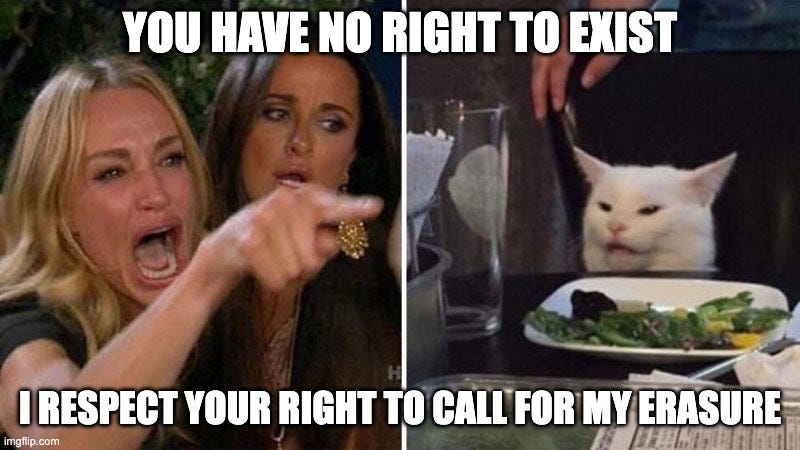
There has since been an article saying that the test of the VCS is not how aligned we are, but how much we can tolerate difference. It sounds good, but it’s also classic bourgeois liberal ideology, and only works for those with nothing much to lose: trans people can’t tolerate anti-trans group Sex Matters demanding their erasure. At a certain point, even in a pluralistic democracy, you have to have actual values which cannot begin and end at the pluralism itself. That is a basis of true democracy; otherwise you just have a marketplace of ideas and survival of the fittest. That, of course, is one of the faultlines, and common critiques, of civil society itself.
I guess you could argue that NCVO’s role is to strengthen civil society’s role as a driver of democracy - but again, what if those civil society organisations are antidemocratic, and actively oriented towards the erasure of others? Disagreeing agreeably is fine until the other person actively wants to take your rights away.
Simon Blake from Stonewall sat there on the panel with Fadi Atani of the Muslim Charities Forum, and they had a huge amount in common, and Blake’s argument was that they can focus on what unites in solidarity. But if the other person there had literally set up a charity to demand the end of LGBT rights, where do you go with that?
The Big (/small) Difference
On one afternoon, the conference had a specific strand for small charities. And the difference between big and small was incredibly visible. Again and again, we heard people from vast household name charities talking big and about deeper issues. For me, it was a bit of a relief. But the smalls can only really talk about day to day management - and endless complaints about funders. This drove me towards my usual question of who has the right, and who has the time, to think? In the sector, as in society at large, my sense is that the thoughts ‘from below’ are trapped where they are, and sometimes barely formed. What does a charity voice and an intellectual firmament from below look like? And where would it be?
[Edit: To be clear, I am not saying there are no ideas in small charities. I’m saying the opposite - there is a whole potential and actual wealth of ideas, not just practice-based, but theories, concepts, experiences, epistemologies and goddammit demands, that exist there. They need to be supported, liberated, developed and heard.
But they have 1) no time to think, and 2) no place at the table. Wherever ideas are discussed, small charities are excluded. You won’t find them at big conferences or summits or philanthropy theorising. They are seen as the little people who are too busy unblocking toilets to be able to think and speak, and therefore have no place to do it. That needs to change.
At the same time, there is often an outright refusal I’ve seen to engage with ideas - partly, I think, because of feeling pushed out by an elite, and because elites tend ti talk and do nothing for the communities small charities and nonprofits represent. But theory and thinking and talking is valuable to everyone. And if you don’t do it, trust me, someone else is doing it for you. And you probably won’t like what they come up with.]
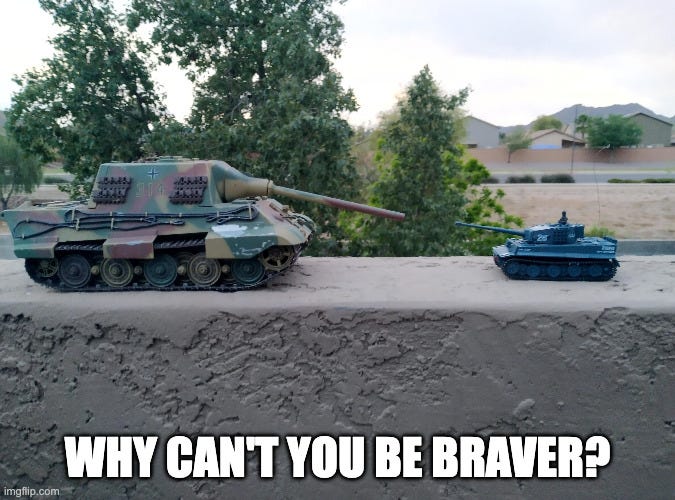
And most of all I saw massive confidence and an ability to speak out, take an independent view, stick to guns, and speak in an intellectually-informed way, for large charities, and of course, less so for smaller charities. As the CEO of CRUK told us to be braver and more courageous, I would note that this often looks like bravery, but confidence also comes from power, independence, and your own assets. Even if I absolutely agree in principle.
At the same time, Stonewall reminded us that all these bigger charities started in rooms above pubs, and indeed, fortunes can shift rapidly, as they have found.
I think we also ought to note that there can be some independence that comes from being small - but only if you have financial independence. Which brings us to that funder problem.
Funder/ Funded: a Coercive Relationship?
I observed later on the panel, with something of a needle scratch, that hearing people talk, it sounded like funders and charities were in an abusive relationship. It sounds like when I’ve listened to people in community centres talking about financial coercion by their ‘partner’. (And we’re meant to partners, right?) Every dime is controlled, your behaviour and survival is decided by your adherence to strange and arbitrary rules. You can barely leave the house without asking for permission. And they may say that you can make all your own decisions, but everything you do could cut off your lifeline. The point is that a parental relationship of, even supposedly benevolent, paternalistic control is only okay(ish) when you’re a child. Once a relationship of paternalistic control persists into adulthood, isn’t it just coercive?
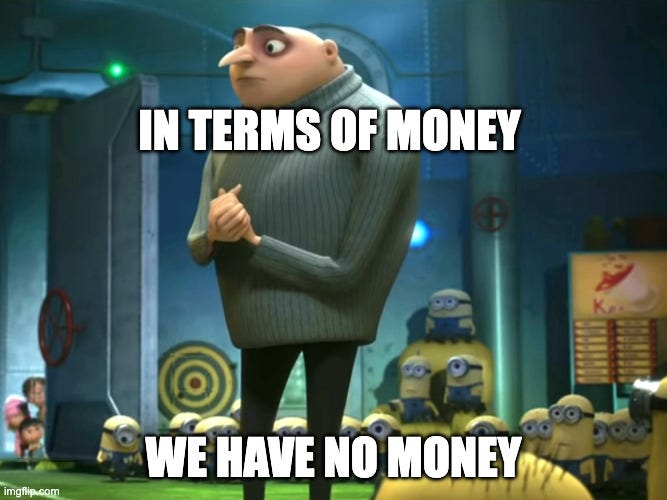
And this is the problem: we are infantilised - while doing all the work. Part of the master/ servant mentality is that all of the thoughts driving actions are how best to serve the people in charge.
Of course, with all this parent-child relationship comes explosive resentment towards the parent. And when, at one point, one of the finance bros asked who in the room was from a funder, I felt nothing but sorrow and empathy for the one poor guy who put up his hand and dropped his head, as if waiting to be slapped.
Obviously, I slapped him just to be sure.
But these kinds of toxic relationships don’t come from nowhere. They come from material relations. The individuals within them are buffeted by a system of thought, and structures of practice, which are designed to continue to justify control of assets. As ever, this does not come from an individual - the poor bloke with his hand up and head down. It comes from systems, structures, and ideology within which we are all embedded, and which require significant effort, thought, and eventually, action, to shift. Good luck with that anyway.
»Insert here something about ‘not all funders.’
Corporates Will Not Save You Either
One of the most interesting panels looked at corporate funding. For once, it wasn’t the usual Pollyanna bullshit about how corporates are the potential saviours of the charity world. Global LGBT charity Kaleidoscope Trust talked about the overnight withdrawal of funding for their programmes from corporates within moments of Trump’s pronouncement that any organisation which was supportive of DEI initiatives would no longer be eligible for Government contracts. As Alex Farrow, their CEO put it, they were somewhat taken aback by the speed of it - it was pretty much overnight.
Another charity, Full Fact, which fact-checks politicians’ claims and provides the context they often leave out was, first, excluded from the US, and then, lost a third of its funding that came from Google. They had very recently been told that this was rock-solid and that fact-checking and democracy was at the very heart of what Google wanted to do. Well, things can change. And so they did, with immediate and total withdrawal of funds overnight.
But wait, aren’t Google supposed to be driven by the maxim ‘Don’t Be Evil?’
Alas no, that changed too - and some time ago.
As Kaleidoscope put it, they had fundamentally misunderstood the business model of those sponsors.
And that is the point: business model. All corporate grants are sponsorship, as I am fond of telling clients. They are simply purchases of a halo, or tax rebate, for the company. Again, the individuals may be very positive about this and care deeply, but that’s not the point.1
But it also goes beyond the business model, and the deal, again, to systems, and even legal strictures for the protection of Capital. Those public businesses in the US who withdrew funds are legally obliged to maximise profits for their shareholders. At all costs. If the Board had continued to fund those organisations despite any personal reservations, they would have been sued.
Again folks, remember: material conditions and relationships of extraction. Everything else is smoke and mirrors.
The Important Bit: Me
And so we come to the final panel which I shared with the co-CEOs of Action Aid, who are honestly doing amazing thinking and doing around decolonisation and feminist leadership, and the CEO from UK stalwart Home Start.
What did I say?
Well, I was briefly interviewed by Third Sector Magazine reporter Lucinda Rouse after the panel I was on, about ‘Changing the rules’ in the non-profit world. They’ve very kindly let me use the full material here.
Lucinda: You were part of a panel discussion entitled “Rewriting the Rules?” You made a couple of interesting points. One was around “You can’t be neutral on a moving train.” Tell me what you meant by that.
Alex: I was quoting the left-wing historian Howard Zinn. I think it’s very relevant at the moment. There were a lot of people throughout the day who talked about “a world on fire.” And at the end of the day, we can all see the direction our world and our culture is going in. In terms of our national politics, we can look over to the US and see, in some ways very worryingly, what might be about to happen here [with the rise of the MAGA Christian Nationalist movement and the rise of Reform in the UK]. We also know that civil society is often a target for the far right, and we saw that already, in fact, with our previous government. [For example, with Suella Braverman using rhetoric that inflamed mobs and directed them towards law centres that worked with asylum seekers and refugees.] We may even have some of those people back again [Braverman herself] if things go badly in three years’ time.
So we’re actually in a position where we need to realise that the world is changing and going in a particular direction, and we can’t just sit there and wait for it to happen and say, “Well, we’re apolitical, so we won’t do anything about it.” You can’t be neutral, because the train is going somewhere, so you have to ask: are you on the train or off the train? I think we’re on our own train, trying to make things better. [Wresting control of the train?]
Lucinda: Comparing the discussions this year to previous years, there was a real sense that we are a sector under attack, as a reflection of what’s going on in wider society. But I found it quite uplifting. There’s a sense that civil society needs to be standing up and putting forward its position on why so much of what’s going on is so problematic.
Alex: Yes, we’ve gone feisty. I really wasn’t expecting that at all, but it’s almost like in the past we had this gelatinous, rubbery thing on our backs, and suddenly we’ve reached behind and gone, “oh, look, it’s bony.” We’ve found this… spine… There have always, of course, been people who’ve really fought for things in the voluntary sector; we wouldn’t have had many of the massive changes we’ve seen unless they had. I loved what Simon Blake was saying about the LGBT+ movement and how much they have achieved, from early starts in rooms above pubs to total legal change. There’s been a massive amount of change.
But in recent years we’ve also got very good at censoring ourselves and policing ourselves, even beyond what others are actually going to police us for. That’s how it works: you internalise that policing voice. [I described this in the panel as ‘the cop in the head’, after Augusto Boal.] We need to make sure we don’t do that, and that we’re realistic about what we are actually able to do — which is probably more than we tend to think.
Lucinda: There were quite a few discussions over the past couple of days on data and the importance of data. I’m going to read out a quote of what you said during the panel: “We’ve collected so much data, and nothing has changed because of it.” Why did you say that?
Alex: Let me clarify — it’s difficult, because when you’re trying to say something slightly outside of what the normal debate is, you can seem like you’re going too far. There’s no question that data [note: I was talking about numerical data] can be a powerful force that can shape what we do and make it better. But there’s also a danger that data becomes an end in itself. In my day job, I’ve worked with loads of organisations, particularly funders, who become hoarders of data and have no idea what to do with it — it’s a kind of cargo cult: “if we have the data, then everything will change,” even though we don’t know what to do with it. And we don’t know what it will change.
[I’d add here - I can almost understand this for Governments, but for charitable funders? My concern is data’s use to decide what is ‘effective’. Who determines effective? And how can we use these techniques at scale for the kinds of heterogenous, highly qualitative projects the VCS is designed it support? What then happens is that data-driven charities only support what can easily be measured, rather than what is worthwhile. Or right.]
The other thing I really think we should be worrying about is that in philanthropy we’re apparently [TBC] going to see a lot of money coming in from the AI sector. A lot of those people are advocates of things like Effective Altruism, which essentially turns people’s lives into metrics and decides who’s worth saving. I think we should be very anxious about the drive towards data as something that flattens everybody and lets us compare people’s lives and their quality and importance against each other. There’s something about the structure of thinking in data and metrics that can dehumanise people. That doesn’t mean data itself is dehumanising - the question is who’s using it, and why, and what for. And often we just don’t know what for at all.

Lucinda: The final question of the panel — and indeed the conference — was “what gives you hope in the sector?” and you gave a lovely response. I wonder if you could tell me again what you said?
Alex: I went back to a philosopher of the early to mid-twentieth century called Paul Tillich, who fled Nazi persecution. He talked about the need for what he called “a resistance movement against the destruction of love in social reality.” For me, I find that incredibly inspiring, because when I look around that room and hear what people are talking about, they’re talking about all sorts of things that nobody wants in a spreadsheet: love, care, community, hope. And they’re not alone in that. If you look across the world and the growing debates, there’s a return to concepts like care ethics, and to the idea of an economy of care rather than an economy of profit. There is lots of interesting stuff coming out of [socialist] feminist circles.
I think we are part of that movement, as a sector. We are a movement for love and care and community. That should be where our solidarity comes from. What Tillich says there — that we’re a resistance movement against the destruction of love — couldn’t be more apt, given where the world is going. The kinds of views we’re hearing now, some of which are, shall we say, quite uncharitable, and are indeed precisely about the destruction of love.
I think it’s more important than ever that we fly the flag for love, and care, and community.’
Here’s the podcast. There’s a load of other randoms on there - who invited them?
Andy Burnham and Civil Society
Andy Burnham is not coming to save us, but do not underestimate the potential for VCS support. Real support. Maybe even cash - not new, but redirected from elsewhere.
“The voluntary sector needs core funding - not project funding but core, multi year funding.”
Andy Burnham - Locality Conference Keynote 2024
Maybe it's good news that the bourgeois liberal press are already gunning for Burnham to fail, with the Grauniad basically a list of 'he's not as clever as he thinks he is' articles today. They did the same with Polanski, did the same with Corbyn, so maybe he's more of a threat to the status quo than he seems.
Or maybe they've just realised if it bleeds it leads, and honestly every Prime Minister is bleeding before they've even stepped over the threshold at this stage.
One thing I think you can say about Burnham is that he is 1000% a supporter of the VCS - and with money. He was even talking about them in his big economic speech. Much as I fear talk about welfare-to-work given its very problematic history and ethos.
Don't forget, Starmer said nice things because he wanted philanthropists' money. He may be well-disposed to charity, but he's had zero real knowledge of it. He's a lawyer.
But Burnham was literally at a celebration event for learning disabled people when Reform descended unannounced with cameras. He spoke at the Locality conference, and meant it.
I have little hope economically for Burnham because he's committed to Reeves' dumb-arse fiscal rules. And most of the Manchester thing has been letting capitalist pigdogs do whatever they want. There has even been talk about private finance. Nnh.
But you know: the key is to manage expectations, critique with integrity, and seek out opportunities.
Meanwhile, the most important question remains: how has he got even hotter as he has aged?
Oh, and several people think Farage is in trouble. 🤞 Looks like the crypto donation may not just stand….
Internet pics…
Sadly, Instagram have broken Substack links and you can no longer embed them, which means most people could not see the internet awesomeness last time, so we’ll have to leave that for now.
Would you like to write for Barely Civil Society?
I’m looking at creating a platform that includes other authors and essays with a critical (bur fair) political eye on the nonprofit and philanthropy world.
If that interests you, drop me a line and tell me what you’d like to write about.
I’m open to all sorts of subjects, but it has to go beyond ‘funders are mean’, ‘we need more unrestricted funding’ or ‘we need to improve DEI procedures’.
Tell me what is underneath things. Why are things as they are? How does it relate to wider society? Don’t feel the need to come up with a policy recommendation. We’re allowed to just think sometimes.
I’m particularly interested in any psychological approaches, accessible economic analysis, and anything that explains complex social or other critical theories relevant to our work in accessible ways. It has to explain what it means, and why it matters.
I’d also be interested to hear from people who might want to be on an editorial board.
Barely Civil Society is about making the nonprofit world braver.
Here are three ways to help.
1. Subscribe! Or become a patron!
Barely Civil Society needs patrons to stay active. All the content is free, but if you’re able to support this work, it means a lot if you can buy a paid subscription.
2. Share Barely Civil Society: Lord knows the algorithms are not in our favour.
3. Buy me a periodical!
There are practical reasons to chuck me a fiver: I’m saving up for journals and periodicals/ libraries access so I can keep better track of what is happening in the sector. That improves the blog you get to read, a blog writing the kind of stuff nobody else does, completely in my own time and at my own cost. Can you chip in and buy me a periodical? Or a Jammie Dodger?

I am always reminded of the first corporate I ever worked with, Vivendi Universal. Funded as part of their ‘Create Joy’ (Joi?) programme, I remember their very French liaison looking at all the work we had done with getting gang-involved kids into creative education, and saying in her perfect Allo-Allo accent:
“Eet’s very nice, but zis is all about ‘create joi!’ Zis is very important to us!’
‘Yes’ I said, ‘look, isn’t it amazing? A real sense of joy!’
And she said, ‘No! Where are our t-shirts and ze stickers? Zis is about “Create Joi!”’
The capital letters appeared in my head and suddenly I got it. Interestingly, Medical Aid for Palestinians suddenly made money hand over fist. This is fascinating. But again, there has to be a calculation of risk here. Never forget where the power is.
Very true, about data!
And love the Tillich quote.