


Hello everyone, and welcome to the latest edition of Barely Civil Society, where UK charity people come to drink and forget.
This week: I’ve been struck by how many absolutely terrible meanies there are out there. It is painful to watch. And several of those meanies have washed up on the charity news shores this week, so prepare to hold your nose.
I fully expect to lose some readers, but you have to stand for something. I’ve (we’ve) seen all this before…
The Meanie Mummies Strike Again

It was with some horror that I saw the headlines relating to Girlguiding UK deciding it must exclude trans girls from its services.1 Then, not long after, the Women’s Institute did the same.2 Both have been powerfully inclusive to now. What this tells us is that the vicious anti-trans movement has moved on to attacking charities as one of its key battlegrounds.


Apparently they won’t exclude existing members - that is something. And I see how they have been pushed into this by incredibly powerful and well-funded legal bullies. As the Good Law Project explained,
“They say this is because of the ruling of the Supreme Court earlier this year on the meaning of sex under the Equality Act 2010. Both have said that they do not want to exclude trans people – but feel that they have been forced to by legal threats.
Perhaps they’ve got the law wrong – it doesn’t require trans women and girls to be excluded. Indeed we think that a change in policy to exclude trans members may well be unlawful. It is unclear, for example, how the inclusion of trans girls in Girl Guiding can have been impacted by the decision in For Women Scotland. This is because the decision was about whether the definition of sex under the Equality Act 2010 included trans people with Gender Recognition Certificates – something under 18s have never been able to obtain. But it is more likely they have been bullied into submission by the costs of defending their policies of inclusion – they have decided they have no financial choice but to give in to the bullying.”3
Sometimes I wonder how people can manage the sheer level of spite. And I wonder why this issue of all the things.
Hate and disgust
But there’s a myth being pushed at the moment that all social hatred eventually comes from fear. I’m not sure. If it is fear, it isn’t fear alone: it’s disgust, quite a different emotion. Disgust is, quite literally, a gut feeling, and happens that happens to all animals in response to a pollutant:
“Disgust is typically said to be a bodily sensation experienced as nausea: repelling and expelling that which causes the nausea is its chief goal. People respond with disgust to things that will supposedly taint or poison them.” The Power of Emotions: A History of Germany from 1900 to the Present
Look at the faces of transphobia. Look at the screwed up face and the upturned lip. That is the face of somebody disgusted, not afraid. People are selling this as fear because they know that in our culture these days, fear denotes victimhood. But this is just a strategy.
Disgust is what happens when humans feel there is a threat to their purity. Those instagram videos of cats who retch when someone puts food they don’t like near them - that is what humans are doing when they are disgusted. The goal is to purge and refuse the contaminant. Shit, blood, body fluids, vermin. The strange thing about the human animal is that in our development of social and cultural imaginations, we developed the same response for our sense of social contaminants - those things we perceive to be fundamental really damaging to our shared cultural beliefs. And indeed, that tends to map onto ‘others’ - those who may threaten ur way of life.
Disgust, therefore, is the greatest dehumaniser. Disgust reduces the disgusted themselves to animals (that is, an animalistic response), just as it reduces the objects of disgust to something less than human: Jews, gay people, other races, trans people.
Much of the work on propaganda and disgust comes, tellingly, from studies of the Third Reich. It’s no surprise to discover that Hitler was a germophobe. His disgust at the idea of contaminants mapped from the biological to the social and racial. Then comes the antisemitic propaganda of the Third Reich: rats, vermin, filth, disease, pollution, are all harnessed to transmit the disgust to others, and on-to ‘others’. (Not new to the Nazis - building on ancient myths - for example the ‘blood libel’, itself designed to evoke disgust in the name of hatred.)

As a sidebar: there is a rolling anti-trans oh-so-innocent claim that they are not hateful at all (they just love ‘real’ women and want to protect children from being allowed to act out their mental illness). The claim isn’t going to wash with queer people who have spent decades hearing evangelical Christians say they’re not persecuting us because they hate us, but because they love us.
Trans toilets
Perhaps the most evident mobilisation of disgust for trans people has been around toilets. There’s a powerful human disgust about toileting, and toilets can be used as sites to differentiate and ‘other’ human beings unlike us. I’m sure many of us remember the jokes about the French hole in the ground toilets. I remember foul mythological stories told about Indian people’s toileting practices when I was a child in a racist northern town.4
But it’s not just the fear of contamination by excrement - the fear we developed as a species to ensure we kept our waste separate from our food in order to avoid infection. Toilets are also a site of one of the most fundamental oppositions we perceive in our society, of man and woman. Perhaps one of our earliest memories of sexual difference is when suddenly we have to go into separate toilets with a parent - male or female. When we are told that mysterious others inhabit the opposite side, just on the other side of a wall. When we are told of the palpable threat that exists there. But we are also told that there is something unspeakable and dirty on ‘the other side’. The toilet wall is the seventh veil.
Meanwhile, the privacy and seclusion of toilets makes them sites of dangerous unknowing. What might people get up to in there? We want to know, it’s an object of fascination, and yet one of profound disgust. Remember, disgust also has a fascination - humans are also strangely drawn to the things that disgust them. Toilet humour, obsessive jokes about sex and sexuality, all betray an innate fascination with what we render abject. The horror is thrilling. And destroying what disgusts also helps to alleviate the sensation.5
Note also that disgust, contrary to our general beliefs, is not ‘natural’. Humans’ natural disgust at, for example, excrement, is taught: children are initially fascinated by it; we just teach them not to be. But we learn early to feel disgust at certain abject objects deeply, physically, so that it feels as natural and absolute as possible. That is its social function.
Toilets have long featured in the dehumanising mythology of gay men: cottagers, toilet traders, the fear of the dangerous others floating around filth.6 In the AIDS crisis, blood, semen, excrement, drug use, prostitution, the dark continent of Africa and its horrors of impurity and pollution were all used to dehumanise sufferers, and to justify their abjection and ejection from society to die. Their impurity was evident by their disease, but their disease was seen to be caused by their impurity.


Sexual difference, contamination, and the terrifying liminality of private and public spaces enmesh around toilets for trans people just as they did for gay men. This meets infantile enculturation around the banal rituals of compulsory reproductive heterosexuality.
And of course, the deep belief that fundamentally, boys smell worse than girls. Disgusting and dirty, they must be separated from girls who are clean and pure. Boys and girls alike are fed this utterly banal and infantile myth in our culture.
Again what goes here is not fear, but disgust. Keeping the two ‘sides’ separate is about purity. And this reinforces the idea of purity and separation between sexes. When that boundary is broken, something disgusting, emetic, nauseating, and disturbing to the core, literally to the stomach, happens. This is how trans people are seen, and toilets are the theatre of this lame psychodrama.
These infantile responses have been weaponised by right wing forces, as they always are. What is perhaps most horrifying is that they have done so so successfully for grown-ups who should know better.

Threats to children
And speaking of grown-ups, another common trope of organised social hatred is the threat to children. As toilets have taken a no doubt temporary back seat, children and their protection has taken over in the latest flap.
(Although ‘how would you feel if a trans woman followed your little girl into a publc toilet’ is a pretty common ‘what if’ raised by transphobes on social media. The weird thing is their genuine expectation I would say, ‘Ooh, now you mention it, yes, I would be terrified and immediately shoot them, like in a really bad 1980s Brian De Palma movie.)

Protecting the children is one of the oldest strategies in the book. (As indeed is protecting womenfolk: witness the vile history of lynchings to protect the purity of white women in the Deep South.)
“What intrigues and worries us is that, as it brings children into the picture to construct an exclusionary “us”, the far right heightens the ostensible innocence and vulnerability of the nation as well as the apparent ethical righteousness of those who claim to be its protectors. Children, therefore, have become a powerful instrument of the far right.”7
Protecting children has been used by every right wing authoritarian group. We see it happening across Europe and the US now. Children are harnessed to the lurid fantasies of their parents - and often, not even to their own parents, but to other members of the moral ‘majority’ who think they know better. Indeed, children whose parents do not make their children beholden to this ideology are seen as substandard, unparental, and dangerous.
Most of all, what we have always seen is that those who demand the protection of children have precious little interest in children they consider ‘other’. Brown children on small boats are not included. Jewish children in the Third Reich were not included. Queer kids going to prom were not included. Trans kids going to their girl guiding group are not included.
In this case as in many other, the protection is not of children, it’s a protection of wholly constructed and culturally imagined purity. Children are useful as the symbol of that purity, but real children who don’t appear ‘pure’ are of no more value than the adults who inspire such direct disgust. Perhaps some can be ‘saved’. But if not, they are not real children at all; they are unworthy of protection - and worse.
So we infantilise a society demanding protection, and render real children something less than human if we think they threaten the purity of the social body.
Hatred and civil society
Back to charities. What we know is that social hatred works its way through every aspect of society and develops power through threats and intimidation. The hateful appear in all manner of spaces. In the Third Reich, for example, hospitals and nursing were involved in euthanasia for the disabled and learning disabled. Many teachers happily accepted that Jewish and Roma children were not children. I can remember very well the treatment my gay friends and I received from medical professionals or at the hands of teachers. Caring did not apply to us. Friendship was not available. At best, we should stick to our own. Perhaps we just needed to be cured.
Being ‘caring’ doesn’t necessarily mean you’re immune to deciding some people don’t deserve care - or indeed, quite the opposite. Nazi Germany had the charitable ‘Winterhilfswerk’ where food, clothing and other needs were met by National Socialists (sic) in the winter - and of course, denied to those who were not racially pure.
Meanwhile, controlling and terrorising civil socety - and those who are in a caring role - is a classic authoritarian move, especially where it relates to social hatred and out groups. Not only was there Section 28 targeting teachers and youth workers and health workers, but civil society organisations are always a key target for despots. Trump has done this most recently, but Suella Braverman tried her hand at it in the last Government. Now, in the third sector itself, there are plenty of people, organised groups, who desire the exclusion of trans people from charitable services, but more than that to use them as a beach head and a soft target to change hearts and minds and normalise the cruelty of excluding kids who have it pretty tough in their lives.
This is one reason that without putting a profound and absolute liberatory freedom and unconditional love at the heart of charity, we are doomed to simply be the implementers of whatever current - sometimes horrific - fashion mainstream society chooses.
What I find particularly tragic in all of this is that there are many people pushing this kind of rhetoric who do not see themselves as far-right at all, and indeed, beyond this specific issue, probably are not. And I don’t doubt some truly do feel they are protecting kids - or at least, the ‘good’ ones.
With that said, they are being harnessed to those causes - as I explained in my previous article about Arendt and the Tommy Robinson march, that is increasingly how far-right movements are working across the globe. Indeed, many cis lesbians have been at the heart of the stoking of this hatred (EDIT: alongside a huge number of those who are supportive. My point is that people who have experienced prejudice and cruelty directly should know better.] The problem is, people never see themselves as the bad guy. They always see themselves as the victim, or protecting the ‘vulnerable’.
This constant projection of their own hatred and disgust onto a dangerous other, versus a fragile one of ‘us’ can stop us, and them, seeing the selfishness and sometimes sadism at the heart of the hatred.

And in case anyone wants to object to my, even implicitly, comparing patterns of social hatred to what happened in the Third Reich (where, remember, trans people were imprisoned and then sent to their deaths with homosexuals), let’s be clear. I am not suggesting that this is the plan. This not about hyperbole or equivalence, it is about understanding a trajectory, and a structure of thought, underneath which we find a deep, dehumanising cruelty we are capable of.
I’m reminded of the words of my favourite (gay, Jewish) playwright, Tony Kushner:
“If you have a standard of evil like the Holocaust or the Third Reich and you make the decision that it is absolutely forbidden to compare anything to the standard, then everything else is on another spectrum somehow, and the standard is alone, this peak of isolated awfulness, then you’re essentially turning what should be the standard for political evil into […] reassurance. Nothing looks like that. So it’s not that bad.”8
If we don’t see the continuity between extremes of evil and the stirrings of hate, we have no chance of stopping anything, or indeed, becoming better.
At that point, of course, comes the inevitable Martin Niemöller quote.
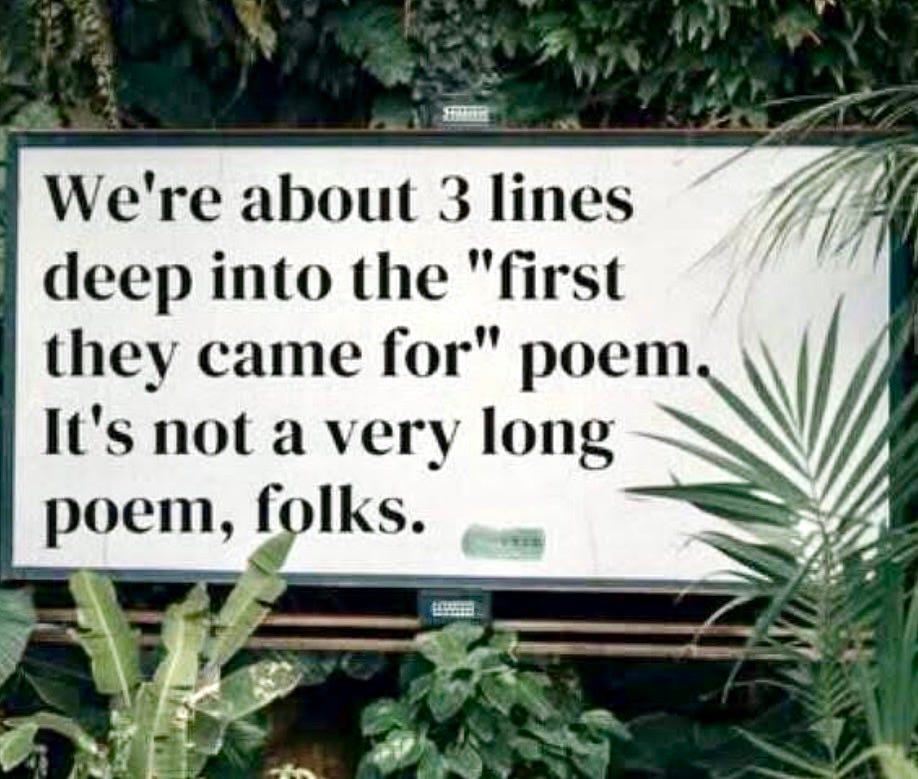
We must stand up to these people. They are dangerous.

How to help in the third sector
Kevin Taylor-McKnight has set up a Linkedin group for trans-supportive people in the third sector. Please join it - and be supportive of others who post. My advice: don’t feed the trolls in comments on posts. You won’t change any minds, and the bullies just enjoy it. I literally turn them off for anyone but my connections when it relates to this subject.

Meanwhile, please see these excellent posts by Penny Wilson, Kevin Taylor McKnight, Amsel Page-Von Sprecken, and Ellen Jones.
What if the transphobes come for your charity?
If the transphobes come for your charity - and they might - don’t go down without a fight. Speak to the Good Law project or your local law centre, or your solicitor if you have one, straight away. Don’t accept the immediate advice to just fold to avoid financial risk. Boards are there to manage not just legal and financial risk, but also to steer the mission and ethics of the charity. Changing your charitable objects is an option, although very much the long game…. [Update: the Charity Commission has made it clear that it does not see its role as enforcing or policing how organisations interpret the Equalities Act. Well, tbh that sounds kind of obvious, but given that some have been claiming they have to exclude trans kids because of the Charity Commission, I guess it needed saying. And I imagine Orlando would not have made that clarification….]
Be very careful about these people infiltrating your board - those are, again, the tactics adopted, and advised, by Project 2025 and the US hate groups. This is not a matter of ‘agreeing to differ’ in most cases. We’ve seen what happened to the National Trust and similar organisations before the current ones. They also have a tendency to seek out and punish and threaten individuals with doxxing and threats to careers etc. This is partly behind people’s fear of speaking out.
I did have someone ask me on Linkedin in the comments rather haughtily and disapprovingly ‘if this kind of thing was what I advised my consultancy clients?’ As if I was about to say, ‘Oh no! I am completely unbiased! I never have an opinion because all I care about is money!’ Yes obviously it’s what I advise my clients, if relevant or asked. But it’s not advice is it, it’s a matter of moral and ethical judgement. Do I advise you not to be mean to trans kids? Yes, and, also, weird that you asked.
More generally
Most importantly, give JK Rowling a run for her oodles of money. Support the Good Law project. The law is where these battles are being fought most effectively.

Meanwhile some good news
The New York legislature is considering a bill to legalise the presence of Bodega cats.
And meanwhile this reminds me of when we had two moggies. (A brother and sister with so much drama.)
Barely Civil Society is about making the nonprofit world braver.
Here are three ways to help
1. Subscribe!
2. Share!
I’ve taken a three week break. Substack’s algorithm will crucify me. Please share to give me a chance of anyone seeing this.
3. Buy me a beer!
Bugger coffee. In this climate, you need buy me a beer. That way you can help me spend more time researching and writing - including some bigger projects I’m working towards. And keep me drunk.
https://www.bbc.co.uk/news/articles/cz7n921wyzvo
https://www.theguardian.com/uk-news/2025/dec/03/womens-institute-no-longer-accept-trans-women-members-april
https://goodlawproject.org/excluding-trans-people-wont-stop-you-getting-sued/
Food - the other end of the spectrum, so to speak - is similar. Imagine how many times you have been told what horrible ‘others’ eat and felt nauseated. Remember the same feeling when you have heard about their sex - or perhaps even your own sex...
Note also that disgust, contrary to our general beliefs, is not ‘natural’. Humans’ natural disgust at, for example, excrement is taught: children are fascinated by it. We teach them not to be. But we learn to feel that disgust deep, physically, so that it feels as natural and absolute as possible. That is its social function.
https://www.londonmuseum.org.uk/collections/london-stories/toilet-photos-that-saved-gay-men-trial/
https://www.greeneuropeanjournal.eu/save-our-children-breaking-down-far-right-narratives-around-youth/
https://www.thenation.com/article/archive/tony-kushner-interview-bright-room/