



Here it is - a less than chirpy, but nonetheless mouthy, Barely Civil Society Shitshow Update (tm). It’s Halloween which feels somehow appropriate for the current (constant?) horror show.
This week: Infrastructure, AI, Charity Sexiness, other news, then cats. You’re welcome.
Sponsor Barely Civil Society
I’m looking for a sponsor for the very popular annual Barely Civil Society ‘Well, that was a shitshow’ Christmas Edition.
Get in touch if you’d like to give everyone a shot of levity and misery combined in the depths of winter, both literally and metaphorically….
TBH Halloween feels more appropriate, n’est-ce pa?
A reminder
With the collapse of Directory of Social Change, and an increasing number of friends who have been made redundant, or are saying they can no longer find freelance work, it’s a slightly depressing time. I’m doing my usual ‘sheep dip’ approach - I sort of inoculate myself against charity sector misery by immersing myself in frontline charities, and especially community centres.
Even if I’m just going in to talk strategy, funding, evaluation, or crisis: the vibe, the people - and even the smell of the blocked bogs - revives me. Earlier this week, I was talking at length to someone about day to day case work. The stories.
If it’s not your everyday job, make sure you do that, everyone. You’ll remember why.
Things are tough all over
As the Budget appears this week (prior to writing), we have to remember that we are partly experiencing a wider economic disruption unlike any seen for decades. It’s worth bearing in mind that much of what we are seeing in our sector’s ongoing collapse is just a harsher and more concentrated version of wider economic collapse of neoliberalism and any kind of market diversity.
People demanding something from the budget might want to think about whether we ask for more money for charities, or something else - which has to do with how a whole economy has been geared to the top.
And to wealth over work. That does have a surprisingly direct connection for us: after all, what other phrase could describe the separation and power dynamic between funder and funded?

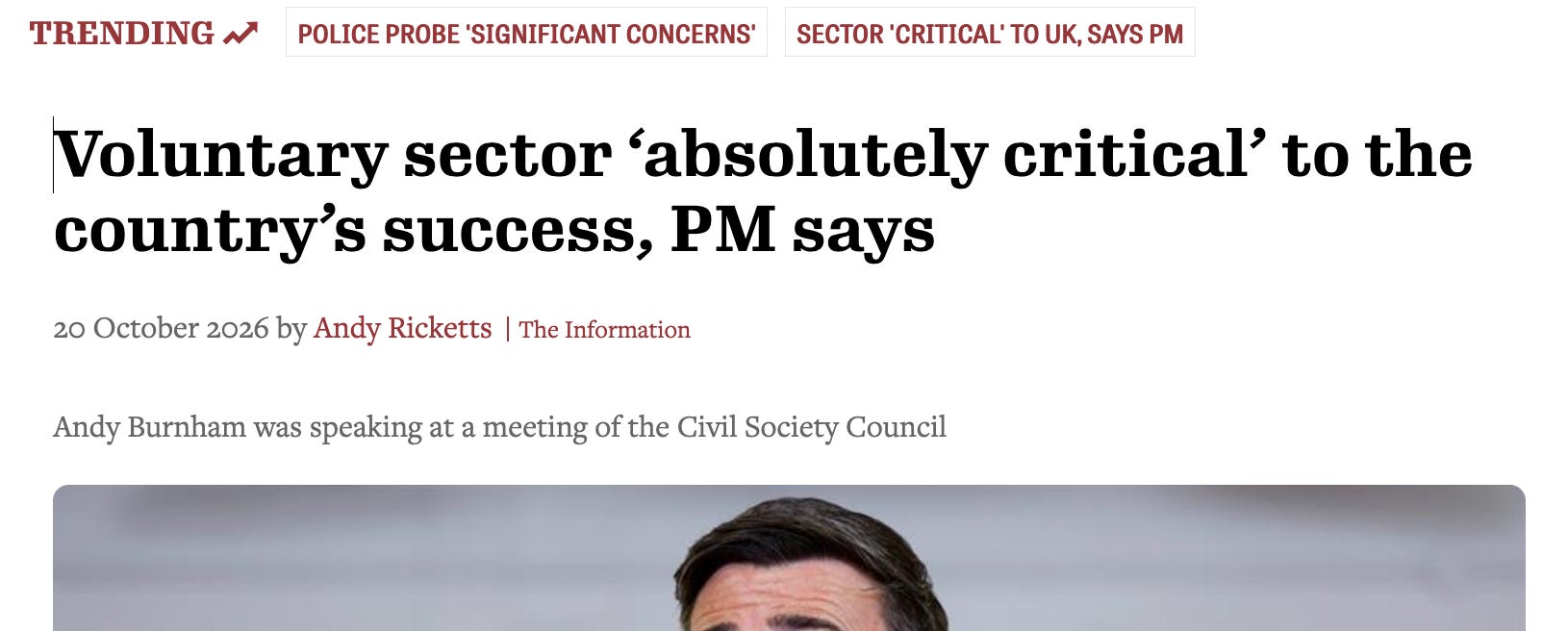
Meanwhile, Andy Burnham has had his first Civil Society Council meeting, so everyone is breathing a sigh of relief. Amazingly, he told a room full of people from the voluntary sector that they were important and valuable. I don’t know about you, but I feel much better.
Thought for the week
More and more, I am calling funders ‘charitable wealth-holders’. The judgement is not necessarily negative, but ‘funder’ does rather naturalise a very specific arrangement. Let’s be clear what we mean when we’re talking about trusts and foundations.
Whose infrastructure?
Third sector infrastructure is collapsing. With the recent closure of Directory of Social Change - which the word ‘venerable’ barely covers - and the narrow avoidance of closure by Reach Volunteering, a professional volunteer service widely relied on by smaller charities - the ripples are significant. Morale is rock bottom. They are only part of a growing list.
This is far more important, and something much more fundamental, than saying ‘infrastructure organisations are closing’. One might have hoped that the constant disruptions of the last two or three years - from rapid technological shifts, to the machinations of sector wealth-holders, to the continued failure of governments to invest in voluntaristic care – would have given infrastructure organisations the chance to truly come into their own. But instead, they were starved out, just at the time when they were needed most.
A quick explainer for non-UK and non-civil society readers. ‘Infrastructure’ here describes a whole range of different kinds of organisations which have developed to work between, and support specific charitable and nonprofit organisations. For me, that includes think tanks, local connective organisations and organisational membership bodies, right up to the largest representatives of the whole sector. (Still unsure? See this footnote.1)
But within that there are all manner of faultlines we’re struggling with.
At a certain point, a shrinking market can no longer support an infrastructure. It also goes without saying that some infrastructure was reliant on a commercial model which was simply unaffordable in a market in decline. Infrastructure organisations have seen vast cuts to local authority, and more recently, NHS spending (including the forthcoming end of Healthwatch schemes) [EDIT: NOW CANCELLED!] , and I’ve seen many lose around 50% of their income over the last 5-10 years.
Meanwhile, sector wealth-holders have long moved away from paying for infrastructure, in a Mexican standoff with local and national government. Foundation trustees, usually from outwith the sector itself, demand photographs of happy faces of children with face paint and old people looking at computers, not co-production workshops with local authorities or databases. At the same time, funders have been putting more resource into their own infrastructure – either as a response, or because of an increasing comfort with their role as charity’s natural strategic leaders. They chose, perhaps understandably, to just ‘own’ their power and crack on. To do that, they may as well own the infrastructure as well Rightly or wrongly, their decisions determine charity’s direction. This is part and parcel of their shift towards becoming more akin to procurers of commissioned services with ever tighter specifications and focuses in the now near-universal ‘strategic grantmaking’ of funder-led grantmaking approaches.”
It isn’t just about market downturns. There are also many specific headwinds in the market that go beyond a simple economic contraction. There has been a remarkable flood of AI tools, databases, gimmicks (often of questionable quality) engulfing the charity market, particularly as entrepreneurial marcomms and fundraising specialists saw the oncoming storm three years ago and chose to hoist their sails. Gen AI’s ability to do many of the things that infrastructure did – creating policies, the more mechanical and scalable stuff to do with fundraising - has particularly hit those whose model relied on materials. After all, AI material doesn’t have to be good, it just has to be good enough for people who don’t necessarily care or know what good looks like. Some have embraced it, albeit slowly. More broadly, infrastructure tech has long been pretty appalling – because they have no money. But in some quarters, there has long been a belief in the replacement of infrastructural ‘organisations’ themselves with technology. In fundraising particularly, enshittification continues apace, and before long, fundraisers can expect to become the reverse centaurs of the sector.
Workforce changes may have also had a significant impact. Massive cuts in charities have led to the shedding of whole layers of senior management, and a wealth of people with all the professional skills infrastructure bodies used to trade on floating around an increasingly desperate and overheated giggified economy. Is infrastructure just a flexible supply of managerial wage labour? This comes in the eternal context of the continued refusal of core funding for professional managerial skills or expertise. After all, lack of internal infrastructure in charities was always what drove one of the key needs for that external provision. When both are gone, what remains?
There is also the question of voice – and whose voice. The most commonly lamented lost infrastructure bodies are those who very openly spoke truth to power. Small Charities Coalition, for example, specifically reached out to the majority of the sector and spoke openly about their concerns. Others have not been perceived to do this so strongly, struggling to balance a tricky role across often seemingly contradictory stakeholder demands on either side of the power divide. Some cases, especially the largest, this is a fair judgement. For smaller and more local ones, the problem is a natural one for any ‘middle man.’ Greater empathy was required – and perhaps also greater care from some of those infrastructure bodies.
My memory of discovering our local CVS had decided to do community organising, on our patch, with a large grant from the Local Authority, in place of us, the local community organising charity, did not dispel when I went to work for infrastructure bodies. I always felt a deep discomfort at how easily we could end up competing with our members. And an even deeper knowledge that this was almost unavoidable.
Because of this: who is coming out to bat for infrastructure? Charities, long irritated by what they saw (often with justification) as a tendency for infrastructure bodies to build empires and take their funding by moving into the delivery space, have been slow to lament their passing, or fight for their continuation. This is especially true because the medium to larger charities rarely used infrastructure, and had their own. That meant they were always in danger of finding infrastructure bodies an irrelevance or competition. Smaller charities often relied on them, especially locally, but they have almost no voice in the sector to fight for anything. Indeed, their only voice is usually through those infrastructure bodies - which brings us round in a circle.
Think tanks have waned, and are finding the same issue with a lack of funding for infrastructure or anything other than ‘direct’ delivery. Their research has long been simply a matter of selling evaluations, position papers on philanthrocapitalism, and more ‘promotion’ of models that challenge nothing deeper in society, and always put the money side - ‘philanthropists’ - first. This has as much to do with their business model and potential funders as any theory of change.
And perhaps they most of all have embodied a sense that charity infrastructure has now long been made in the image of those who pay for nonprofit work - the wealth-holders – not those who deliver it? The thrust of the infrastructure business model has had to be largely to commercialise making charities attractive to those who make the real decisions. Data, funding, stories, governance, compliance, all that. This particularly gathered pace with the considerable investment in the sector by New Labour in the early 2000s. It was part of the bargain. In a way, rather than providing infrastructure, there is sometimes a sense that funders both voluntary and statutory, and perhaps charities themselves, simply want infrastructure to provide systems support. For charitable funders’ systems. Sadly, funders tell me this is exactly what charities tell them they want infrastructure to do. A world outside of that framing has become nearly unthinkable.
In that, perhaps there must be a distinction between infrastructure which is about systems, and infrastructure which is about connection, voice, joint power, and true coordination. For example, highly localised infrastructure often takes a vitally needed approach to connecting disparate communities and causes. Some are specialists in this kind of movement building. They are needed more than ever. The sheer connective tissue of communities and their voluntary provision, and indeed, in specialist communities of practice – vis. the original Charity Organisation Society) matters so much more than funders and commissioners have recently recognised.
So what should it be? Shared services? Uber Eats-style professionals for hire? Strategic shaping? A powerful voice for connecting across disparate interests and causes? A voice - for justice, or for an industry?
While we may see the return of shared service providers, what of the human, relational, and practice-related infrastructure? What will remain? Perhaps the question now is what infrastructure those with the money believe in – as we speak, moves are afoot in the ivory towers of trusts and foundations to decide on a new approach.
So what are they going to back? Whose infrastructure?
How can charities help poor, struggling philanthropists?
Some ripples in the last few weeks in the UK sector with a discussion of whether charities need to ‘do better’ and make their stories better for their, erm, betters. And whether philanthropists need wonderful philanthropy advisors - armed with those better stories - or just need to learn to ‘use Google’. No prizes for guessing I agree with Vic Hancock Fell….
And with Rob Preston, whose brilliant headline wins the week: “If rich people want to give charities their money, they should just do it”
A Conversation With a Philanthropy Advisor Who Is Telling You This For Your Own Good
“Listen. This keeps happening to you. And I know it’s hard to hear but…
If you want to get yourself a philanthropist, I think you need to make a bit more effort.
I mean really - are you making the best of yourselves?
Get a makeover, tell a story. Lose some weight.
That marketing, it’s a bit, you know, frumpy. Couldn’t you, you know, open a button or two?
Philanthropists have needs, you know. You have to excite them a bit. Put on a show.
It’s only natural. You know what they’re like. They can’t help it.
Now, it’s no use getting upset, I’m just saying what everyone is thinking: I mean, you’re not exactly award-winner material, but you’ve got nice eyes, and with the right outfit, you’d get someone at least.
And those philanthropists - I mean they’ve got a really posh car. They’re members of the golf club. I’ve heard one of them knows the Prime Minister.
Yes, yes, well, it’s all very well talking about your pride, but do you want to be left on the shelf?
They could provide for you. That’s important.
I’m only telling you this for your own good.
I’ve been out there trying to set you up. But you’re not making it easy for me are you?
Just get out there and smile for goodness’ sake.
…..
And don’t wear that. You look like a hooker.
Anyway, I was wondering how sexy you can make charities, and so I decide to give it a go with my own business. So my best friend Chat GPT has helped me do just that.
New Philanthropy Capitalists would be so impressed!

The AI Crisis of Bureaucracy moves into the next stage
Last week but one, there was a starting shot in the AI arms race of fundraising by ancient UK foundation, The Clothworkers Foundation. They are now starting to use AI to ‘assist’ them assessing grant applications. I’ve written before about AI causing a wider societal ‘crisis of bureaucracy’.
Clothworkers are sensible, thoughtful people, and fairly progressive for a Livery company. They have been overwhelmed with applications, largely by AI. Interestingly, they have been sold a solution to do this by an AI company who originally offered a system to write low-effort AI bids as part of a ‘everything system’ they are selling to funders as well as frontline and infrastructure bodies. And ‘everything systems’ - the dream of tech bros everywhere, including Elon Musk who wanted to mimic We Chat/ Weixin, the Chinese everything app in the social media space - are designed, intentionally or otherwise, to lead to total control of relationships.
Imagine a future funding resource-allocation landscape where funder AI bots consistently surveil charities’ data/ stories in realtime. Their monitoring reports, their ongoing online presence, their delivery, their case studies. With prompts from the machine and a human to input them with support from A.I.
The database sees every person every charity works with and cross checks with a central database. It is able to keep a constant watch over all changes to charity delivery. It flags accordingly and can be searched actively or passively. Funders use A.I. to monitor trends and developments in the social sphere and their own portfolio. Before long people will want the database connected to local authorities and NHS databases. Decisions will be made ‘strategically’ by trustees who rely on the data provided by AI - and the Daily Mail.
Time will not be wasted on applications because your data will always be up to date, your ‘story’ updated from what you record on your database, and an updated narrative, (maybe from website or social media etc). (They’ll be kept up to date for you - those too are likely to be AI generated with your prompts). There will be no constant beauty contest applications rounds, just a constant distant interplay between algorithms making decisions - with inevitably decreasing human oversight. The process will be entirely rational - or at least, as rational as the black box is able to be.
It will be totally objective - as much as the black box is able to be. Is objective what you want?
This, not AI writing bids for charities with funder AI reading them, is the end goal of tech. Remove the effort of fundraising, allow seamless integration of funded and funder, gather data and interrogate it actively, or increasingly, passively. At that stage, of course, absolute and total power held by those with the money. But beyond that, it is held by the system itself. But you won’t have to write or read grant applications. It saves money, and gives it to the middle man. That of course is the main model of AI and the rise of all technology, not only in the digital age. You remove the workforce, and give the money to the technologists - and the owners of new systems - in their place. That is the fundamental of technological disruption, from sheep to Spinning Jennys to Microsoft Excel.
What may be even more pressing with AI is just how much this removes a vast swathe of professional jobs (yes, it’s finally coming for us…) and essentially dissolves the middle class that bureaucracy created.
As for fundraisers, it also feels interesting that Palantir Psycho Alexander Karp was quite open: one effect of AI he feels is positive is that it will disenfrenchise humanities-educated left leaning women.
“Like … this technology disrupts humanities-trained – largely Democratic – voters, and makes their economic power less. And increases the economic power of vocationally trained, working-class, often male, working-class voters. These disruptions are going to disrupt every aspect of our society.”
Alex Karp, Palantir CEO2
The direct political cost in charities may not be so severe - but the voices, beliefs, and values of fundraisers being removed from the sector, given their hugely female demographic, does say something else about this technology.
Above all, this potential vision does ask fundamental questions about what happens when human to human storytelling is removed, & replaced by data transactions. This is just the charity version of the wider AI-driven (+population size +economic/ profiteering) crisis of bureaucracy, which creates a further crisis of relationships between organisations & humans. It’s a question about boundaries and limits, who will set them, and whether we care about them.
What I find myself asking is, what is just a matter of process, and what inevitably degrades human relations?
Other news
Globally, Anthropic have said they are going to give 5% of shares to a philanthropic fund. This is not bad news exactly but the details are awkward. Note that Bernie Sanders’ pledge was to nationalise 51% of shares in AI.

At this stage, Anthropic are the good guys, but only like Stalin was at the end of WWII.
Elsewhere, Civil Society Media reported that stress and low pay are harming staff at homelessness charities. But clearly it goes far beyond this: a friend and I caught up and agreed the best description of how we feel at the moment is ‘scared and miserable’.
That will be worse for the many who are losing their jobs and who is looking after them? I have to ask again, much as I don’t feel a specific nonprofit union is the answer, I do feel we are almost unique in having a professional caring role where our own needs are absolutely unrepresented - even by a proper membership body that can be joined by individuals. Doctors, nurses, teachers - perhaps care workers are the only others, similarly kicked form pillar to post as ‘non-professional’ professions. (Many of whom also work for ‘charities’.)
Most important of all is solidarity! It’s easy to get drawn into douchey competitive or exploitative behaviour at this stage. Please try not to.
And be kind to people, and yourselves. It’s tough out there.
Cat Pictures
I am increasingly becoming known as the ‘Charity, Marxism and Cats Guy’ on Linkedin, so I’m leaning into it here. A selection of the best cat pictures from my holiday. Take a break from the stress, and admire. Emma Collier, Rachel Cross, and these are for you.
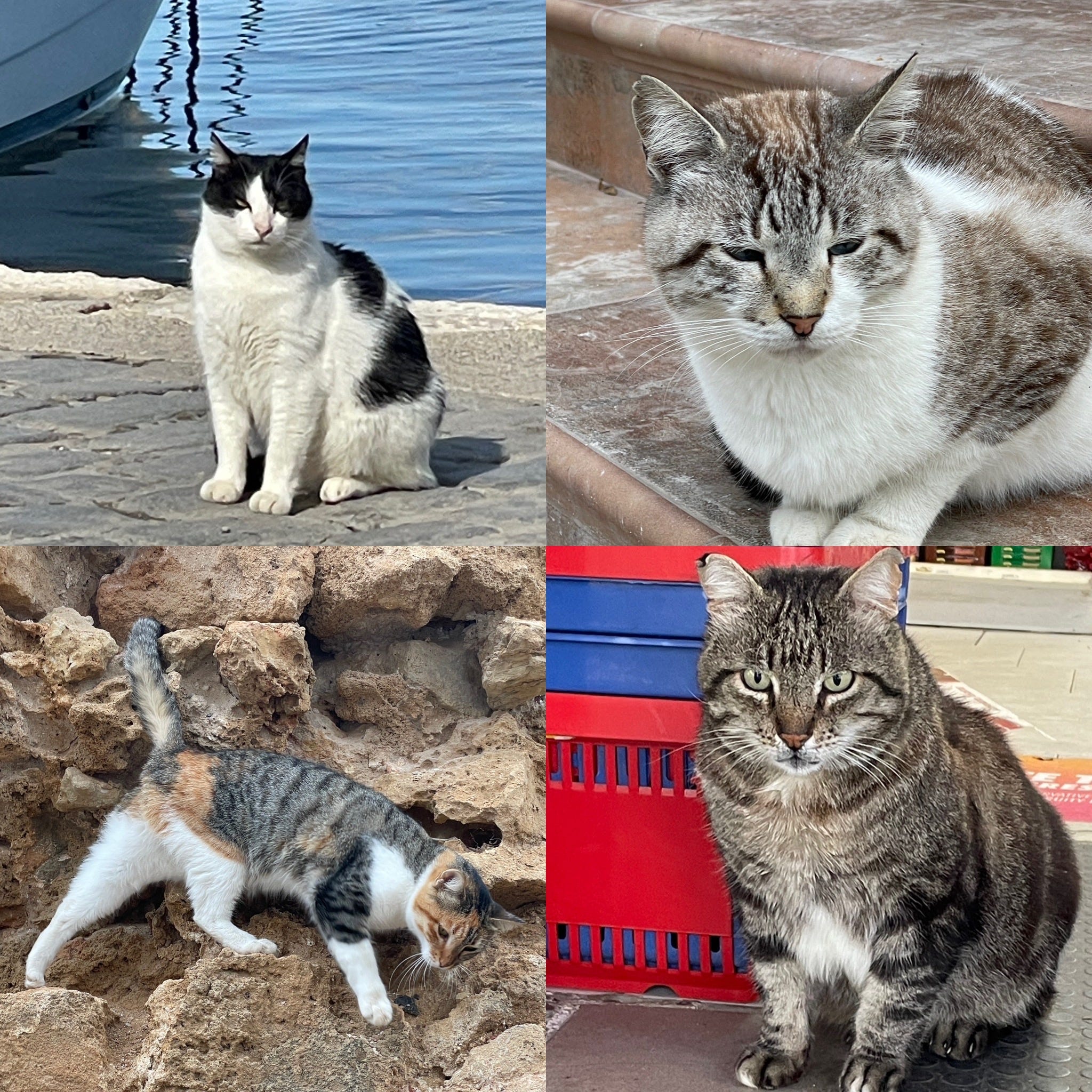
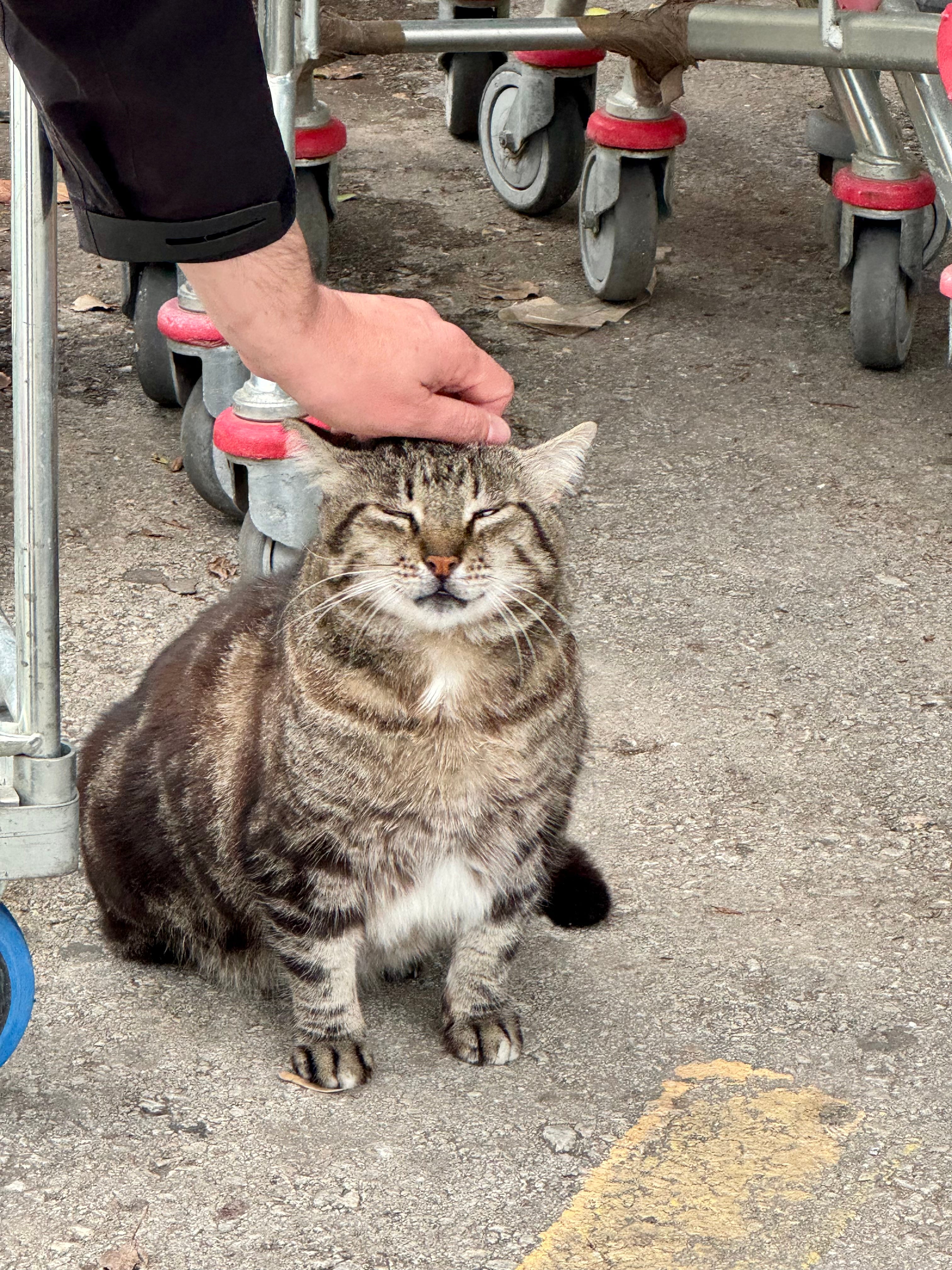
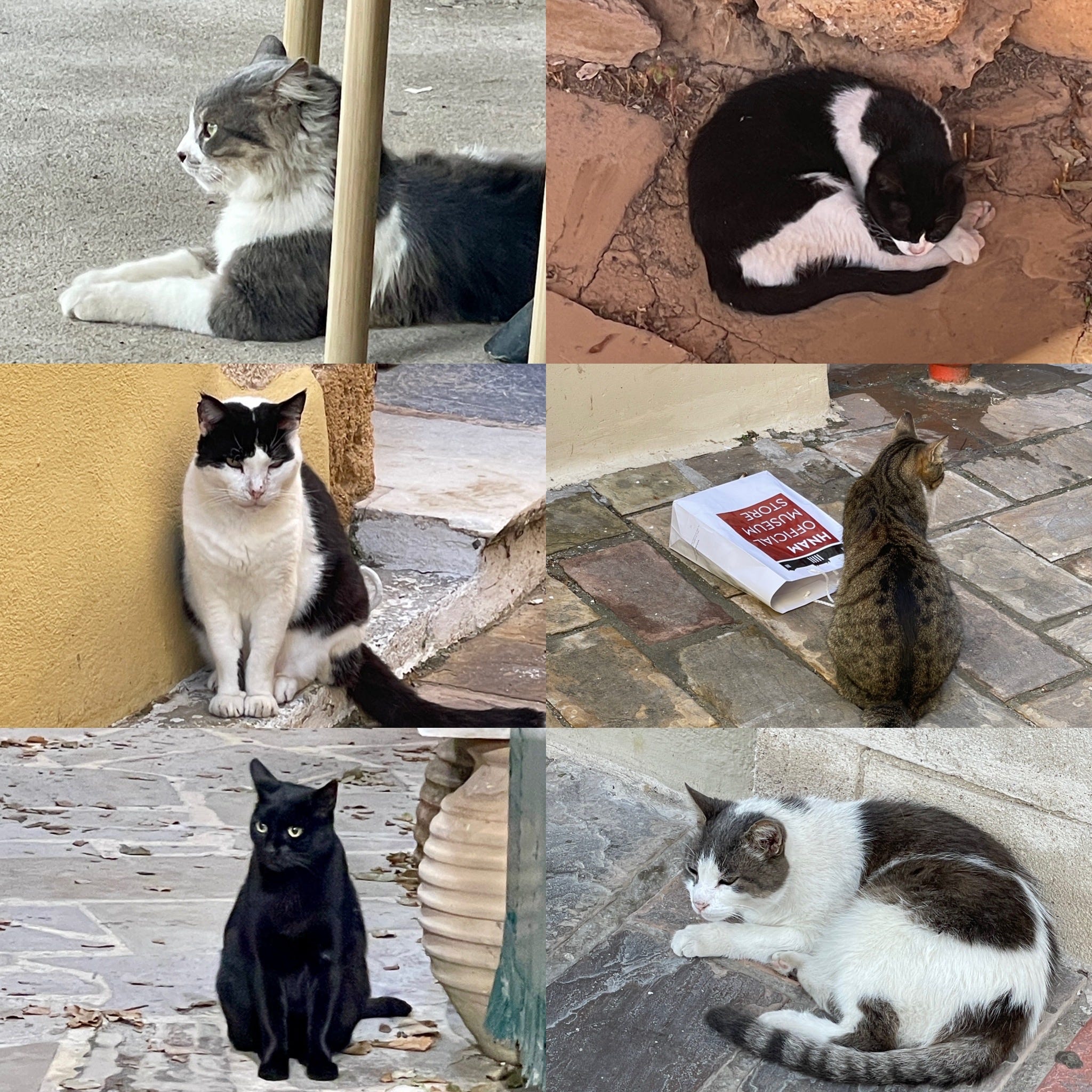
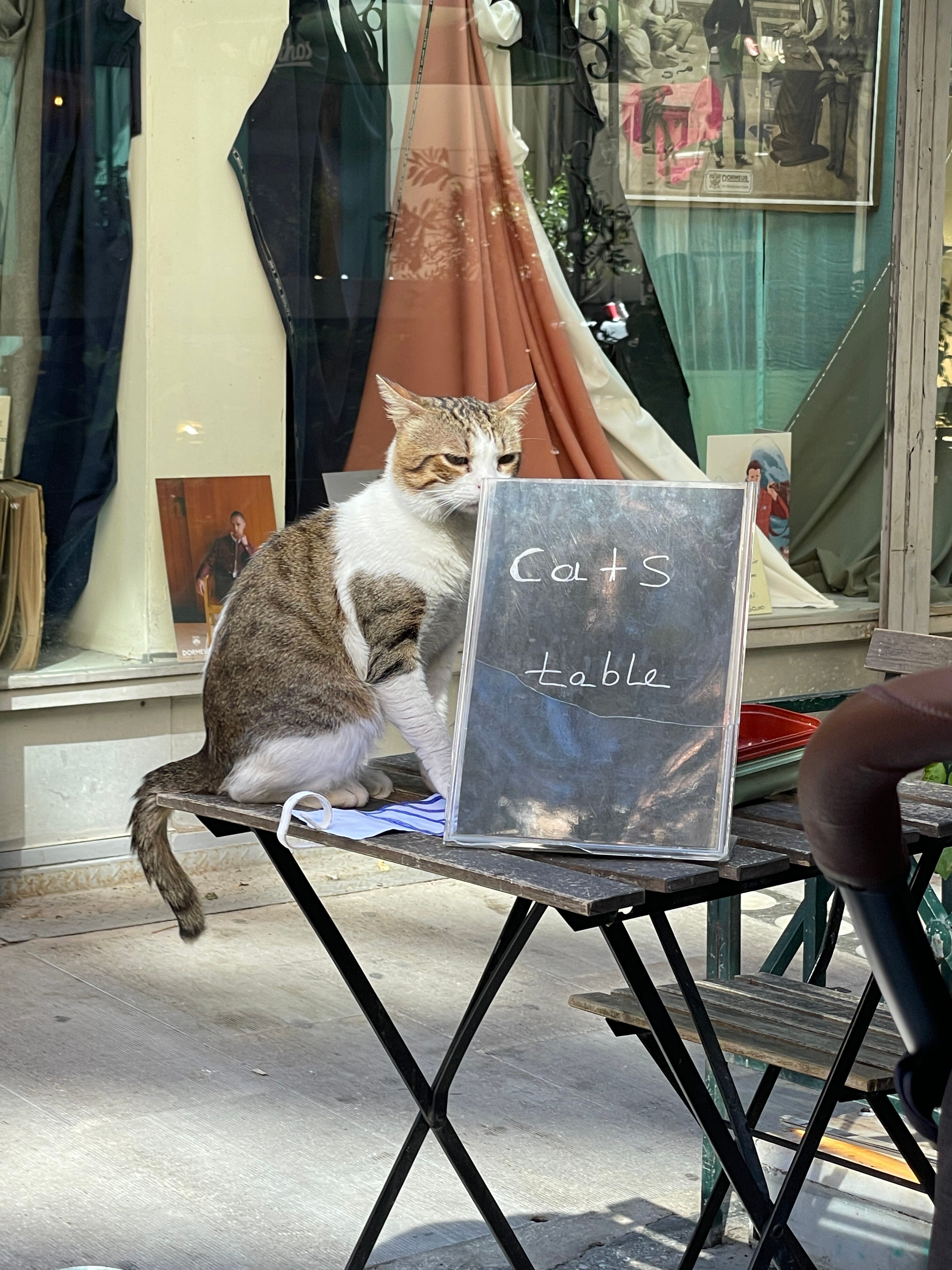
So many more, but I fear for your inbox. BTW, it is my dream to work with an animal-related charity…
That’s it for this time. See you in three or so weeks.
Barely Civil Society is about making the nonprofit world braver.
Here are three ways to help.
Subscribe and become a supporter!
Share!
Support!
Reading this work is free. But if you like it, a coffee is really appreciated. Or a periodical. Or a box under a bridge.

Send me a message
I love hearing from readers. Drop me a line!
Work with me!
Check out my day job webpage.
Or I will starve.


Because explaining this is incredibly boring, Claude AI has helped me:
“Nonprofit infrastructure organisations are the support bodies that sit behind charities rather than delivering frontline services themselves - providing shared training, advice, representation, networking and practical help (on things like fundraising, governance and compliance) so that small groups don’t each have to build those capacities alone. Think of them as the sector’s connective and back-office tissue, much as chambers of commerce and trade bodies do for small businesses.
In the UK, this includes local councils for voluntary service, which help community groups in a town or borough stay funded, connected and heard.” - A robot who does not mind writing boring stuff.
Politically, this is more worrying: According to Malcolm Ferguson, “Karp’s message is loud and clear: My technology will take political capital away from one of your greatest enemies—liberal women with degrees—and give one of your favorite demographics to patronize—working-class men—more political power to transfer to you.’