

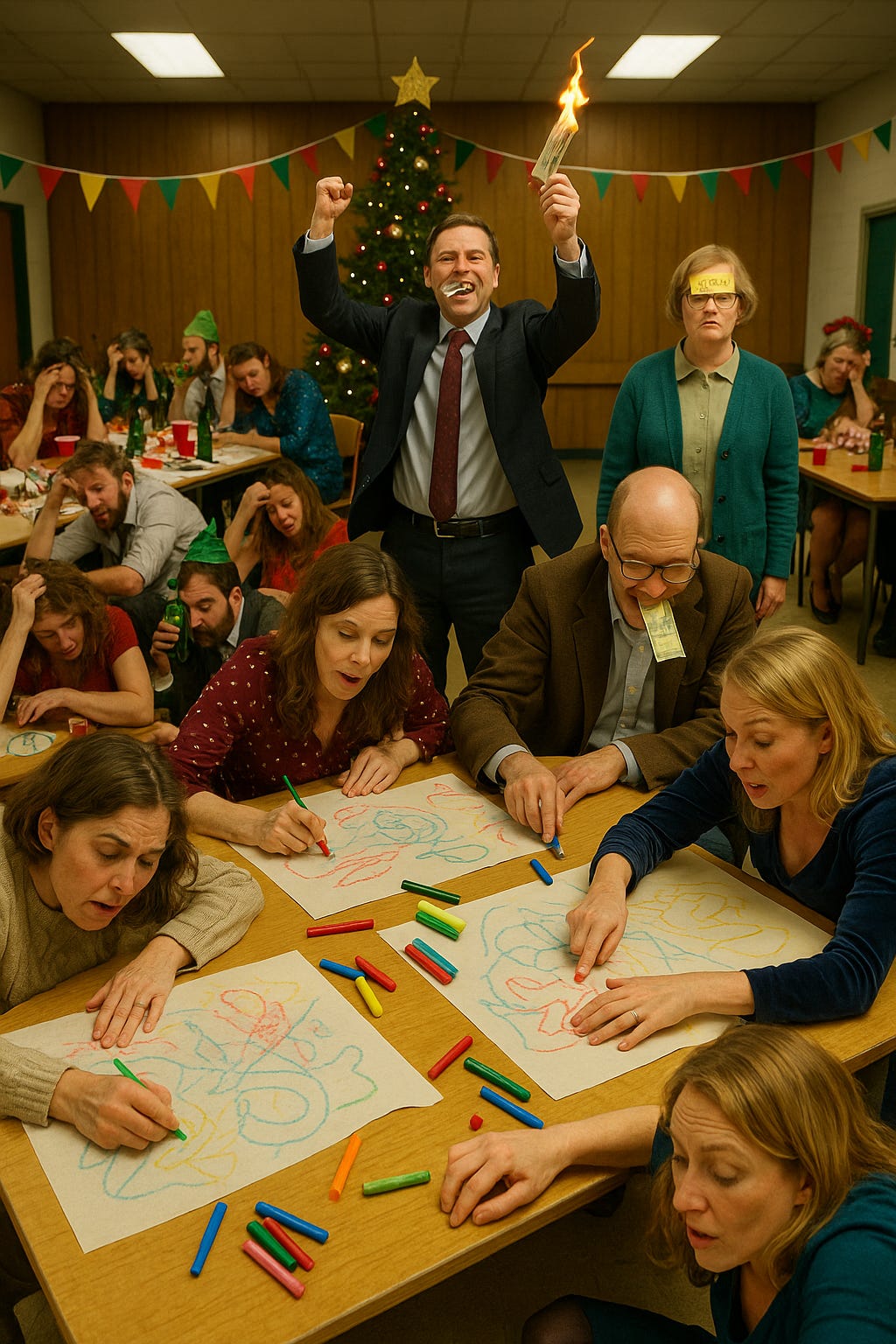
It’s nearly Christmas, most of us are sick as dogs, half of us have lost our jobs.
Even I’m not reading so much social theory and hardcore politics at the moment. So let’s just say it’s end of term and we’re bringing toys - and booze. I think Foucault would approve anyway. A largely frivolous end to a rather serious year.
As an update: I decided not to announce the last edition about Trans issues on LinkedIn because of the nasty bunch on there. You’ll be horrified to hear, however, that I suffered the biggest ever loss of subscribers - 4! Yes four. So I didn’t lose too much sleep and good riddance. Back to the bogs with them.
We start with a somewhat acid review of a challenging year. And then move on to a Christmas treat in the form of an absolutely totally real charity sector party which totally happened and is pretty much the nichest bit of puerile comedy ever written. But hey, why not.
If you just want the funny bit, I don’t blame you - scroll towards the second half.
Well, That Was a Shitshow 2025: a review of the year
Much like in many company parties, you now have to listen to some Berk tell you about the past year before you can shake loose and start eating the free food. So I’ll try to keep this short, and light on SORP.
Winter
So in January, the oligarchs took over the US and a mentally-addled satsuma and Commander Data from Star Trek (if he was much less convincingly human and a Nazi) took over. They quickly froze the USAID budget, which hit a lot of nonprofits (and just as many public sector handout-hoovers from the private sector, admittedly). This hit UK charities as well, not just those in the international development space, but even domestic, including Stonewall, which was forced to make significant redundancies.
That helped pile the pressure on a UK charity industry already reeling from many of the big funders deciding to ‘pause’ for a little rest the previous year (and continuing into 2025).
Meanwhile we all started railing against growing fascism in the US, despite having kept fairly quiet when Suella Braverman was actively trying to get mobs to set fire to community and law centres in case there were migrants in them. That was different, we said, because, you know, it might have affected our funding.
It’s been a big year for the Charity Commission. The Torygraph published an article about senior charity pay, making it seem as if every charity CEO in the UK was earning a king’s ransom. The Charity Commission then responded by not really denying it, and saying that some of the big wigs (nb. mostly men) deserved stellar pay, but they expected most people in charities to be ‘selfless’. Charity leaders ‘criticised commission chief’s tone-deaf comments on senior pay’, by which we mean, did a primal scream in their office and had to be talked down off the roof by the caretaker. But it did emphasise the yawning gulf between the vast majority of the voluntary sector, and a different breed of massive, essentially, corporations and cultural behemoths.
The Commission began the year still Chaired by a politicised Conservative called Orlando who seemed preoccupied with crushing ‘woke’ and believed charities should stay quiet on politics. Unless, that is, they were an extremely right-wing neoliberal think-tank (charity) called the Institute of Economic Affairs; for which, coincidentally, he and several other former CC trustees appointed by the Tory Government used to work. He had spent several years decrying the ‘culture wars’ in charities, especially when the wrong side was winning. This was always much like Russia claiming it is trying to end war in Ukraine - by winning it. Fortunately. Orlando lived up to his Shakespearean nomenclature and exited stage left. Even on his way out, he stressed that “If a charity decides it’s not so much a charity but an engine for social progress, we can step in,” he said in a valedictory interview in, of course the Times.
The following interim Chair seemed much less ideological, and the new one, Julia Unwin, who arrived in November, is from the Joseph Rowntree Foundation. This may be the end of the Tories’ 14 year attack on charities, which they saw as dangerous obstacles to ideological total domination. Fingers crossed.
In November the Festival of Trusteeship had a speech from David Holdsworth which was widely respected. (Meanwhile I hinted it was time to get rid of trustees in the ‘Radical ideas for trusteeship’ session I compèred with Penny Wilson and Eastside People a few hours later. Don’t think he was there. 😎 )
Back to the timeline. By February, Wes ‘I will fight you’ Streeting was saying he wanted to “break the culture of the voluntary sector”, which was nice of him. I still think he looks like his eyes stick on in the morning.
Meanwhile ACEVO and NCVO (the Acronyms™) came together to create a new ‘Civil Society Covenant’ which agreed that the Government would not ask for community centres to be burned to the ground, and that charities were allowed to question Government policy. For now. It took a while, but it finally got signed off. The sheer effort of getting that signed was by all accounts monumental - it’s not like the Government didn’t have other priorities. Meanwhile, while many are sceptical about its likely longevity or effectiveness, there’s no question about the amount of work it took to achieve it.
In youth work, when Axel Rudakubana was convicted of the horrific murders of three schoolgirls in Southport, everybody started asking why ‘Prevent’ hadn’t prevented it by bundling him into a high security prison as an extremist. Reasonable to ask, but also, nobody asked whether the decimation of CAMHS and youth services or chucking everything into ‘knife crime’ might have been unwise. The Government has spent a year on its new strategy for youth and, well, when it finally appeared in December, it is basically what you would expect - and what was there before Tory destruction. But with much less resource, and of course in much worse times economically. In a sense, people are more relieved than anything that there is a strategy at all: because it’s proof of life. Our expectations are that low.
Incidentally in BCS that month, I used again a term I’d first used years ago, and first wrote about in 2019 to describe these failures: ‘interventionitis’. Interventionitis is where we throw tiny interventions at individual symptoms and social ills, usually drawn from newspaper headlines, without ever thinking about the whole problem or considering prevention, maintenance or a holistic view.
Weirdly this has now appeared in an academic paper recently where some academics ‘coined’ it. Oi! Ah well, great minds think alike!
In March, ‘leading UK philanthropists’, including the homophobic activist and businessman Brian Souter (who ran a campaign in the 2000s to keep Clause 28), and that bloke off Dragon’s Den who runs some hotel gyms, wrote a barnstorming introduction (intro-suction?) to ‘Supercharging Philanthropy’ by the Centre for Social Injustice, set up by Iain Duncan Smith, (whose Big Society-era welfare cuts led to thousands of deaths). They claimed that they “stand ready to respond” to the challenges faced by the UK and to “propel the nation forward”. Indeed, they told us that “Philanthropy can do far more than the sum of its parts, taking risks and driving innovation in a way that taxpayers’ money cannot.” [My emphasis.]
Not subtle is it? Meanwhile, public sentiment against oligarchs, broligarchs and billionaires was rising, and people started burning Teslas, with people like Patriotic Millionaires suggesting that throwing a few coins might be less helpful than paying the tax you owe. The discomfort of philanthropy in a world of billionaires and oligarchs was a key theme for me at least in the year, but very much swept aside for the mainstream of the sector, as indeed there seemed to be more enthusiasm than ever for asking rich people to tell us all what to do.
Spring
By mid-March, as I went to my Mum’s wedding, the ‘Labour’ government’s new budget decided that disabled people seemed like a pretty decent target for welfare cuts, presumably because they thought they were less likely to be able to run with a pitchfork. Swingeing cuts were proposed, eventually reversed, but not before one of The Acronyms™ had posted on Linkedin that they wanted the Government to involve the voluntary sector to make sure cuts were made humanely. That post disappeared fairly sharpish.
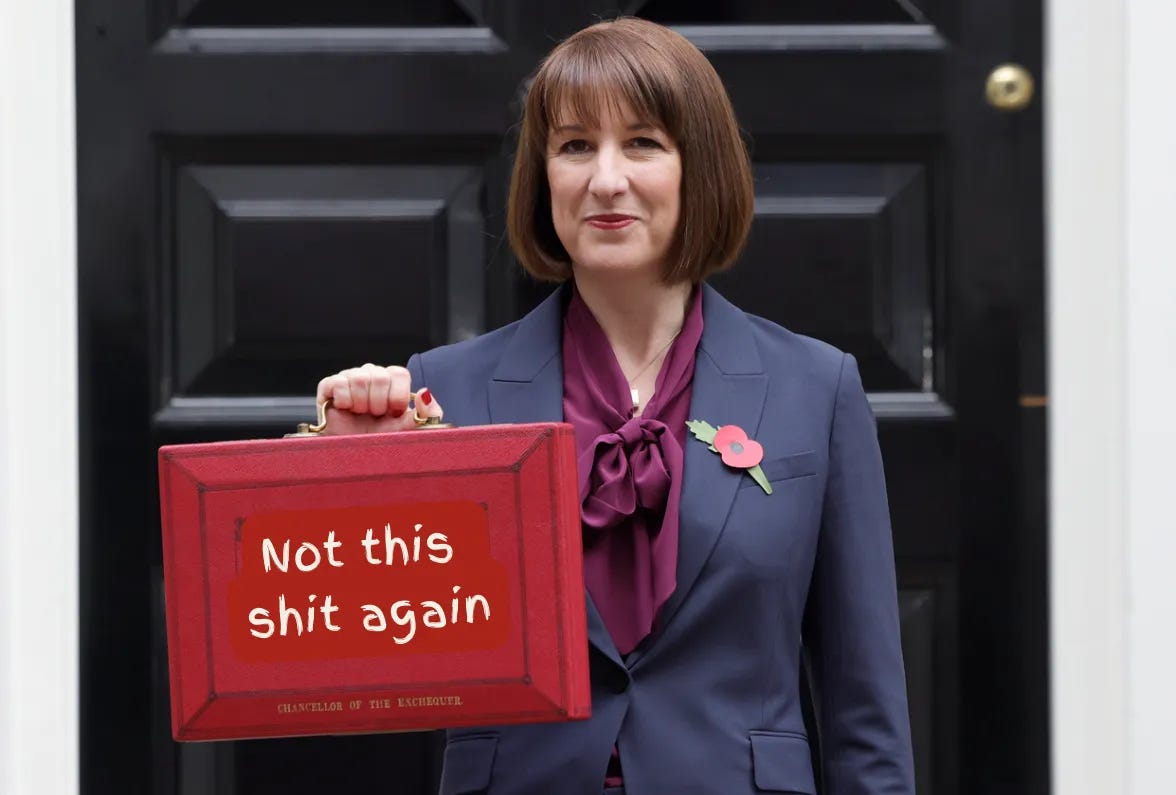
April was a weird one, Trump’s insanity with tariffs had started to hit trusts and foundations’ investments and there were worries - later proving unfounded - that their income was take a huge hit. Just wait ‘til the AI bubble bursts and see how that feels. Meta gave a grant (or did it?) to the charity suporting kids bullied on social media, set up in memory of Molly Russell. Then a London trust turned out to be fighting a legal case against freehold reform because it would give it less money to spend on grants to the poor. Better to uphold feudalism than reduce your grants for kids’ football, right? Then the National Lottery Community Fund launched their new priorities. Big Local finally closed, having spent a quarter of a billion pounds on Big Society boondoggles. With all this said, the NLCF’s importance, not just for our industry, but for the kind of things we need to achieve in our society, only gets stronger.
Later in the year, Henry Smith became a Foundation, and launched a new strategy, moving towards strategic grantmaking in common with many others in the sector, and the first ever grantmaker I’m aware of that explicitly included LGBT youth. I have concerns about losing responsive grantmakers, but nobody could deny their new focuses are good areas to focus if that’s your approach.
Sadly, the charity sector recession continued, and Jo Jeffery published her ‘A Very Quiet Crisis’ blogpost looking at the wide range of charity closures. Some have continued to deny this process, but even some funders, such as Esmee Fairbairn Foundation, have noted that they have seen substantially more closures than ever before. Infrastructure charities were among them, and are struggling, but even some larger charities have disappeared unexpectedly. By June it was being reported that nearly half of small charities were facing closure. People then started claiming there were just too many charities. The question remains, too many for whom? Or what?
As for trusts and foundations, they had come in for significant criticism in 2024 (guilty), and even more worryingly for them, in the US there is a new drive to make foundations pay tax on their interest (they also have minimum giving rules in the US). These things make UK foundations anxious about their ‘autonomy’, so a funder-focused acronym mounted a fight back, along with 360 Giving, and set up a new ‘UK Grantmakers’ platform. Their first report claimed that for the first year ever there was more money in grants from philanthropy than the Government. Only partially a cause for celebration, because the cuts in Government were no doubt partly the result of private donors avoiding (or being allowed to avoid) taxation.
The danger was how this may contribute to the narratives of generous philanthropy which are being used for political purposes (cf. Supercharging Philanthropy). This was not growing philanthropy so much as a shrinking state. The two are far more connected than either would like to have you believe.
For some, it wasn’t really clear who they were trying to persuade - for many charities, such brazen self-promotion at a time when there was a huge crisis, and many of the funders had been closed, seemed rather tone deaf. And nobody had claimed they were giving out less money - a straw man they invented and repeatedly returned to, perhaps to obfuscate the disruption they caused, the effects of which the sector (and they themselves) are still feeling.
Then Captain Tom’s daughter, the rich woman with the same perm everyone in Preston had in 1980, got done for building a swimming pool with the money from her Dad’s fundraising. Everybody in charities shook their head and said, ‘No. You think? I never expected it.’

Summer
Honestly, I’ve no idea. I wrote some big essays about socialism and queer civil society. I might have been drunk. There was a lot of Foucault and Marx and Wilde and Kropotkin. And gin.
Autumn
The rise of the the far right continued across the globe, and activists here were emboldened and whipped up by the field day for morons in the US. By the time we were having marches of the Far-right in central London, moving in from the burning trash fires outside hotels housing asylum seekers, charities were of course finally, rightly, speaking out. Nobody in mainstream discourse however had noticed that slashing and burning all kinds of community assets and support across the UK might have contributed to this along the way.
By December, the Guardian had set up a telethon fund for local community charities, and Labour had decided youth work might be a good idea - with funding from, well, somewhere. The Rayne Foundation had set up a fund for community centres - very positive indeed although £2m and vast numbers of applications of course. We can only hope the NLCF continues to make multipurpose community organisations a central part of its work, even if it means creating more committees than communities.
It was a bit galling people realised this was a thing after years of trashing community centres as surplus to requirements, and with trusts and foundations and public sector alike refusing to support anything but care-based interventions. What was considered ‘nice to have’ suddenly seems urgently necessary when there are Nazis marching on Whitehall. Perhaps that glue was needed after all?
In October, CAF revealed that only 25% of UK companies give anything at all to charities. This was surely a surprise to no-one except all the people who have been singing the praises of corporates who gave them a packet of mince pies and good vibes for running their staff christmas party on the cheap (see below).
In policy, two of the remaining major think-tanks in 2025 underwent big changes: one merged with a philanthropy brokerage, and in another case, made massive cuts, and was badgering Government to create another What Works centre, about six months after those had all been closed down. Again, the goal was to prove the worth of charities. The data mountain grows and still nobody knows what to do with it, like the cans of just-in-case chickpeas I amass at Tesco every week and never seem to use. The worry is that all of the policy and think work in the sector is essentially shaped by philanthrocapitalism. Part of the goal of the less satirical parts of this blog is to change this.
On which note, me and Felicia Willow and Dorothea Jones set the cat among the pigeons by finally talking about class in the voluntary sector on a well-received podcast. It was a good programme, I loved talking to them both, but I did have a bit of an ‘am I completely insane’ moment of when I saw how in the later commentary everyone ignored all the Marxist and political change stuff I talked about. (Which Felicia also noted.) Instead, while further discussion on class is vital, it’s a shame we’re broadly focusing on a version of identity politics, DEI and not being judgey about people’s accents. That isn’t going to change much, I’m afraid.
More charities were closing by October, with Scotland worst hit in a ‘slow-motion apocalypse’, while Oxfam and other majors made mass cuts to their staff - cuts which had far-reaching consequences.
Jo Jeffery’s list website went live, which meant you could finally see all the opportunities for funding that weren’t there…

Freelanceageddon really got going. Over the course of the year, mass redundancies led to what apeared to be a massive growth in charity people taking ‘the exciting and brave step that they’d always wanted to take’ of ‘launching out on their own journey as a dynamic independent charity consultant’.
‘So brave!’ ‘Congratulations!’ the Linkedin followers say. But what we all knew was a lot of people were being forced into a gig economy, as the middle was hollowed out of the sector. This mirrors wider patterns across society and the economy in a ‘k-shaped’ recovery…
Third Sector reported on this workforce development in their podcast with an excellent interviewee called Alex Evans - oh wait, me!! And we talked about Blume’s survey which showed both how much people enjoyed the work (which probably has a lot of survivor bias), but also having a stark picture of their previous work conditions in employment. Meanwhile, others were upset at being treated like money-grabbing monsters as a freelancer (what money?) - especially when they had not chosen it at all….
Winter
Throughout the year, UK foundations were themselves under massive pressure, with between triple and in one case almost 200-fold increases in applications. Many were hit much worse by the result of their own previous closures, but others were put under pressure by the reducing pool of alternatives, with knock-on effects of reduced individual giving and public sector contracts. This created a perfect storm when it hit technology: over the year, AI and chatbots had continued their ascendancy in the charity sphere, especially as relates to fundraising. Few could deny by the end of the year that AI had played a role in collapsing the fundraising applications system. Bid-writers probably have good reason to be worried in the future, not because they don’t write better than an AI, but because people don’t really care if they do. The same race to the bottom is hitting journalism and all other writing professions of course.
This does raise the question of whether most of the crap we write in businesses and bureaucracy needs to happen - and many of us have said for years that bid-writing may be one of those things. This is unfortunate, as bid-writers are a creative bunch. Their skills will still be needed - but their paymasters will need to be educated aboiut what the real skill is. A sector obsessed with price and not value will be tricky to navigate.
By December, nasty meanie Tory leader Kemi Bad Enoch had decided that it was unChristian to pay taxes and that charitable giving on a voluntary basis was better - based on her own D grade GSCE version of history. Of course the main reason these kind of people like voluntarism is because they would never, ever volunteer anything. Hopefully she’ll be gone, likely with Starmer, by the next Christmas Shitshow edition. The replacements may be ten times worse, however.
As a special early Christmas present, the EHRC’s prejudiced and ideological overstep of the For Women Scotland judgement about women’s human rights (which led to the exclusion of trans women from basics like toilets in some cases), came to visit us like the curtain-twitching ghost of Christmas past. Girlguiding UK, and quickly, the Women’s Institute, both previously trans-inclusive, decided to exclude trans girls and women from their services. This was followed by much delighted ululation and gleeful stabbing of voodoo dolls by people who have nothing better to do with their time - the same people who would have been writing poison pen letters blackmailing the local queers in the 1950s. The two charities both claimed it was legal threats that had forced them to do this - but some doubt this.
Suffice to say, the Third Sector Against Transphobia group on Linkedin (and soon beyond) set up by Kevin Taylor McKnight, and which I’m happy to be part of with Penny Wilson, Felicia Willow and Debra Allcock-Tyler among many others, had double the number of members within a week than the one set up by the Mean Girls who want to look down people’s pants and bully them. Penny Wilson wrote an excellent letter to the Charity Commission asking them to make a series of changes - and the CC at least clarified that it did not see holding charities to the equalities laws as part of its remit. That has upsides and downsides.
Overall, what this tells you is that yes, the charity sector is full of decent people. But we have to be brave. If you want to help, join the Third Sector Against Transphobia group and give to the Good Law Project. We need to get these monomaniacs of mean-ness and small-mindness out of the charity sector (and beyond) for good.
Bringing things full circle, by the end of the year, reports apeared suggesting that thousands of people had died as a result of Trump and Musk’s cuts to the USAID budget. As I go to press (which sounds very professional…) Oxfam’s CEO has been forced to resign, partly (it’s is said) because she lost the confidence of her staff during the aforementioned redundancies. According to the Guardian, ‘a restructuring of the organisation she led had created “widespread animosity”. They claimed it created an “intense climate of fear” that had become “deeply rooted in Oxfam, including a very real fear of retribution from senior management”.’ Some claim she is the victim of racism and sexism, some that this was a bullying culture and a badly-run change programme. None of which is good news, however you cut it: big changes often lead to a febrile atmosphere in a sector which is in significant recession.
We need to end on a high. Well, a high based from the viewpoint of a mouse’s nethers. I’ve been enjoying seeing small acts of resistance in civil society. So for me, perhaps the most uplifting story of the year is the success of the Everyone Hates Elon campaign, which raised £100,000 for causes hated by Elon Musk: asylum and migrants, anti-racism, trans people and so on. They did this by getting people to pledge money every time Musk wrote a hateful tweet. A roaring success of course….
It was a year of the rise of oligarchs, a return to the worship of philanthropists alongside a shrinking state, and rising intolerance, enabled by transatlantic far-right nutcases, as well as a year of massive economic uncertainty and rising inequality, with a hollowing out of the middle class. Alongside that, a failing, flailing left has allowed much of this to go unchallenged - and people desperately need a new vision of a fairer, kinder and more just society.
All of this impacted - and perhaps was impacted, in its own small way - by the UK nonprofit sector. There is a rethinking and restructuring underway driven by all of these forces, but it is mostly unthinking, and as ever, drivne by ideas and ideologies form outside our own culture. It’s up to us to fight to make sure whatever new shape we see in our work, not just as an industry, but as custodians of social and cultural practices of love, care and community, finds us on the right side of history. There is no room for complacency, and everything to play for.


And now the party…
And so, well done everyone for listening to that. The bar is now open and there is some free food, but I would give it a sniff first. As the youth workers among you will know, make sure you get to the buffet before the kids do. Otherwise you’ll be munching your way through piss-contaminated vol-au-vents and dodging licked sausages half-submerged in the hummus.
Anything in packets is safe.
WELCOME TO THE ANNUAL UK CHARITY SECTOR CHRISTMAS PARTY!!!
Hello, hello, hello! Come in. Before I take you through, just to say I’m contractually obliged to tell you this is sponsored by a leading database company, and some techbros are going to be using your personal data and selling it to Peter Thiel for unknown purposes. But they do have a LOVELY website. And 150 quid is 150 quid.
Anyway, would you like the tour first? Well, as you can see, this is a delightful community centre with attractive period features like bars on the windows and toilets from the Victorian era. We’ve gone for a particular look: think ruin chic.
So come this way.
Just leave your coat there - don’t leave anything in the pockets though.
And then come through to the main hall. Shall we find you somewhere to sit?
So, as is traditional, we’ve separated people out so they can talk to their own social class, I mean, subsector. Yes, funders, policy, delivery people (don’t make eye contact with them) and some trustees. There’s an MP too. Yes, he’s pissed again.
So, over here we have the funder table. Yes, they needed quiet space so they could talk about how hard their role is. Don’t let them think you’re going to ask for money though, they get frightened. Approach them calmly from the front and don’t smile, it makes them nervous.
So if you fancy a game, some of the biggest funders at that end are playing that game where you stick a post-it on your forehead and have to guess what you are. It is a bit strange, yes, all the post-its say ‘CLOSED’ and they don’t seem to have noticed that all their friends have the same thing on them. There’s a fundraiser trying to reason with them. I think she got in through the window.
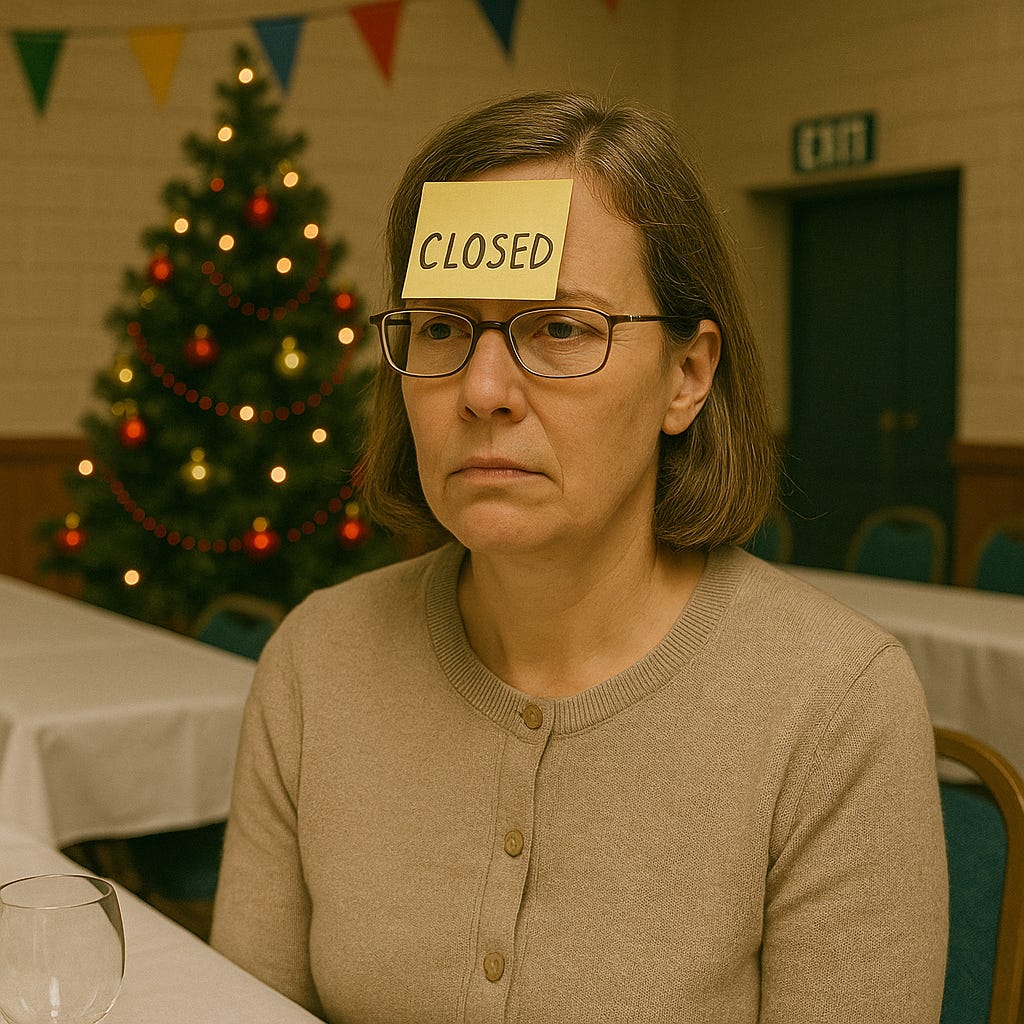
That’s the ACF. They’ve been changing the text on the post-its to say ‘PAUSED FOR REFLECTION.’
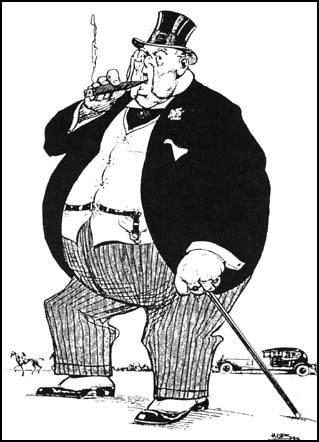
Yes, you’re right, they do seem a bit ensconced in their own thing. Well, at the other end, if you fancy a bit of glamour, there’s a guy from a local corporate. Arrived in a Jag. He’s always up for a free christmas party run for him by charities. He does keep shouting about how much money he’s given, but so far it seems to be a fiver.
Oh but there have been lots of offers of pro-bono advice. Most of which has been, ‘Get a better job’.

He’s a bit of a character, he started urinating in the corners to ‘make sure people know he’s been here,’ and I think he’s been sexually harrassing the Christmas tree. Then he was hanging around the coats. Eventually he’ll make a really big donation, I’m sure of it. He’s already announced it in the press, although no cheque yet.
He says he’s ‘supercharging philanthropy’ although he seems to be mostly supercharging it up his nose in the bathroom. He’s waving that fiver again isn’t he. Yes, he’s very proud of it.
Now over here… Ah you’ve noticed. Yes, I would avoid this table if I were you.
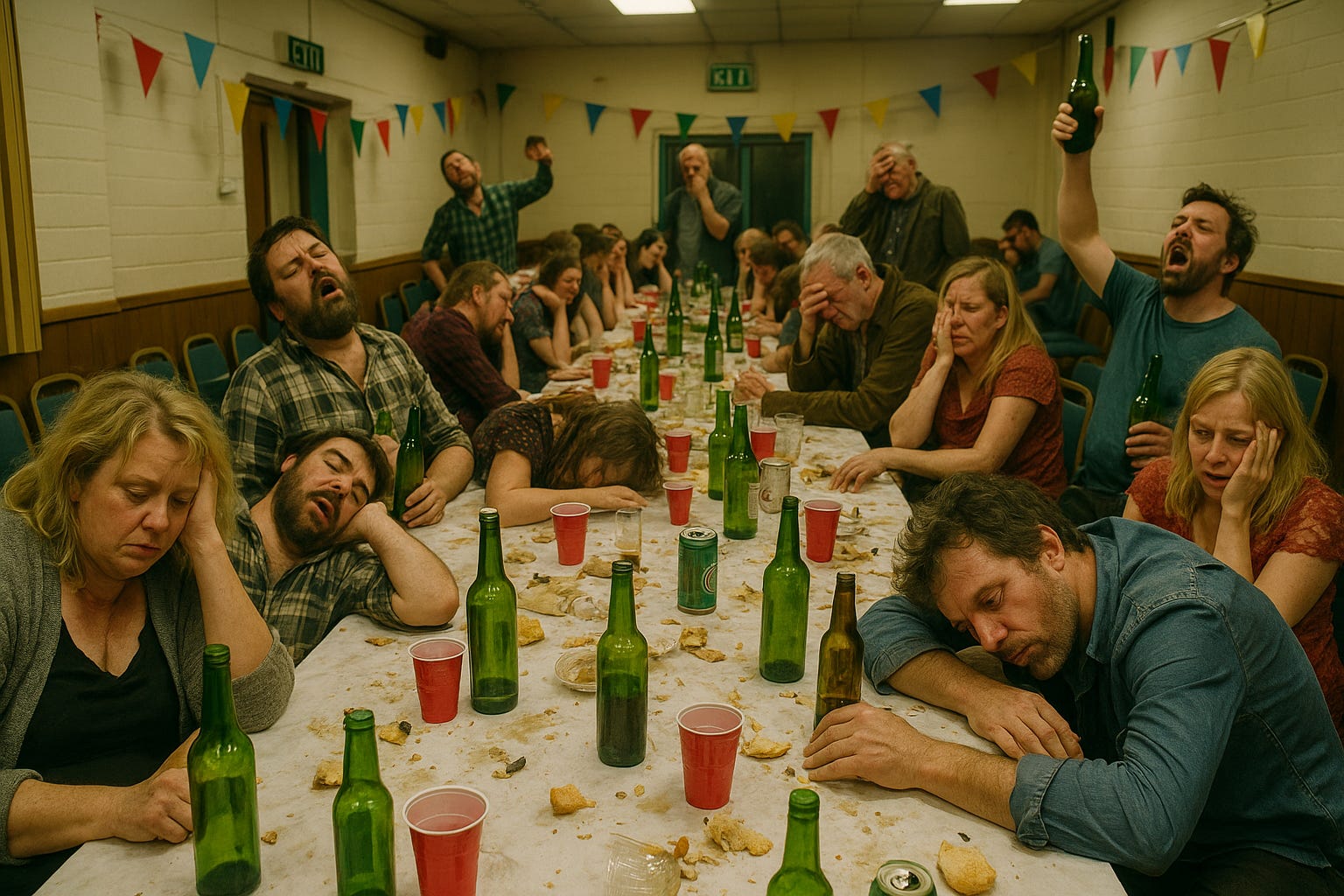
They’re the delivery people. You know they do that stuff, like, in rooms with kids and old people and… well I’m not really sure to be honest. What is it, workshops? Bingo? But they’re so dedicated, you know. Yeah, so we didn’t give them any food, you’ll need to take some from another table, although not from the funders, or you’ll be filling in forms til tomorrow morning.
Yes, they do seem to mostly be crying and drunk.
Not that table then? No, well, I quite understand. Well you’ve got one more option. That one there is the top table. It’s where the policy people are, you know, the “clever” ones. I think we could sit you there, yes, no problem.
So at that end you’ve got the think tanks. Yes, in the crèche, they’re the ones with the crayons. Tell them you like their drawings, I mean, diagrams, they like that. They keep showing them to the funders, they’re the only ones who like them really. They’re not allowed out very often because they just keep going around shouting IMPACT in people’s faces and then asking for money.
Oh and that guy’s from Bayes. I know, he just keeps shouting EFFICIENCY at everyone and rattling an abacus.
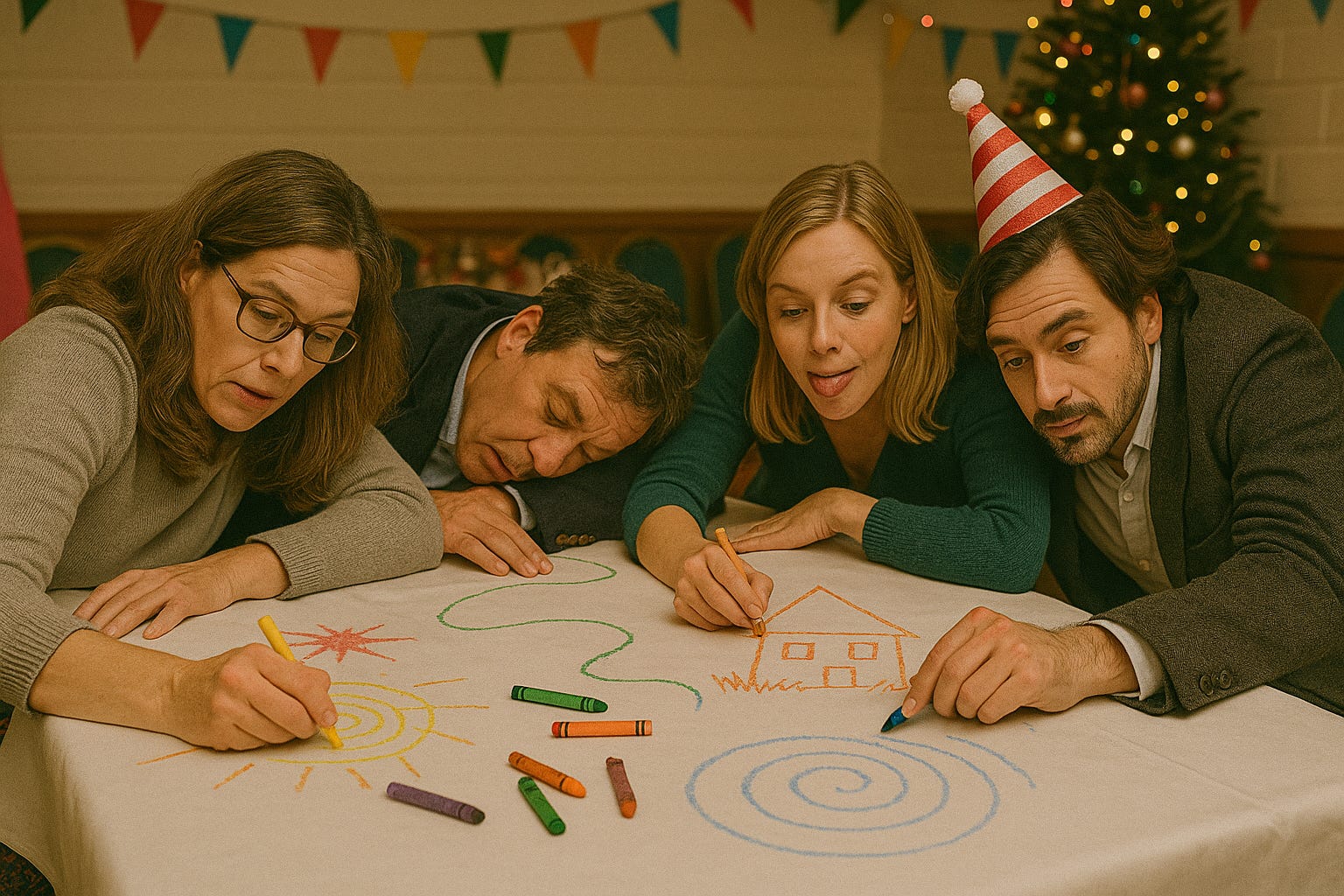
Yes, there’s the Acronyms. I’m not sure, they’ve just been going around nodding and agreeing with everybody.
So, which one tickles your fancy? You have to pick one, they all hate each other and once you’ve chosen you’re stuck there.
Oh… the table in the hallway? Oh that’s the trustees. I know what you mean, they do look a bit confused. And they’re quite, um, mature… We’ve written on their hands ‘CHARITY’ so they can remember why they’re here, but it is tricky. They’re mostly sleeping I think. Careful not to wake them up though, that’s even worse...
So, where do you fancy? Which table?
The bathrooms? Oh, yes of course, I should have shown you - just out there. Yes, next to the women with the Harry Potter books. If they ask to see your genitals, you’re better just letting them; you don’t want to get sued.
You’re going to just wait? Well, if you can. The Girlguiding lot have just gone in the bushes outside. Easier, I suppose. But if the neighbours see them, we’ll lose our late licence.
Oh, running off so soon? Another appointment, gotcha.
Got your coat?
You’ve lost a fiver? Ah. Well, I did warn you to empty your pockets… At least he’s going to donate it. Eventually.
Well, toodleloo. Lovely to see you.
Yes, next year. We’ll probably be here next year, or, well, you know...
Have a lovely breakdown. I mean break.
Merry Christmas from Barely Civil Society
This has been an especially frivolous edition. But there are big plans for the new year, which I look forward to sharing. I dream of a world covered in bunting.
For charities and society there has to be a better way - and there has to be a place to say that. That’s why I’m planning, with some good people, to expand this work and really change how people think about nonprofits, philanthropy and a society where care for people and community is the norm, not just an industry. Are you in?

Barely Civil Society is about making the nonprofit world braver.
Here are three ways to help
1. Subscribe!
Barely Civil Society is a reader-supported publication. To receive new posts and support my work, consider becoming a free or paid subscriber.
2. Share!
Linkedin recently removed 1,500 followers from my account (apparently it’s happening to a lot of people). Please share to give me a chance of anyone seeing this.
3. Buy me a mince pie!
Iceland have won best mince pie again. Can you sub me a pack? That way you can help me spend more time researching and writing - including some bigger projects I’m working towards. And keep me overweight.