


Hello everyone, and welcome to nearly February. I’ve spent the last week doing grant application interviews and have learned a lot, not least that vodka takes the edge off, but it’s best not to start before11am. Also, don’t mix it with anti-dizziness medication. Oh, and people are doing amazing stuff - probably too much, which is also the case for me. Apart from the amazing bit.
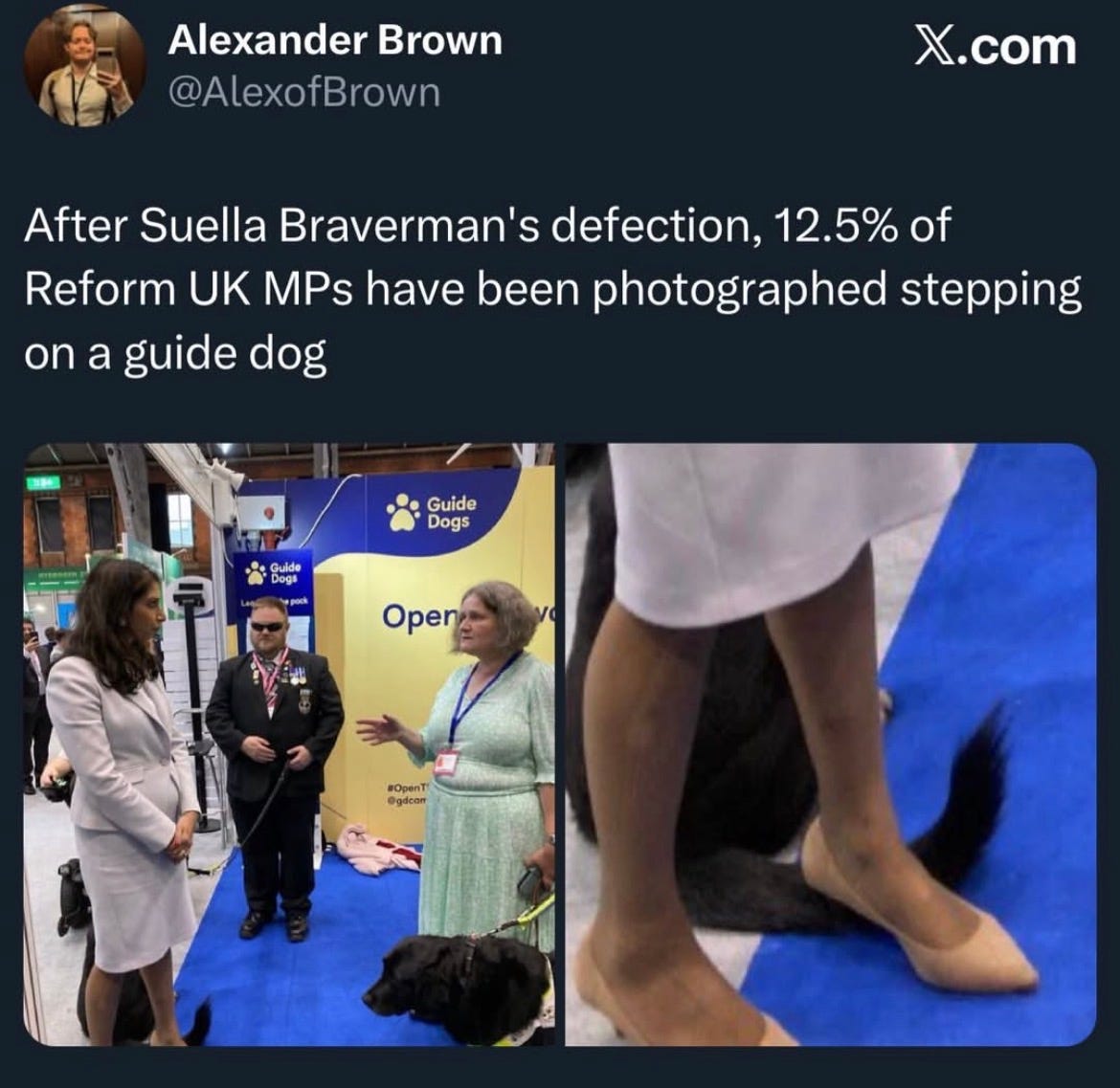
In general news, democracy strikes again as Andy Burnham is prevented from returning to the parliamentary Labour party. Suella Braverman joins Reform, which is not the coup they think it is because everyone knows she’s mad as a f*cking brush. Same with Jenrick. It’s bad for the Tories but not necessarily good for Reform…
America has descended into total fascism and quickly discovered that people aren’t just going to quietly accept that, especially in a place like Minneapolis. This is really interesting: Minneapolis is what they call Mall of America territory - this is not Portland. Go Prince fans!

Next week, I am off to Copenhagen, which every single person I speak to tells me is the best place they have ever been, but also, not to bother with the Little Mermaid. I’m looking forward to it, albeit wrapping up warm….
Liberal Democracy Returns to the Third Sector

Charity Commission CEO David Holdsworth spoke this week at the annual charity conference of the Institute of Chartered Accountants in England and Wales. (Wow, I can’t believe I missed that no doubt Bacchanalian celebration.) I’m quoting it at length because it was sort of buried in reporting, but I think it was the most important thing that he said.
Charity not expected to be ‘fluffy’
‘Holdsworth discussed the distinction between public trust and approval, saying that “none of us will support every single charity on the register”.
“We all have different worldviews, passions and interests. It’s one of the sector’s great strengths - how broad the sector is. And as regulator, we don’t expect charities to be uncontroversial,” […]
“In fact, it’s my personal conviction that societal progress over the decades has come about precisely because of the work of charities whose missions have been at odds with what was, at the time, comfortable, respectable or common ground amongst the general public.” […] “We shouldn’t expect charity to be fluffy. Sometimes charity is and must be disruptive, but – and this is an important but – the ability and freedom of charities to pursue controversial charitable aims rests on a collective commitment to integrity in how charities are run.”
David Holdsworth, quoted in Civil Society, 23rd Jan 2026
I cannot stress enough how heartening I find Holdsworth’s speech - compare this to the insanity and intense politicisation of the Orlando years. It fits with the notion of the Civil Society Covenant. It acts as a reset. This is all the more important in a week where another conference found larger charities (always the only ones who get invited to talk, of course) were talking about the ‘self-censorship’ of charities.

Make no mistake, this goes down to the level of individual censorship of those who work for charities daring to have an opinion or a persona beyond their work one, as we have seen with those struggling with trustee disapprobation if they speak out of turn.
Let’s be clear: This is the speech the CC needed to make, and I’m impressed that they have done so.
Stress test: trans inclusion and the law
Meanwhile, in the same week, the Charity Commission asked theGoverment for guidance on how they should deal with requests to include trans people in charities whose objects state they are solely for women. This is absolutely predictable but also likely to have a very bad result for those trans little girls who want to go to a youth club with their friends, given the Government and the EHRC’s outright hostility to trans rights.

At the end of the day, this is a moral, ethical, and political question about kindness and inclusion - and the Labour government and the EHRC have been hostile to trans rights for some time. So this is like the teacher asking the bullies whether it’s okay to bully you. But what else can they do? They have to apply the law - and indeed, their interpretation has to rely on the interpretation in turn of hostile actors and judiciary. My take: we are going to hasve to win hearts and minds and build a groundswell here, in the charity sector as much as anywhere else. Fiddling with governance and the law is not going to cut it alone - because governance and the law are currently on the side of the most powerful.
Overall, the Charity Commission is setting out a pluralist, dialogic, highly liberal democratic vision of charity. But the reality of the climate in which that is taking place is increasingly fraught - and all the benevolent and democratic will in the world can’t help when the judiciary and the interpreters of the law are powerfully hostile to certain aspects of justice.
Why Lawfare Has Charities in its Sights
Meanwhile, working with colleagues opposed to anti-trans bigotry, we’ve been shocked, if not entirely surprised, by the weaponisation of the law to intimidate and frighten enemies. This is not just about charities and civil society per se - it’s making me think about the wider impacts on law in the world and politics as it changes, where we have to decide between law as dsialogue and law as a weapon.
The growth of ‘lawfare’ in the charity sector is frightening. Test cases, appeals, and various other legal instruments of change are one thing. The Good Law Project is doing an excellent job here, and of course, the Mumsnet Meanies backed by Wizardy Enid Blyton are doing a great job of, not winning them (because in fact often they are losing and spinning it as success), but of presenting victory.
But there is a more sinister kind of lawfare happening, where legal threats - and people’s fear of legal attack, and inability to legally defend themsevles - is being used to frighten, coerce and blackmail people and organisations into positions they don’t want to take. Small charities and individuals now being approached by anti-trans legal activists and told they will be personally sued if they don’t comply in advance with excluding trans people is a somewhat different thing than a discursive process of legal argument in the courts.
This is just a type of juridico-legal violence, where the process is used to terrify and intimidate. This is deeply sinister.
You can see the law as a set of fixed rules that govern behaviour and apply punishment or favour based on absolute moral precepts handed down from a higher power. You can also see law as a kind of neutral umpire for managing conflicts, and avoiding the Hobbesian ‘war of all against all’. Since the Enlightenment most of all, it has been seen as a place of dialogue where we slowly come, through discourse, debate, and rational argument, to new agreements of social and moral norms. In this, we find the fundamental belief of liberal democracy: respect for the rule of law, and the ability to challenge and change society through legal discourse and legislation. But that model only works (if it does) when institutions accept the premise of social progress as dialogue - and in good faith.

Marxist approaches to the law have always stressed the idea that laws are outgrowths of the ruling class (those who have the greatest share of the wealth) at any time. Alongside this we see the insights of things like Critical Legal Studies which developed in the US in response to new social movements and indeed their experiences of the limitations of legal arguments in the context of civil rights. Both approaches were sceptical of liberal democratic claims about the law, to my mind rightly, at least in part.
But there is a newer approach to law (well, newer in focus), very much born of the aggressively litigious culture of the US, and of the increasingly emboldened New Right: law as a matter of explicitly asserting dominance and exerting power over its enemies. It does this through terror and intimidation, leveraging fear of personal, financial and reputational ruin. It is basically using the law as a weapon of blackmail. In a sense it is seeing the law as part of the ‘war of all against all’, not as a way of avoiding or overcoming it.
This has grown out of political ‘realism’, very much the core belief of the right in the US since at least the 1980s, and most of all in international frameworks - essentially the idea that ‘might is right’. 1
The end of law?
As Mark Carney put it this week, quoting Thucydides from the Melian Dialogues (no, I just looked it up) we are approaching an international legal order where “the strong do what they can, and the weak suffer what they must.”
The rule of law is evaporating at an international level (let’s be clear, that was indeed largely the international ‘law’ prior to the 20th century). But evaporating that law is also a key strategy on a day to day, micro and national political level by the rising right wing forces across the globe. Authoritarians despise the authority of ‘law’ as a social and civic function of democracy, because they only love their own authority. As Judge Dredd would have it: ‘I am the law.’ Laws just get in the way of authoritarians - unless, of course, they make them. Project 2025 and its various local implementations are precisely designed to erode the rule of law and put in its place authoritarian executive systems which act purely on coercion and might.
At the same time, the attack dogs of the New Right know that law, including civil law, is a powerful weapon. The New Right treat law as something that is useful in as much as it can be used to command and coerce, even if in its liberal democratic form it is also a barrier, if it can be used to temper their power. They attack ‘the law’ but replace it with laws of their own, and stuff judiciaries with their own people, to enshrine their own authority (see for example the US Supreme Court). Access to vast funds to do so is almost always a pre-requisite.
In this mode, law usually attacks the ‘other’ and protects the ‘us’ (per critical legal studies views), supports the wealthy and their property (per Marxist views), and more generally, allows the absolute power of fascists (per realists). And its only purpose is instrumental: to reinforce or take power. There is a famous recent quote about conservatism:
“Conservatism consists of exactly one proposition, to wit: There must be in-groups whom the law protects but does not bind, alongside out-groups whom the law binds but does not protect.”
For democrats, liberals, and even leftists to an extent, dialogue, debate, and rational discourse are goals in themselves. They are not just instrumental in achieving a good society, they are a central part of it.
But for political realists, process has no inherent value; all that matters is whether it gets you what you want. This is the approach that lawfare takes, and the scorched earth tactics of the anti-trans meanies’ legal strategies are designed to do nothing else but destroy their enemies. These are two different ideas about how we approach law and social change in a liberal democracy.
At the same time, I am not arguing here for a naive return to a politics of liberal democratic process. AIDS, LGBT activism, and any number of other social and justice movements suggest it is not enough. For all the Neocon political realism, there is a left, progressive, and anti-authoritarian tradition of realism too. I’m reminded of Michel Foucault’s take: “Shall we say, politics is war pursued by other means?” A Machiavellian streak runs right through any movement that plans to make change.
Nothing is simple.
Why charities?
So why are these attacks are coming for charities? Well, because, whatever people like the IEA and Orlando Fraser will tell you, charities are a fundamental part of civil society. And civil society, central to flourishing liberal democracies, is where norms are formed, dissent is organised, and power is either normalised or challenged.
Italian Marxist theorist of culture and politics, Antonio Gramsci, whose work has now been explicitly co-opted by the New Right, was very clear that civil society is not a sideshow to state power – it’s where hegemony (dominating influence over society) is made, normalised, and contested. Civil society is not peripheral to politics but one of its central battlegrounds.
What could help?
Well, clearly, I’m not going to suggst how to fix the decline of liberal democracy - although Edward Luce has written an excellent book about that. You may also want to take a look at the work of Thomas Piketty.
But as for UK civil society, I’ve talked a lot here about the problem. I’m not one for easy solutions. And yet, I do think there is one very brave but potentially powerful solution that could happen in civil society and in the shape of our market, where funds are held by massive unacountable (but hence extremely free) foundations.
Charities in particular fear legal action, and easily-triggered trustees fear litigation and the costs it will bring - and indeed, are bound to do so by law. So non-profits will remain an easy target, and indeed, a prime target, for those who are looking for a place to attack.
If there was anything that might help, it is simple: a legal fund, from several of the major UK funders to decentre risk, to defend charities who wish to protect trans women’s right to exist. Perhaps even the biggest cannot compete with the resources of JK Rowling (what kind of a world do we live in?). But a sense that somebody with money and power has their back is something that charities need to feel at the moment.
STOP PRESS
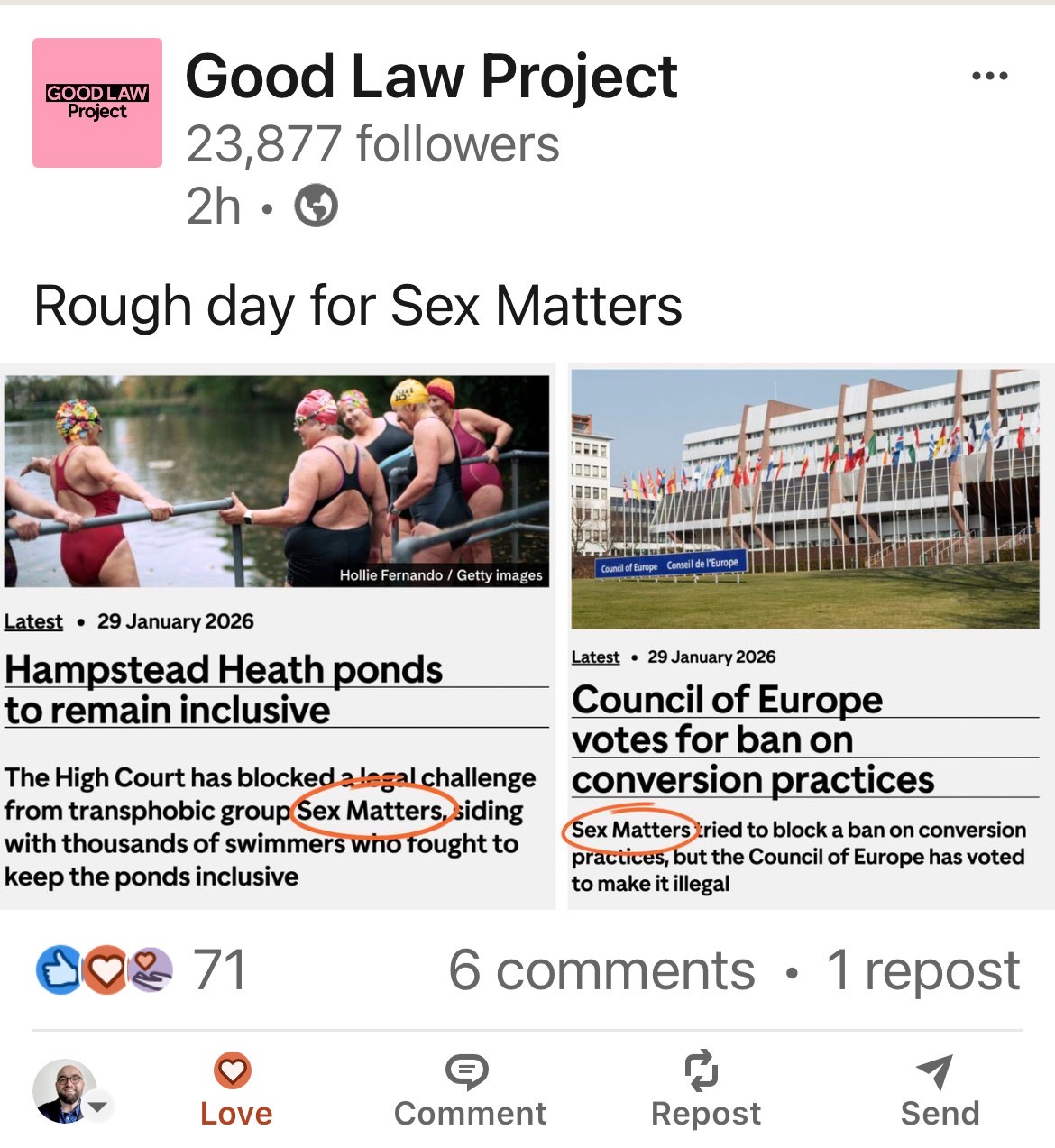
YAAAAAAASSSSSSSSS!
Quick bits
Is the Government a Charity?

Surely the most bonkers story in the last few weeks has been the decision that a charity set up in the early 20th century to pay off the national debt - yes really - has to close, and give its money direct to the Government to be used to pay off £600m of the national debt. Of around £3 trillion.
But this is like using your Auntie Brenda’s 50p for sweeties to help towards your deposit on a house. Just buy some sweets, FFS.
Even the Government has said “thanks, but it’s not even worth getting out of bed for”. Oddly, they didn’t say ‘the national debt is just money we’ve made up anyway because national debts don’t actually exist if you have currency sovereignty.’ Which they should….
Meanwhile, what I noticed was how quickly people jumped to say that the judgement had been correct because it very much was what the charity’s objects said. Of that, I have no doubt - my question is in what universe this is a charitable object in 2026, even if people were dumb enough to think it was one 100 years ago. This also struck me as the classic problem again with regulation, governance, and the law in charities: we’re very quick to affirm that if the process has beeen followed, the end result must be correct. Why? Is this not an absolutely obvious case of the process being followed to arrive at an utterly pointless outcome?
It also worries me that we are allowing the blur of boundaries between the statutory and voluntary sectors again. This always makes me deeply uncomfortable.
Of course, others were quick to suggest that the Government should simply put the money directly into the charity sector where £600m would go down very nicely thank you. And voila, a few days later, the Government announced a new ‘covenant fund’ for chaarities. Aha, I thought!… This is it!
Checks headline….

£11.6m….
So, that’ll be some cola bottles and a jelly snake for me, please. Thanks, Auntie Brenda.
Meanwhile, I guarantee this will go straight to local authorities to pay for their existing local grants - if not directly, it will just be used to replace them. (You’ve got that bit of funding so you don’t need our grant…)
More charities - seriously?

Meanwhile, with another increase in the number of charities registering (although not a massive one, it must be said), we confront the ongoing mystery. If such a comparatively large number of people in the public does not trust or like charities, why does everyone want to set one up?
I can only assume that people are doing this because, as we’ve said before, existing charities have set themselves apart from social movements, and turned themselves into factories for volunteering or donation gathering, taking away people’s sense of agency for doing ‘charitable’ work.
But another question is, what is so attractive about charity status? Is it just the access to charitable funding thing? The tax break? Business rates? A lack of awareness of other models?
I’d like to see some proper research on this: can the CC shed light on it, or help arrange some research to understand what the drivers are for so many people?
High streets are a life or death issue for democracy

You’ve seen my long lament for the death of high streets, especially in my local area. This article confirms that the loss of high streets is a matter of national and political life and death. The thing that most confirms a sense of national decline for people is looking at a place that used to be a place they felt they belonged, and could spend time interacting with others, and seeing it decayed and dilapidated - and therefore increasingly empty. That fact that often, in the place of larger businesses, small migrant businesses start up in their place, only adds to the tendency for people to wrongly blame those ‘others’ for the decline.
My take? All this ‘social investment’ nonsense going into charities is often quite damaging. If you want to invest in society and the economy, with low return but high social impact, start higher risk investment with patient capital for independent high street businesses. Sumerian and the rest, Office for Impact Economy, are you listening? (Erm, nope…)
Or, you could just use the money to pay off the national debt.
Or maybe some of those foam bananas I used to love?

Thanks especially this week to Civil Society News whose daily email updates are a lifesaver - their reporting has been really helpful here.
Barely Civil Society is about making the nonprofit world braver.
Here are three ways to help.
Subscribe!
Share!
Support!
Buy me a coffee or even a pint of gin. Either way I need substances to get me through February. Actually biscuits. I need biscuits.


Send me a message
The messages people send me every couple of weeks are my favourite thing. Drop me a line and say hi! What made sense to you? And what didn’t? (Be nice.)
Work with me!
Check out my day job webpage. No politics, just 25 years of knowledge and expertise.
Or don’t. See if I care.
Prince famously references Reagan-era realists in his song ‘Ronnie Talk to Russia’: ‘Go to the zoo, but you can’t feed the realists…’
We wrote similar posts. Yours has way better memes.