
Hello, my Barely Civil Comrades, and welcome to the first June edition of Barely Civil Society, where good people come to hear bad things about good things, and leave demoralised and cranky.
The theme this week, I’m afraid, is rising authoritarianism, illiberalism, and eroding human rights. If only it were just this week.
Meanwhile, I have to apologise that I didn’t provide the ‘volunteering sucks’ special as promised. I looked at it again and it didn’t feel ready. So my new promise is no more promises.
When the Mob Descends…
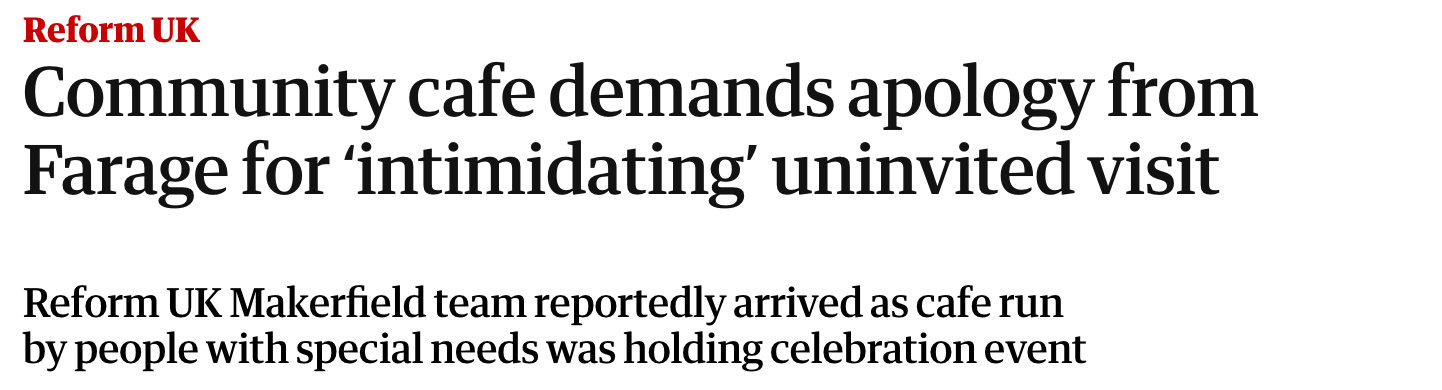
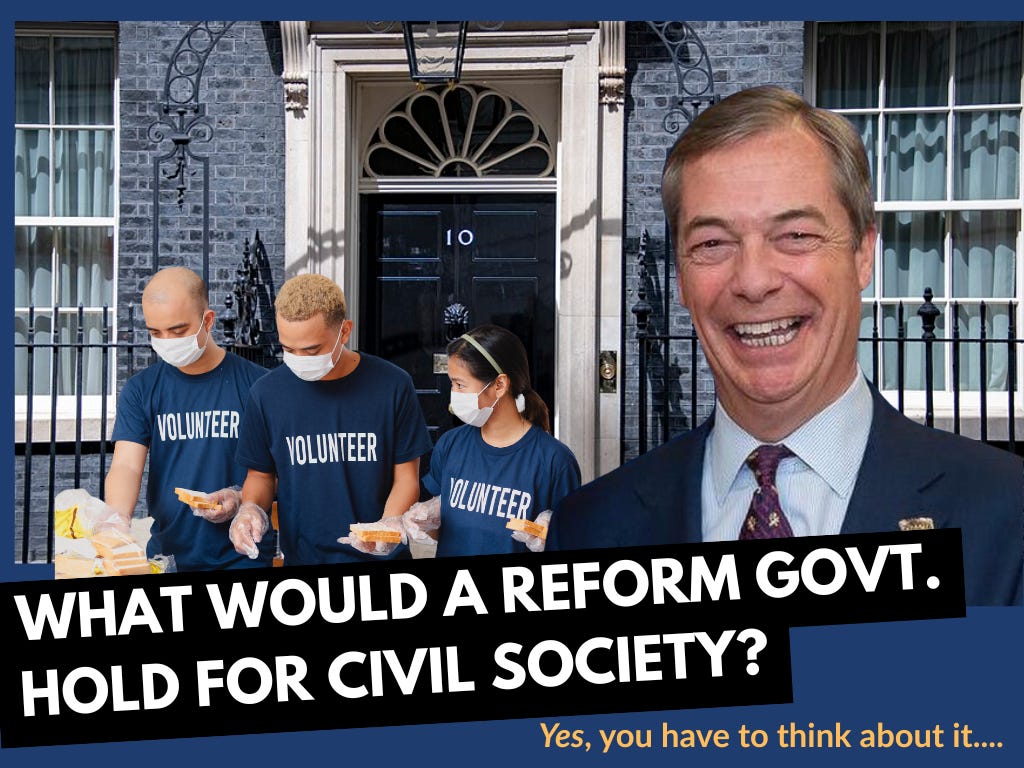
Yet more evidence of Reform being shitty humans recently, as an electioneering mob with cameras in tow turned up uninvited to a celebration event for special needs kids in Manchester - largely, it would appear, to wrong-foot their political opponent.
I’ve spoken many times about civil society being a battleground for politics and ideology. This is why it is being targeted by right wing groups over things like trans rights and ‘DEI’ initiatives. But here it became rather thrown into relief by what I suspect was indeed a very intentionally intimidating visit. Honestly: this sounds like a mafia boss suddenly appearing at a place where he feels he hasn’t been invited, to make it clear he can turn up if he wants to. The fact this was such blatant electioneering is almost beside the point.
They, of course, had to accept the visit, and smile and chat at a table when the mob appeared. After the event, the charity rightly complained. Farage and Reform were surprised after they had had such a lovely conversation. This is like the school bully who claims you only had to say that it was your lunch money, and they are frankly hurt that you would treat them this way.
I’m pleased and proud to see that they have stood up for themselves, but there should be no uncertainty that any resistance will feel the repercussions from a corrupt and vengeful right wing government, local or national.
You may also have seen Reform now actively attacking Hope Not Hate over their charitable status and relationship with campaigning.

No denying this is a tricky one. But you can see again what is happening: just as has happened in the US, and indeed, previously happened in places like Hungary, and indeed under the Tories, civil society has become a battleground for the Far-Right who recognise its moral and political power - and its tendency to side against the very people who fund it.
Let’s be very clear: scores will be settled financially as well as socially by Reform when they come to power, as indeed we are already seeing as they strike Pride from local councils.
And so it raises questions about where nonprofits will put ourselves when the likely Reform Government appears. As Owen Jones (and others) point out, the British constitution (oops, we don’t really have one) will be even easier to dismantle than that of the US, which has been effectively upended by MAGA within less than 2 years.

My worry is that when the time comes, people will be asking - especially trustees and CEOs - ‘how would standing up to this, or refusing to collaborate with any future Reform government, affect our funding?’
I know, I know: they will quickly add ‘because our duty is to look after our service users’.
But ask yourself about other moments in history where that might also have been the primary question for civil society.
As we exclude trans people, roll back on DEI protections, how far will we go to meet the needs of the latest political reframing - given we seem to be so very good at changing with the political headwinds when there’s money in it.
History shows that charities and caring civil society are relatively happy to drop support for some people using the logic that it allows them to still keep supporting ‘most’ of their clients.
The thing is, you can describe your charity as non-political. But what you consider non-political can become political very quickly. What is happening is precisely the repoliticisation of issues, rights and people that were in recent years considered beyond the political. That is what these people are trying to change.
And if you want to know what a Reform government’s relationship to charities who support those beyond the pale, well, you don’t have to look very far. Because one of their MPs is a former Tory Home Secretary, who pretty much wrote the book on attacking civil society, Citizen’s Advice Bureau burnings and all. Mob violence is very clearly part of their arsenal - as indeed it was for MAGA, and is for all proto-fascist uprisings.

Civil society as a whole is always oppressed and silenced by the far-right, by legal means, by threatening mobs, and by the baying hounds of ‘public opinion’. Meanwhile, caring charities will have to decide whether they will care for the people cast aside (or worse) by the new regime. And recognise that there may be consequences for them if they choose to do so.
You have been warned. And the choice is yours.


Habeas Corpus? Not for the likes of you

Meanwhile, another doozy from the Supreme Court on the rights of a vulnerable minority. Since 2014, people who do not have the mental capacity to consent to their care and living arrangements are considered de facto ‘deprived of their liberty’. This does not mean that is necessarily unjust, it means that there must be constant safeguards to ensure that this is just and in their interests. Extra-judicial imprisonment is a no-no for anyone, and this is in theory the basis of democracy and the rule of law. That means there must be ongoing checks on people’s welfare and tests must be met to ensure their circumstances and conditions are suitable, and that it remains necessary. These statutory checks have been undertaken by an independent assessor.
Now the Supreme Court has struck this down, meaning that there is no longer a statutory requirement to revisit this regularly or perform checks. It is highly likely that there will be few if any checks, and no way for people to challenge their circumstances as a matter of course. This is likely to lead to more cases of unjust long term incarceration in poor conditions. Once your lack of capacity has been decided, essentially, your carers can lock you up and throw away the key.
This is pretty startling stuff. According to National Autistic Society at Austism.org.uk:
“The Court implies that individuals with profound cognitive disabilities cannot be “deprived” of liberty because their condition limits their ability to experience it—a view that devalues their fundamental rights.
The Court has suggested that in borderline cases, for a deprivation of liberty to exist, a care setting must closely mirror the extreme confinement of a prison cell.
If a vulnerable person appears passive or does not actively protest their arrangements, the law may recognise this as “consent” — even if they are subjected to routine physical restraint or chemical sedation or have never known a life without a high level of restriction.”
This is bad enough as an isolated legal change, but it does start to speak to that wider pattern of removing protections, and decreasing the purview of human rights for some populations. We seem to be moving to a world where rights are no longer fundamental, but constantly shifting, and it becomes ‘reasonable’ to expect them to be reduced if you sit outside the norm. More and more, we are seeing the Supreme Court being used as a way of removing and limiting rights and protections for certain people. That is a dangerous world, and fits with the wider changes in society and culture that we are seeing.
The Most Charitable Nation
Last time we learned who the ‘most charitable person in the UK’ was. It was a bloke with more money than he had any right to have, which was still the case after he had given £1.4bn of it away. Apparently this makes him charitable.
But now we learn who the most generous country in the world is…. Drumroll….
It’s Nigeria! People give an average of 2.8% of their income. This compares to around 0.7% for the UK.
Hmmm, so let’s dig into this a bit.
Nigeria has a VAT rate less than half of the UK’s (7.5%), admittedly a corporate tax rate of up to 30% (ten percent higher than the UK) but also a maximum tax rate of 25% on individual income compared with up to 45% on UK incomes.
Now, the tax burden in the UK is significantly higher, but it has a high-tax, high service approach. UK tax to GDP ratio is 34%. Nigeria’s is 6-10%. They do not have a high-tax, high service approach.
A better comparator, perhaps, is the US, of course. We often talk about a greater culture of giving in the US (it’s a constant lament of fundraisers in the UK), and yet the US average giving rate of around 0.8% of salary’s divergence from the UK’s rate of 0.7% is waffer-thin. Meanwhile, the US has a 25% to 28% GDP tax burden, and they still get bugger-all healthcare or welfare: and one might therefore ask how much of it goes to bombs and subsidies for billionaires or UFC tournaments.
Overall, I suggest you might ask yourself whether you would rather have cancer treatment in the UK, Nigeria or the US, and then ask yourself again about giving rates.
Shop Talk
Reaching geographical communities - that is, local ones
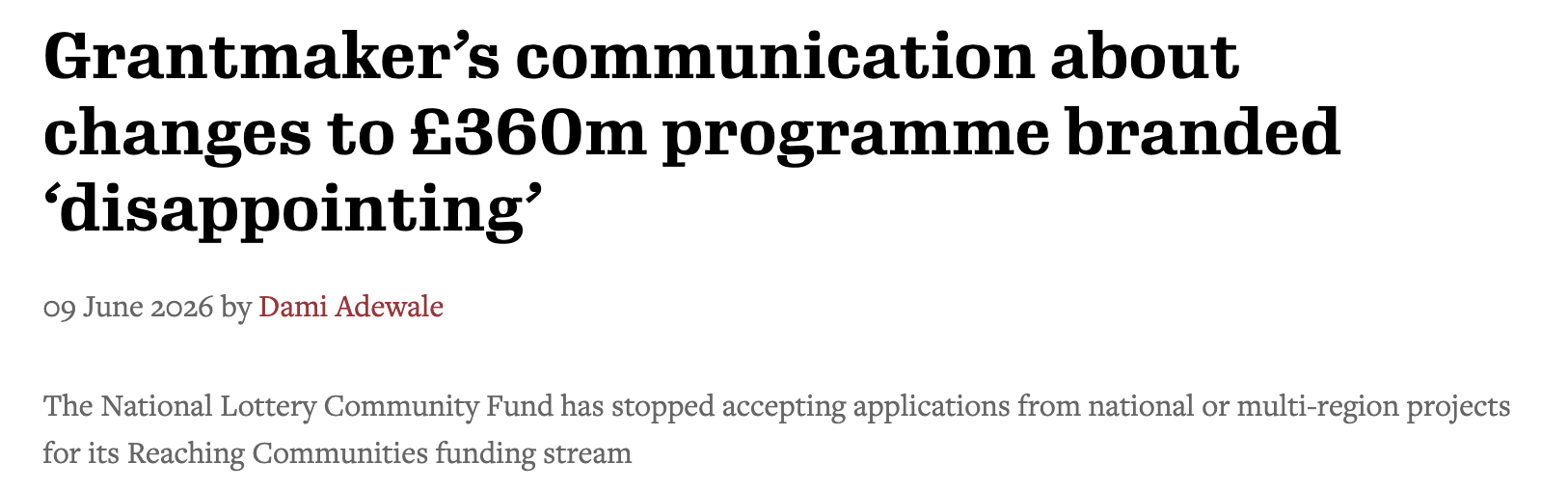
The National Lottery Community Fund has sneakily changed what it offers in its incredibly important ‘Reaching Communities’ fund. I would wager that this funding stream, in its various incarnations, has been one of the most important funding developments in the charity sector over the last 20-30 years. The community and welfare landscape of the UK would look hugely different without it. And I’ve been clear elsewhere that I think the Lottery is a unique national treasure, for all that I have my frustrations (also covered elsewhere). It’s also one of the largest charitable funders in the world.
The change is to move the fund to place-based work only. Organisations who work across multiple regions or nationally will no longer be eligible. Now in some ways, I actually think this is very valuable and important. That place based work can be very hard to fund. And national charities on the larger side have for many years been trying to muscle-in and hoover up from place-based charities who are the real backbone of the sector. That includes many organisations which then secure funds at national level and then expect to waltz into smaller unfunded local organisations and use their existing work to meet their obligations. This makes me very very angry.

And yet there is one thing that really worries me. Communities are not only communities of place. They are also communities of identity and interest.
LGBT communities are a key case in point. Those communities have to develop over distances - unless you live in a city, you’re unlikely to find enough of a community geographically-based to create something. That is also likely to be the case for other cultural or ethnic, or identity groupings. Many of those communities have to exist online, or indeed, to travel distances to be together. So how does this work?
My suggestion would be to add the caveat that they will make exceptions in the case of specific dispersed communities of identity who may otherwise find it difficult to access funding.
Now apply the game theory: yes, I know people will come up with all sorts of ways to ‘get around’ the rubric, but they do that anyway. I can guarantee people are already rewriting their bids to only work in one of their areas, and not all 40.
But it is very important as our societies and governments develop in this direction of active persecution of minority communities that we recognise the importance of communities of identity and interest and the fact that they may be geographically dispersed. Not least, resistance against these powerful forces is going to be all the more important, and all the more about connecting across geographical boundaries.
Again, I come back to my own strong concern that LGBT+ charities/ people in particular are about to be in very serous trouble. And we have no infrastructure to deal with what is about to happen to us.
Meanwhile, as Joanna Jeffery said, it’s no good doing this stuff on the quiet and waiting for people to find out about it. (On the other hand, if they’d warned people, they would have had 800,000 new applications for national work in the space of a month. And then what?)
As Jo put it:
“As far as I can tell there was no advanced warning nor phased communication plan with timely deadlines to help organisations manage this change.
“Organisations already in the process of drafting applications will have lost opportunities to make their case for funding, not to mention the significant amount of time and resources wasted while navigating an already challenging funding landscape.”
Then, under her breath, she swore like a sailor.
I’m kidding!
Or am I….
Legacies
There was a (not very) fun article about legacies this week, and it did get me remembering when I worked in a community centre and decided to put a very nicely designed poster about legacies on the back of the door in all the toilets. ‘There you go: think about your mortality for a few minutes, and I’ll see you when you get out with a pen and a piece of paper.’
It didn’t work, just in case you were wondering; but people were noticeably quieter after using the facilities.
I am allowed in the house!
I’ve been invited to take part in the final closing plenary of the Third Sector Conference happening in a couple of weeks. This was a big surprise, and I am wondering if they have mixed me up with someone else, or it’s a trap and the ACF is going to whack me on stage.
But anyway, we’re talking about how we can transfer power closer to communities as well as new leadership models. It’ll be really interesting, and I might slip in a radical theorist or two and see how confused people look.
For me, this work isn’t like it is for people promoting their services with expertise - it’s more like activism. It’s highly tangential to my day job, even if it is informed by it.
But that also means I can’t really pay to play, which is why invitations like this are so valuable to this project. A philanthropy magazine I wrote for wanted me to pay £500 to remove a paywall to make my article available to a wider audience, probably assuming that this will be good marketing for me or my ‘organisation’.
Yeah, all those philanthropists queuing up to work with the person who said they were part of the same system as Epstein.
At the end of the day, I’m driven only by demons. And pure spite.
Meanwhile, I so hate calling myself a consultant. I just can’t get over it. The other people look great too! Co-CEOs indeed.
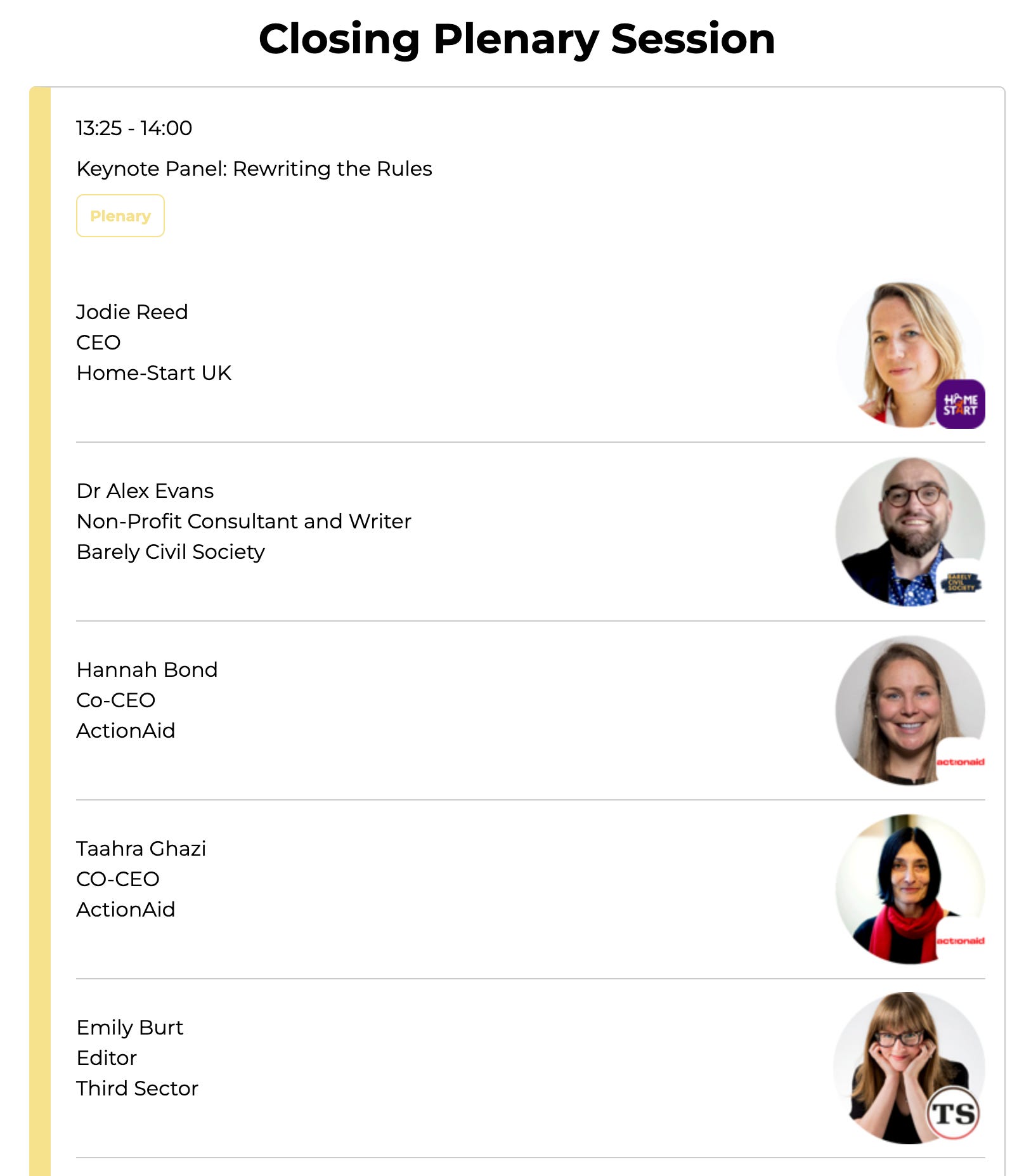
Huge thanks to Third Sector and Emily for inviting me. I really am looking forward to it.
The funny personal bit
This week I went to see Masters of the Universe at the IMAX. In no universe, not even Eternia, can I claim it was good, but it was tremendous fun. At one point, Nicholas Galatzine’s clothes flew off in a bolt of lightning, and my partner violently grasped my knee in surprise and whispered ‘Oh my god, I think I’ve just gone through puberty again.’
I also greatly appreciated the cowardly green tiger, Cringer, which has long been the nickname of my equally cowardly tabby, Trevor.f

Adorable also to see who was there. Fortunately, a late showing, so no dreadful children to ruin it for the intended audience. Alongside many Gen X men who looked like they lived in their mother’s basement (yes, like me), there were a few fun exceptions. One was a tall, porcelain skinned red-headed young man with a Zara cardigan, who looked like he had got lost on the way to the Barbican, or possibly fallen out of an Ikea catalogue. I was convinced he was in the wrong place until I saw him having his photograph taken in front of the He-Man standee, with a huge grin and a box of popcorn the size of his head. His perfect girlfriend, who looked the spit of Coco Chanel, was amused but patient. Awww. That relationship will last.
On Reddit, somebody asked ‘Explain to me like I’m five what Masters of the Universe is about.’ This was pretty excellent:

On Saturday, I sat and read from Ernst Bloch’s Principles of Hope, fell asleep in the cafe because it’s very very long and Germanic, and then got asked if I was okay. Yes, I thought, I’m just old, dear, you’re lucky I didn’t just die here on the sofa with my oat milk cortado. But then I wandered off for a cocktail and to see He Man. See, I’m a philosopher and a man of the people. (Ignore the cocktail.)
In other news, a foreign interloper local cat tried to do a home invasion through the catflap at 3am this week. Given how the local high street is going, I think we’re lucky it was just a cat.
Well, I think that’s about it. See you in three weeks or so.

Internet picks
And finally…
Barely Civil Society is about making the nonprofit world braver.
Here are three ways to help.
1. Subscribe! And become a patron!
Barely Civil Society needs patrons to stay active. All the content is free, but if you’re able to support this work, it means a lot if you can buy a paid subscription.
Barely Civil Society is a reader-supported publication. To receive new posts and support my work, consider becoming a free or paid subscriber.
2. Share Barely Civil Society: Lord knows the algorithms are not in our favour.
3. Buy me a periodical!
There are practical reasons to chuck me a fiver: I’m saving up for journals and periodicals/ libraries access so I can keep better track of what is happening in the sector. That improves the blog you get to read, a blog writing the kind of stuff nobody else does, completely in my own time and at my own cost. Can you chip in and buy me a periodical? Or a Jammie Dodger?