


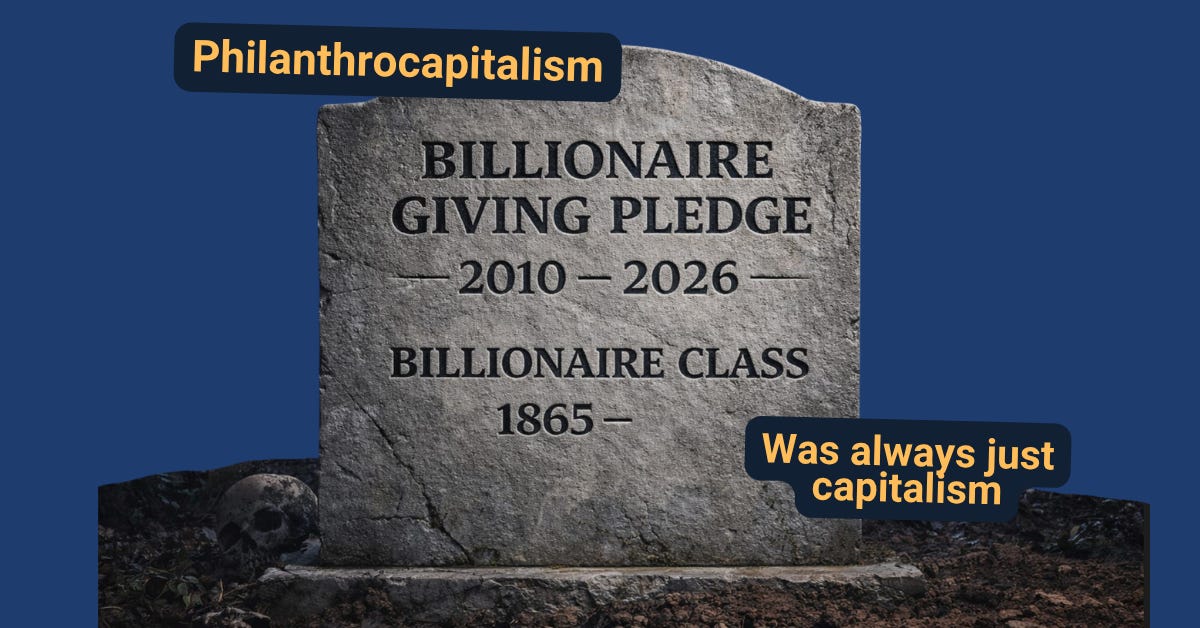
Welcome to this week's Barely Civil Society, where we talk about society, politics and non-profits. After a longer piece kicked off by the NYT article on the Giving Pledge, we move on to the usual quick fire news and nonsense from UK philanthropy and charity. But we’re starting in the US - where the power and the money is.
Pledge? What pledge?
The New York Times [paywall] recently published a remarkable piece on the collapse of the Giving Pledge - the commitment set up by Warren Buffett and Bill and Melinda Gates for billionaires to give away most of their wealth before death. Not only are people failing to sign, they are unsigning. This week, I’m looking at the article’s import, and looking deeper into the structures of thinking it reveals.
Despite Buffett’s claims to the contrary, the shifting sands are real, and they offer an insight into how people of a certain class are thinking. What I want to argue is that the collapse of the Giving Pledge is a window into the moral logic of the oligarchic class at the precise moment that logic is most nakedly exposed. It shows a developing structure of thought, and of power, in our society and economy. It has changed a good deal in 15 years, and more so since the second coming of their enabler-in-chief, Trump who in many ways espouses the same values – albeit without the same pretence of intellectual justification.
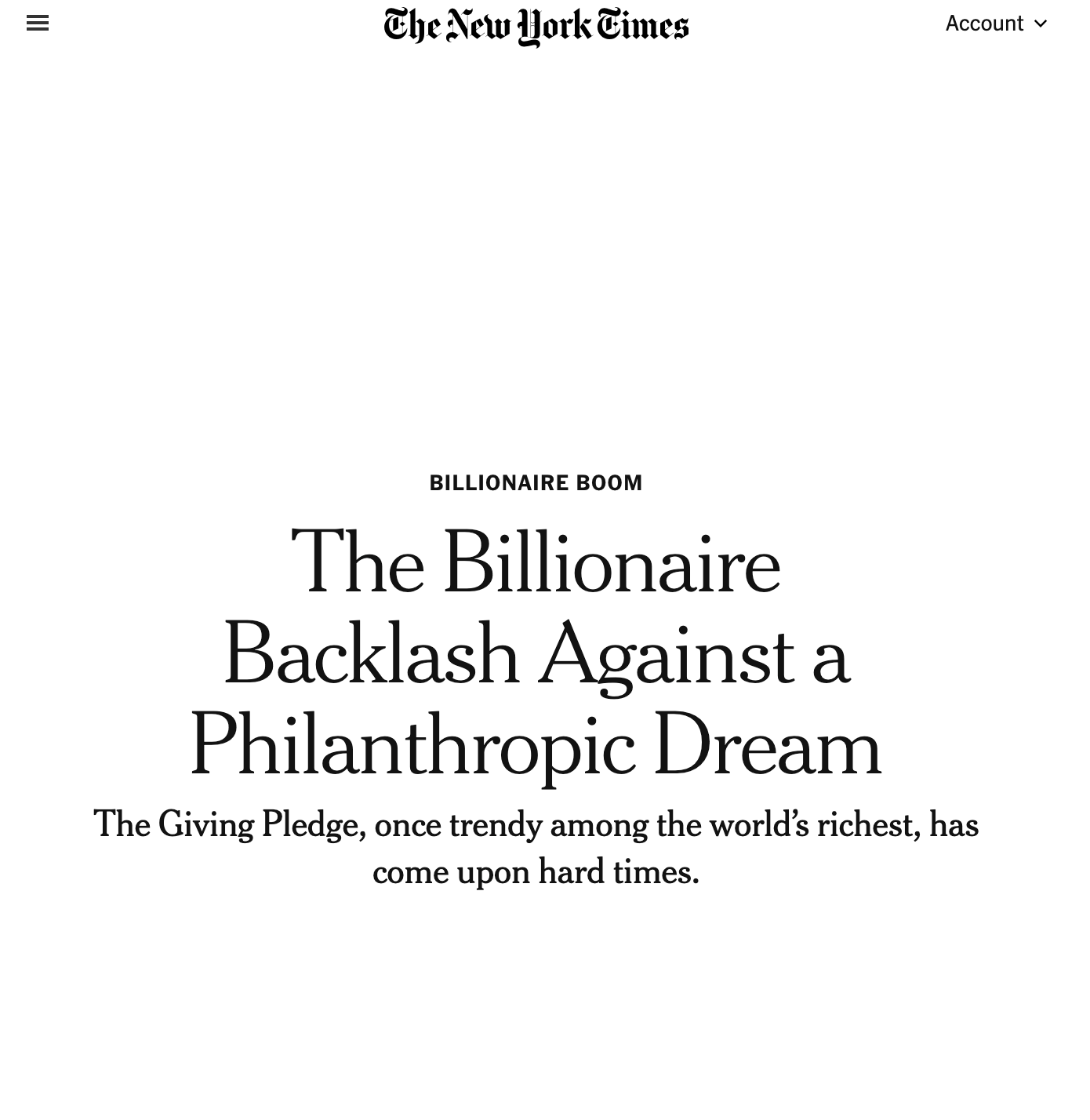
“The Pledge,” Theodore Shleifer reported, “became a way for the uber-wealthy to announce they’d arrived.” After all, what could be richer than someone who could afford to give all their money away?
A succession of billionaires signed. As the Times has it:
“People like Mr. Gates epitomized a humanitarian culture that espoused both big capitalism and big philanthropy. Being seen as a good billionaire who gave back was important. Republicans and Democrats alike embraced the Gates Foundation’s priorities - U.S. education, global health and gender equality. Now, it’s stylish, in a Silicon Valley contrarian sort of way, to bash the Giving Pledge.”
Where did it come from? Lest you think it merely the cynicism of socialist philanthropy critics like myself to suggest there was an element of self-interest in this, even Scott Bessent (Trump’s hardly left-wing Treasury Secretary) put the Giving Pledge down to “panic among the billionaire class” during the financial crisis.
As the Giving Pledge has evaporated, we need to ask what has led to this. It shows us how much the structure of thinking in the US, and by extension the world of the ultra-wealthy, has changed in that time. My sense is that, fifteen years later, billionaires are more confident than they have ever felt. Just as Trump has recognised that his global hegemony is total, and that the rule of law holds only as much as anyone upholds it, so the billionaires have realised that they can simply release themselves from social responsibility. Philanthropy is only necessary when they feel under threat. And they don’t. I imagine them suddenly noticing that the door of their gilded cage was open all along.
Might is right: a repudiation of empathy - and the ‘woke’
And while some have decided not to sign, and others have ‘unsigned’, Peter Thiel has gone further still - actively persuading people to unsign the Pledge, wanting that money redirected to his for-profit businesses. This is, let us not forget, Mr Sovereign Individual/ kindness is the antichrist himself.1
As the Times reported: “I’ve strongly discouraged people from signing it, and then I have gently encouraged them to unsign it,” Mr. Thiel said. His own charitable philosophy is centered around for-profit businesses; his foundation principally funds those who drop out of college to create start-ups.”
His concern is that money will be used to support left-wing causes chosen by Bill Gates.
Meanwhile, Marc Andreessen, the tech right’s leading ‘intellectual’, has spoken against “introspection,” much as Elon Musk has railed against empathy. This is a macho, bullying, quasi-fascistic approach where ‘might is right’, and, as Thucydides put it, recently quoted by Mark Carney in discussions of international politics and economics, ‘the strong do what they can while the weak suffer what they must.’
For many on the US right, power without mercy has become a badge of honour - it is Trumpism, fascism and hypercapitalism all at once.
And for tech billionaires, it simply does not compute to support anything that goes against their belief in the total domination of the weak by the strong. “Woke” is empathy. How could acting for the good of others be accepted by those who have made a philosophy out of denying the value of empathy?
And beneath the arguments piling up against the idea of helping the ‘weak’, can we not see an implication of something almost eugenic? The suggestion that helping the weak does not actually “help” after all?
Thiel is a devotee of the cultish accelerationist movement, with the Sovereign Individual - written by Jacob Rees-Mogg’s father - as its lodestar. Made even more aggressive by his bizarre beliefs in mystical soi-disant Christian eschatology and the role of the Antichrist, the idea is simple and chilling: that a coming crisis will allow the wealthy, strong, and powerful to take full control of the planet, with the remainder of humanity serving as cheap labour. In that framework, solving crises and helping others may delay the reckoning. That is not good for them, or for the other oligarchs who expect to survive and rise from the ashes.
As the NYT article shows, for many of those figures, the belief is that “woke” leftism has taken over nonprofits. Well, of course it has. Wanting to share resources and help people does tend to be more of a left-wing impulse. Wanting to do it for people who might not look or act like you is, of course, “woke.”
(This reminds me of someone who complained that Substack was full of left-wingers, only to be told that this was inevitable - since, by nature, it tends to favour the literate.)
Those who see Nietzche in here are probably right – he’s always been popular with autocrats, oligarchs and crypto-fascists. But my sense is it has a much lesser intellectual pedigree – probably closer to Ragnar Redbeard and the ur-text of social Darwinisim, Might is Right.
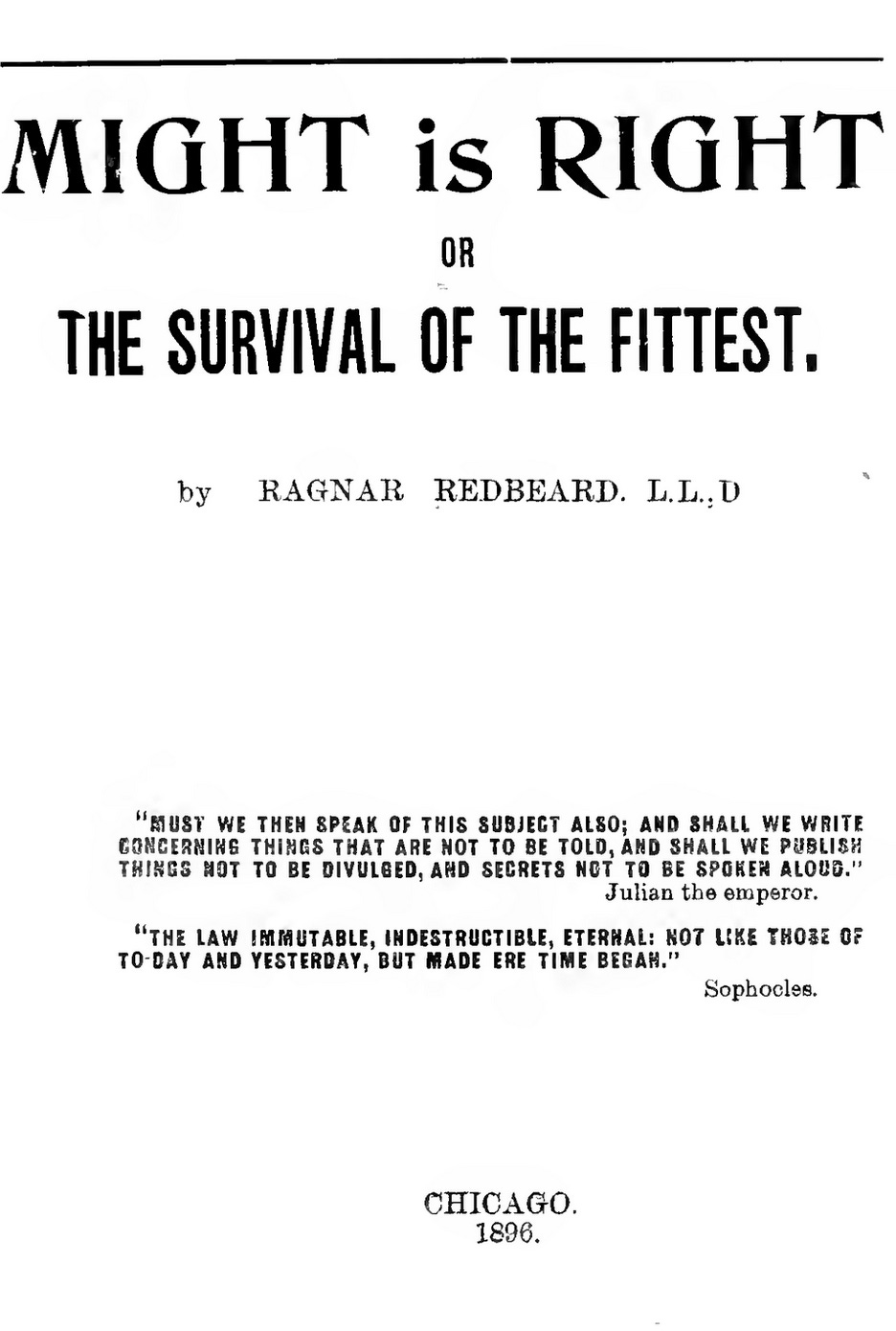
Leo Tolstoy described, with horror, this idea:
‘Right is not the offspring of doctrine, but of power. All laws, commandments, or doctrines as to not doing to another what you do not wish done to you, have no inherent authority whatever, but receive it only from the club, the gallows, and the sword. A man truly free is under no obligation to obey any injunction, human or divine. Obedience is the sign of the degenerate. Disobedience is the stamp of the hero. Men should not be bound by moral rules invented by their foes. The whole world is a slippery battlefield. Ideal justice demands that the vanquished should be exploited, emasculated, and scorned. The free and brave may seize the world. And, therefore, there should be eternal war for life, for land, for love, for women, for power, and for gold. (Something similar was said a few years ago by the celebrated and refined academician, Vogüé.) The earth and its treasures is “booty for the bold.”’
Philanthropy as a now-unnecessary moral legitimacy
The key function of philanthropy, as I have discussed previously, is to launder reputations - or at least to provide a patina of moral legitimacy. As Andreessen puts it, it “reclassifies you from a sort of suspect business mogul to a virtuous philanthropist.” Let us be clear: when those of us who are critics of philanthropy have been saying this is how it functions, we have not been going on hunch alone. These people are very open about it. The fact that they feel more than ever able to say so is itself evidence of their sense of absolute power.
Philanthropists have come to realise that their giving is, as Schleifer describes it, “little more than public relations.” The deal was this: people would be grateful for your wealth, and question less where it came from and how you acquired it. But the deal broke down. People started asking why anyone had enough money to give half of it away. Whether this was the best way of doing things. Even worse, they started asking whether philanthropy was the best route to greater equity - and recognising, plainly, that it was not. (As I’ve noted here before, fundraisers and charity are dangerous - they show where the faultlines are. There is always a danger that people will start to ask difficult questions if they follow the logic - and the money.) Where billionaires were once targeted with lavish praise, that is (in some rarified spheres) no longer the case. And at that point the deal collapses: it is only of value to give if others lavish you with praise and acknowledge your moral as well as financial superiority. And a polite silence.
Philanthropy buys something. These people do not give things away for nothing. It is, as someone once said, the art of the deal.
Philanthropy as intellectual power
As I mentioned last time, Anthropic CEO Dario Amodei recently lamented the end of philanthropy in this class, true to his emerging role as the bleeding heart (comparatively) of AI oligarchy. He is the brother-in-law of one of the leading lights of effective altruism. Effective altruism, as I have argued elsewhere, is an outgrowth of the idea that the tech billionaire is not merely wealthy but an intellectual giant - a further intellectualisation of the Carnegie-era notion that the person who extracted the wealth knows best how to spend it for the benefit of those they extracted it from. Participating in philanthropy, in this framing, demonstrates that you are an intellectual as well as a financial genius. But even this is no longer sufficiently attractive. And believe me, when I am suggesting EA is at least a more morally defensible better position than the current one, you know something is wrong.
Even EA cannot hold their attention now. They got bored when they realised that dropping pocket change to solve problems they had created could not fix the world they themselves had ravaged.
When their intellectual gigantism was punctured, philanthropy lost its interest for them. Because one of the things they most wanted to prove was that the problem of inequality was not a moral one but a failure of intellect - that by solving the intellectual problem, they could fix everything, and demonstrate in the process that their greed was not the issue. They wanted to show that a mechanical, capitalist-instrumentalist approach could “solve problems.” There is surely an element of boredom in the collapse of the Pledge - and a growing, deeply unwelcome realisation that philanthropy cannot solve the problems. That is a dangerous thought they do not wish to countenance. Because if it cannot - what are the alternatives?
Philanthropy as capitalism, and capitalism as philanthropy
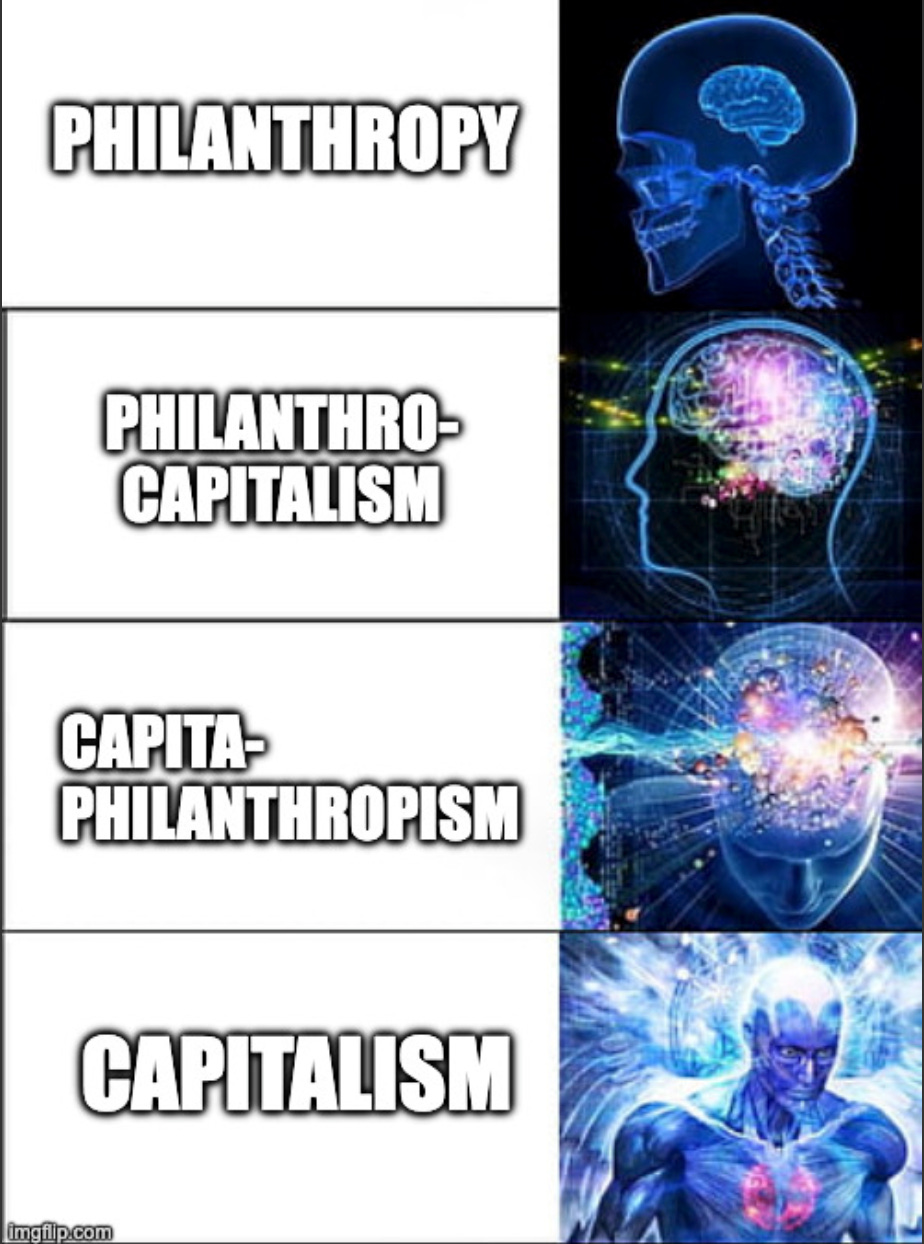
And so they are all doubling down on capitalism as the solution. What has really changed is not a loss of faith in charity. It is a renewed and total faith in capitalism - well, it has worked for them. In the end, it was only a hop, skip and a jump to realise that philanthrocapitalism was just more capitalism. And if so, why did you even need the philanthropy? If giving can mirror the market, why not cut out the middleman: capitalism itself is philanthropy. How very convenient.
What the Trump and oligarch era has brought us to is a belief that there is no morality beyond Aleister Crowley’s dictum: “Do what thou wilt shall be the whole of the law.”
What they have finally realised is that there is no longer any need to hide what they have long suspected and believed: power is its own morality. The masks are coming off. Their power is now so absolute that they have understood, as Trump has in the field of world politics, that with absolute power comes absolutely no responsibility and and no accountability. Where might is right, money, and desire, are the only real morality.
What now?
What all of this tells us is that billionaire philanthropy is a direct reflection of the structures of thought of the American oligarchic elite. We are living through a field day for narcissistic power with nothing but its own naïve self-justifications as its moral compass.
And so what? Well, I’m pleased to see a few people in the philanthropy sphere reacting – more so than they did over the Epstein revelations, at least. And yet, the danger is that we find ourselves, in response, arguing for more philanthropy - pleading with these people to return to their giving. But this collapse cannot be solved by persuading billionaires to change their minds.
We need no more billionaires.
We need tax, of wealth as well as income. That likely includes a one fell-swoop windfall tax, as well as, later, on an ongoing redistributive basis.
And we need an end to voluntarism on this scale. Once we have that, philanthropy becomes a pleasant pastime for the community. Not a matter of survival for many and justification for extraction by a few.
We also need to look at how we return wealth to communities we have taken it from. Ongoing taxation cannot solve this problem at root – and nor indeed can welfare or piecemeal programmes of reform and redistribution alone.
And if any remain of that class who are serious about real change and redistribution, every part of their effort should go into arguing for the permanent end of obscene wealth and its destabilising plunder of the planet and its people.
Meanwhile - yes, give the money. Give it all. And give it now.
More comments
Paul Klein made an excellent series of Linkedin posts looking at this, with thoughtful comments from a range of smart people. (I say that because they agree with me, that’s how you know they’re smart.)
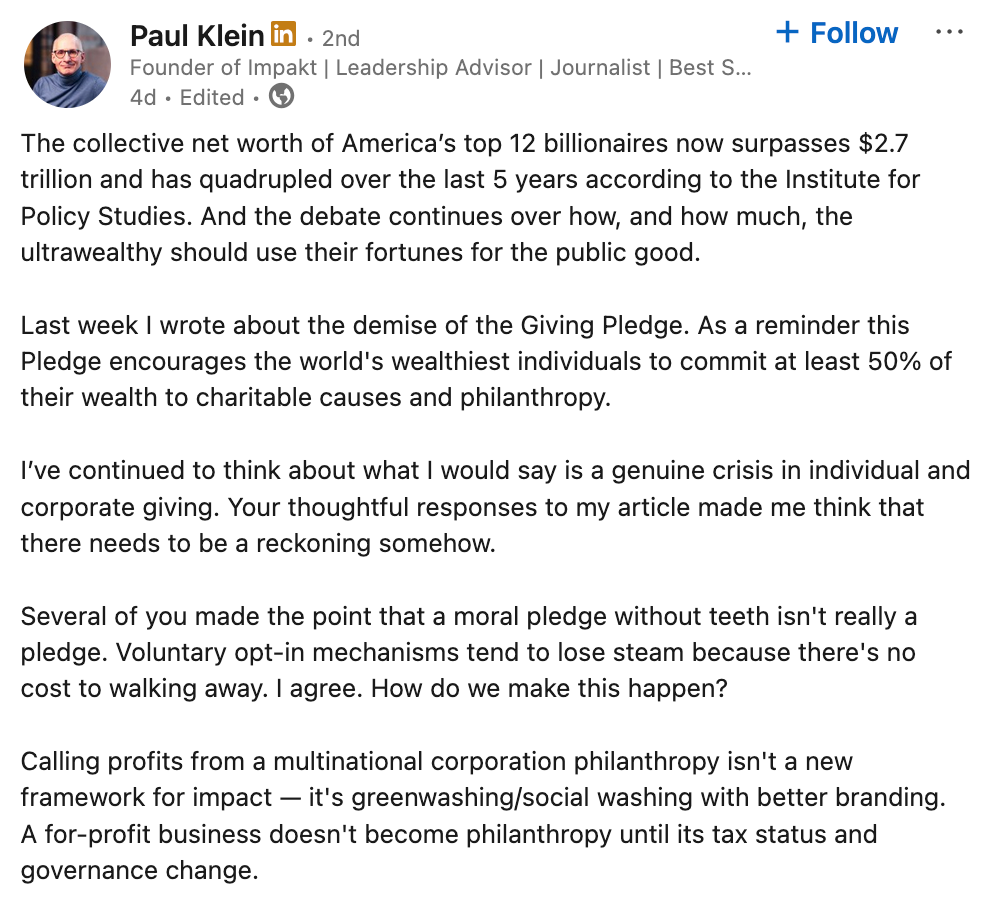
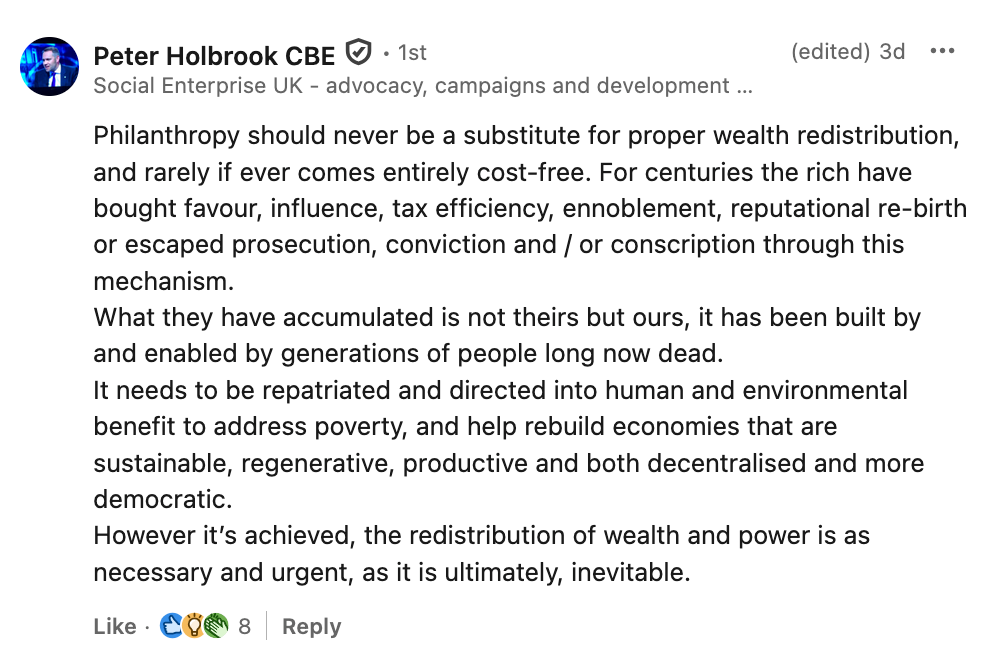

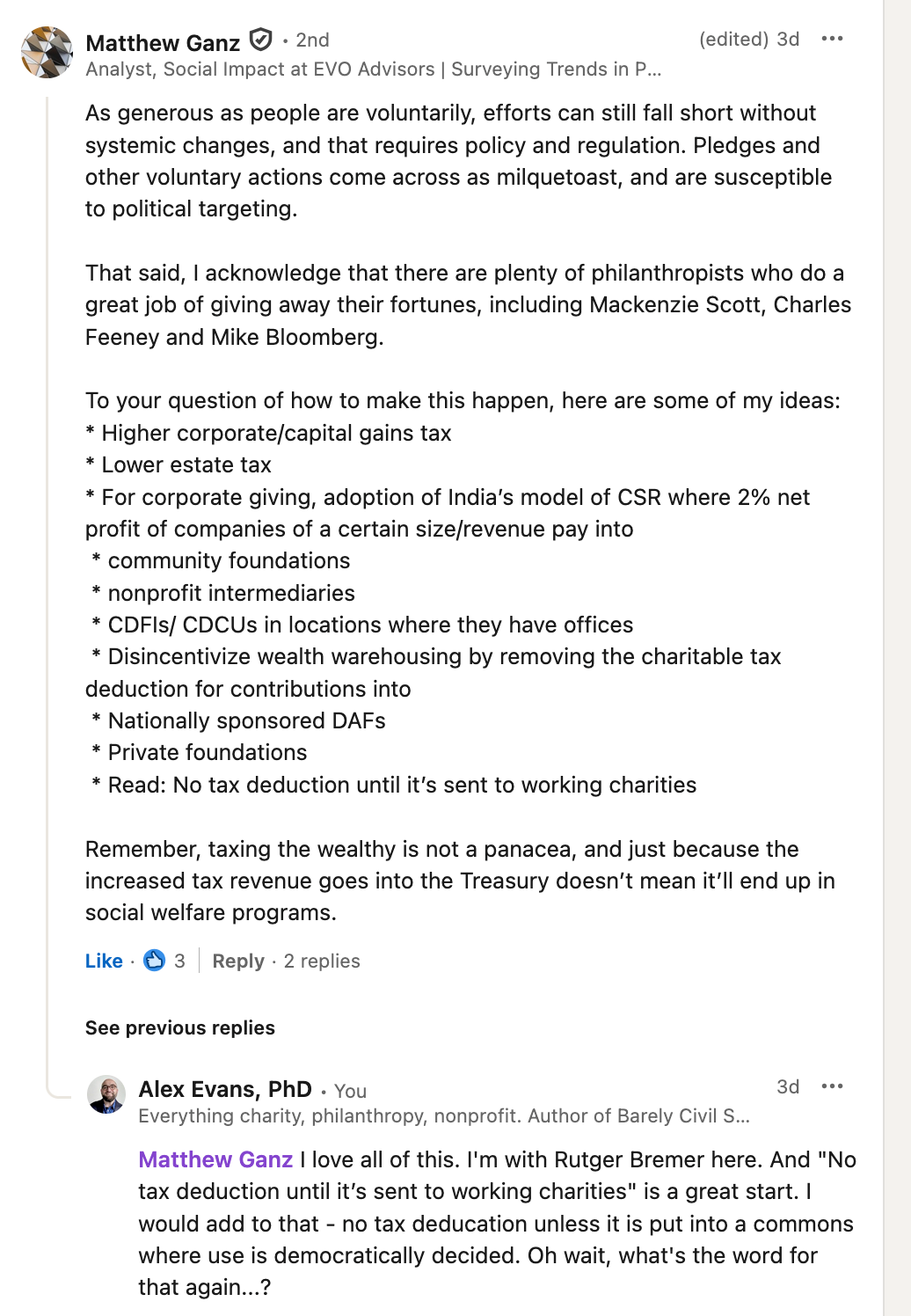
Overall, I think what I keep coming back to is that I am not necessarily a ‘philanthropy abolitionist’. I am a ‘philanthropist abolitionist.’
That may be a slightly different thing.
In UK Charity news
The Charities Aid Foundation published a report last week showing that Uk individual charity donations are down by ten percent. We’ve had a lot of worrying about that, and questions as to whether people are becoming ‘less kind’, while I’m just wondering what it takes for people to notice that nobody has any money. Or to ask exactly why we think a wide range of basic care initiatives should be reliant on voluntaristic contributions, especially with UK taxes at their highest level since the second world and services on their knees. I also think it’s very hard to explain to most people that they should have an ‘embedded’ culture of giving, as one commentator put it, when billionaires don’t want to ‘give’.
As ever, the charity sector’s ability to cast aside any questions of political economy and focus on protecting its own industrial concerns is pretty embarrassing. Let’s just talk about donor journeys everyone!
Following on from that, BBC Comic Relief/ ‘Red Nose Day’ has seen its income fall again by £4m. (American visitors, I am so so sorry to tell you about this weird British hangover of the eighties telethon - you have enough to worry about culturally without bering subjected to this). I think the above issues with giving go double for that, but also - who watches this stuff? I would literally pay money not to. This is only on-the-night takings, so perhaps others will contribute later. [Actually someone on Linkedin said they watched it and got very emotional, so I am actually just a horrible person… I don;t really do charity AV.]
In incredibly upsetting news, Girlguiding UK has decided to exclude trans girls from September - giving them a few months to say their goodbyes. This is the latest win for Lawfare against UK charities, about which I have previously written extensively. The monsters of the hate groups have been out in full force to celebrate. I simply cannot understand why people would go out of their way to do this - except, of course, that this whole campaign is funded to the hilt by extremist Christiano-fascist Project 25 groups in the US, not to mention a certain children’s book author. If you care about this, please join Kevin Taylor McKnight’s Third Sector Against Transphobia group on Linkedin (search there.) If you don’t care about this, fine, but remember, whoever you are, you are probably on Project 2025’s list eventually.
In more terrible news for LGBTQI+ people, Metro UK, a 40 year old charity for the queer community, is to close down due to lack of funding. It had been on the cards for some time. It will not be the last - Stonewall seems to me to be on very shaky financial footing. For both, anti-trans activism has probably played a part in their decline, if nothing else making public sector organisations feel emboldened to discount the needs of queer people. The shrinkback of public sector funds - and especially the massive cuts to Integrated Care Board budgets - has taken valuable funding away from health work, which was always an area that LGBT work relied on for funds.
This is bad enough now, but the real problem comes later. Campaigning work is not enough alone. Support services are still needed for LGBT+ people. And those have been largely blasted away over the years as the overwhelmingly metropolitan middle class people in commissioning and foundations people naively read queer equity as a battle that has been won. The more of these organisations we let die, the more it will be nigh-on impossible to restart them. With the possibility of a Reform government on the horizon - with Project 2025-style plans for the UK, we cannot afford to wait for a crisis to help.
Foundations, where are you?
Meanwhile, I recommend Erin Reed on trans issues on Substack.
And finally…
Well, those of you who usually come for the witty and ascerbic critique/ dick jokes will be disappointed this week, but I promise to return to comedy soon. I had a good conversation with fellow substacker Jason Lewis this week about all things philanthropy, US culture, and political economy. None of which is to suggest he agrees with me here (or otherwise). Subscribe to his substack, though. Lots of interesting stuff.
Barely Civil Society is about making the nonprofit world braver.
Here are three ways to help.
1. Become a patron and subscribe!
Barely Civil Society needs patrons to stay active. All the content is free, but if you’re able to support this work, it means a lot if you can buy a paid subscription.
2. Share Barely Civil Society: Lord knows the algorithms are not in our favour.
3. Buy me a periodical!
There are practical reasons to chuck me a fiver: I’m saving up for journals and periodicals/ libraries access so I can keep better track of what is happening in the sector. Can you chip in and buy me a periodical?


As an opinion piece in MS Now outlined, “Thiel’s evangelism is another example of how the right has strategically co-opted Christian religious teachings to provide support for their autocratic tendencies, as well as their fears about technology being limited through “woke” beliefs.” https://www.ms.now/opinion/peter-thiel-antichrist-evangelism-christianity-billionaires
Absolutely spot on. Thank you!!