



Hello, my Barely Civil Comrades, and welcome to a new edition of BCS after a taking longer break than usual. I am barely refreshed, because the break in publication had more to do with workload than the week’s holiday I took, which made it all worse.
This week, a kaleidoscopic amuse-bouche of quick-fire news items that tickled my fancy, or triggered my gag reflex, over the last couple of months, offering more on the themes I’ve discussed elsewhere in the blog.
We’ve got Trustees, Think Tanks, Sunday Times Rich List, LGBT horrors, and Mamdani being awesome (so far…), then some boring work stuff like fundraising ROIs and grantmaker stuff.
Anyway, strap in for the latest chamber of horrors in our semi-regular/ occasional BCS Shitshow Update series.
The Trustee Tap on the Shoulder: Help or Hindrance?
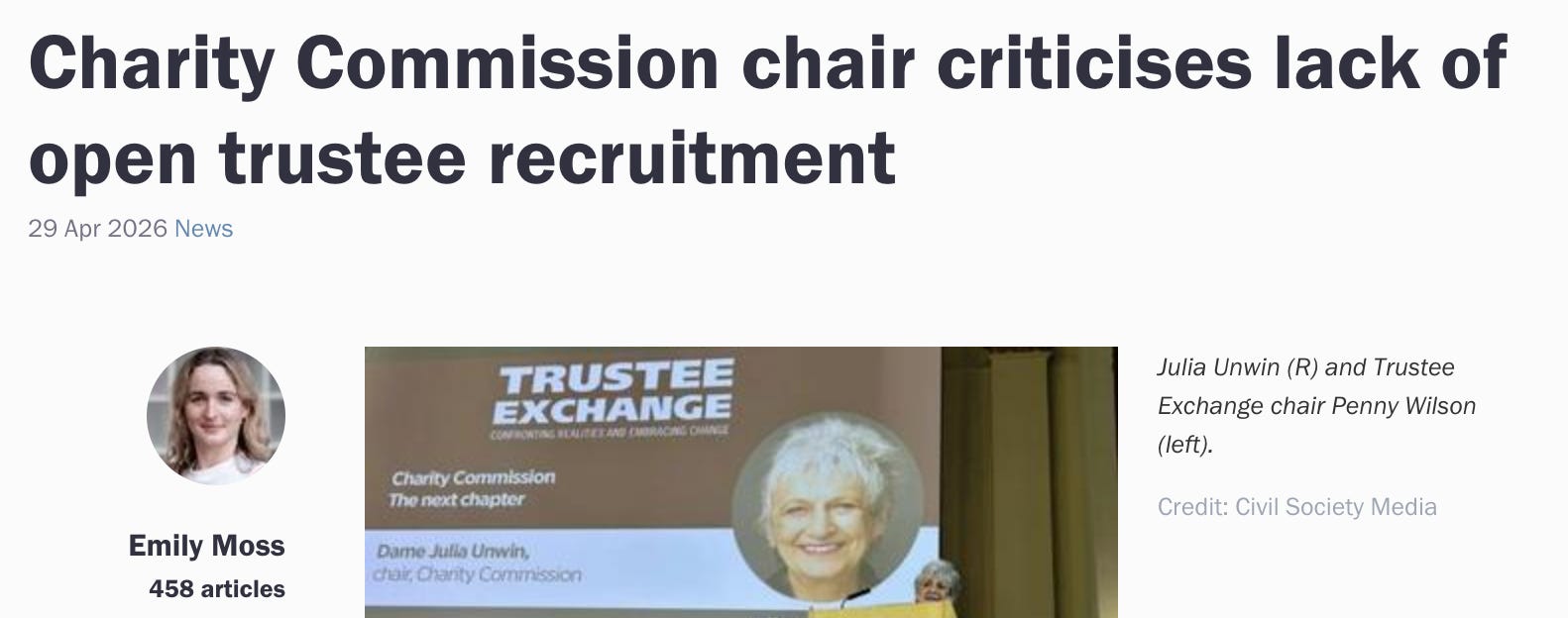
Interesting speech from the new Chair of the Charity Commission, Julia Unwin, with an increasingly repeated refrain about recruitment of charity trustees: that one reason they are not representative or diverse is that they are not ‘openly’ recruited, but rather through contacts. This is in one sense true - the old boy network (which includes plenty of women) is a good way to ensure you always get the same people.
But we also need to beware the bourgeois fantasy of meritocracy that open applications present. We recruit ‘openly’ for people with a high level of professional skill. That’s what we ask for in the job ad, right?
We recruit for people who are good at application forms and interviews. We recruit for people who seem like ‘one of us’. We recruit, let’s be honest, for people’s contacts and access to funding (usually going nowhere) or influence.
If this is how we select, well, yes, open recruitment will still end up with people who are Dames or MBEs, (like the Civil Society Covenant commission committee thingy); we end up with people who are the great and the good, and can connect us to power. Those people may sometimes look a bit different, but they probably will have the same ideas, and often quite similar backgrounds, because whatever happens, we are still looking for the same things: the historical ‘overseers of the poor’ who can be ‘trusted’, and, more than ever, who can offer highly class-coded, as well as class-restricted, professional skills and perspectives.
What this does tend to do is to select for the bourgeois professional middle classes rather than the more traditional aristrocracy and clergy, but that is the whole story of ‘meritocracy’, and the move that Max Weber outlined more than a century ago. That is, towards an administrative culture that claims to remove favouritism for noble birth - but benefits the bourgeois professional classes more than anyone else. In some ways, I’m coming to feel that application forms and interviews can be even more restrictive.
The answer? Probably flexibility. Sometimes a tap on the shoulder might be exactly the right call.
But please don’t tell me that doing ‘selection days’ or ‘aptitude tests’ or longer interview processes and various games, is going to solve the problem. It’s going to be extremely tricky, and much of this stuff needs generations to solve it organically - or radical overhauls of the very idea of trustees.
Splitting the professional skill and governance requirements from the vision and mission requirements seems to me to be a matter of urgency.
But in that, I don’t mean final decisions by professionals who are informed by a steering group of service users. It may indeed look more like a reversal of that. But it’s not simple - because democracy isn’t.
You can read more of my thoughts on trustees - although they have moved on considerably since, and not in a good way - in the article below.

Are Think Tanks ‘Charities’?
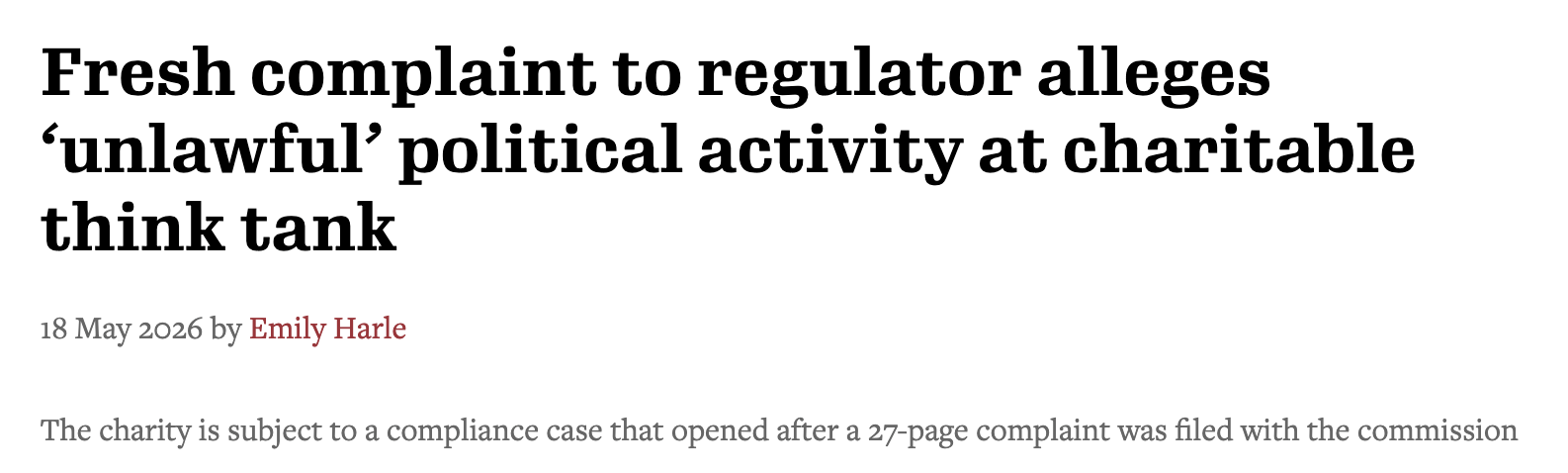
Good Law Project has complained to the Charity Commission about Policy Exchange, the foremost right-wing think tank in the UK about what they allege is continued partisan political activity. This is their second complaint, when a previous investigation is already underway.
Charitable status for think tanks is a classic wheeze, and especially problematic given that some, for example, the neoliberal extremist Institute of Economic affairs (IEA), have actively argued that ‘charities’ should not be considered part of ‘civil society’ - and should not be permitted to push a ‘woke’ agenda or argue for progressive social and economic policy changes in the public sphere.
GLP are particularly concerned about policy papers by Policy Exchange that reference ‘Project 29’ - a nomenclature worryingly, and no doubt not coincidentally, suggesting reference to Project 2025, the devastating right-wing plan that elected Trump and has driven their extreme right wing agenda. Like Project 2025, it looks to centre power in the Government, make sweeping cuts to all social support, remove Net Zero targets, and a ‘stop the boats’ focus. It is clearly designed as a battle plan for Reform in Government. GLP is also concerned at an ‘unhealthy’ preoccupation with trans issues….
Not long before this, GLP were also taking to task the Commission itself, who very quickly threw out a complaint against the IEA - you can see GLP’s case here. They complained in 2024, backed by a cross-party group of senior politicians. The complaint was swiftly thrown out, and Orlando Fraser argued in a blog that think tanks do deserve their charitable status. The Charity Commission’s then-extensive links to the IEA (including said Chair having previously worked for them) were a matter of public record, and you can find more about that in my article below.
Some suggest think tanks and their dark money are a threat to democracy as a whole, as we have seen in the US. The Unlock Democracy Group - the All Party-Parliamentary Group on Fair Elections - has warned how vulnerable to authoritarian overreach our systems and democracy could be if an authoritarian government won power.
Policy Echange are also known for almost zero transparency on their funders - dark ‘charitable’ money, probably from the US, is shaping our democracy - and potentially eroding it. These kinds of issues have been covered extensively elsewhere but this Monbiot piece from a few years ago mentions Policy Exchange extensively - set up by Michael Gove and other Tory cronies in 2002. You can also find out a lot more about the history of think tanks in Owen Jones’ book, The Establishment.


Sunday Times Scumbag List
Meanwhile, this year’s Sunday Times Rich List, which some fundraisers live and die by (how do you do it?? I start retching when I hear the words) has been released this year. Under no circumstances am I going to buy and read it and tell you anything about it. But their coverage was very special this year:
Billionaires are abandoning Britain — this is what it means
One in six people on the Rich List two years ago do not appear in 2026 and a third no longer live on the mainland. Our analyst Robert Watts unpacks the wealth exodus. (Times)
I find it interesting to see in Mamdani’s New York that some suggest there is no evidence of an exodus of billionaires, and indeed, news stories in the UK have otherwise suggested the same, for example this report by Tax Justice Network, Tax Justice UK, and Patriotic Millionaires - despite huge numbers of right wing press stories to the contrary.

But I also just find it astonishing that the Times thinks we should care. Oh no! Those billionaires are so important to our economy, what with all that completely dead money they sit on and assets they amass at the cost of everybody else. Whatever will we do without them?

But don’t forget, it’s hard being a billionaire. Your life is utterly meaningless. So the Times reassures us that someone can help:
I teach children of the super-rich how to discover their purpose
She runs a £120,000-a-year course helping wealthy offspring find their place — just don’t call them nepo babies. (Times)
Seriously, you could not make this stuff up.
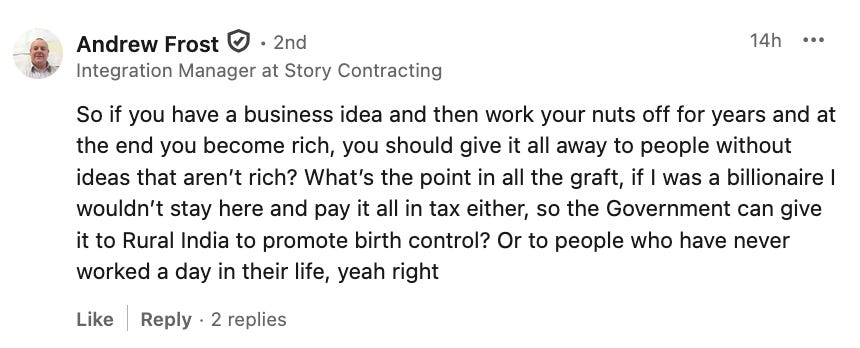
What I will say is that Russell Henley’s Linkedin post pretty much sums up my feelings.

Meanwhile, Andrew did the honours this time of the contractually required ‘ITS MY MONEy!!! U CaNT HAV IT!! I WROK HARDR THaN U!!!!!’ reply this time.
The ‘Most Charitable Person in the UK’
Meanwhile, connectedly, we must send a ‘small gong or an invitation to meet a royal’ (as former Chair of the Charity Commission Orlando Fraser once suggested), to Chris Hohn, hedge fund CEO and now officially ‘the most charitable person in Britain’ according to Civil Society Media…..

They continue:
‘A charity founder has become the first British person to give away more than £1bn in a year, while donations by the UK’s 100 wealthiest have risen to nearly £5bn.
Chris Hohn, founder of the Children’s Investment Fund Foundation (CIFF), reclaimed first place on the Sunday Times Giving List 2026, published today.
He donated around 16.8% (£1.44bn) of his estimated wealth in 2024, and in doing so, became the first British billionaire to give away more than a billion in a year.’
Second only to Mother Teresa and J to the C, Chris will be remembered by all of us for his deep love of fellow humanity. And money.
Meanwhile, the much-vaunted but wafer-thin increase in rich-list giving contrasts perhaps with reports earlier this year that charitable donations from the public in general are down by around 10%. Other alarm bells were sounded by the decline in on-the-night donations to Comic Relief (I would rather punch myself in the face with a sea urchin than watch that, so I suspect lack of charitable inclincation may not be the only factor). Some then lamented the lack of a UK ‘culture of giving’ among the wider public.

But here is something worth noting: Chris Hohn has given a total of around £1.44bn to charity. If ONE billionaires is able to give £1.4bn and it is only 14% of their income alone, what does this tell us?
And the wider public has given £14bn. Meanwhile, other major donors on the rich list have given £5bn overall, out of their combined £772bn.
Those people on the list hold around 25% of the wealth in the UK as a whole. And they ‘donated’ around 0.65% of their wealth.
You can either say this shows that the billionaire is disproportinately ‘charitable’. Or you can ask how this can be possible…
That starts to suggest where that wealth might be coming from in the first place - and why philanthropic donations might never work to sort this problem out.
Because if the rich can afford to give slightly more, and the normals can afford to give slightly less, this is may be because more of the money in the first place is being hoovered up the noses of the wealthy through rolled-up £50 notes. As ever, ‘growth’ is usually just further redistribution to the top.
Unless you’re very new here, you will know I have done quite a lot about billionaires and philanthropy. Here is more:


LGBT Charities are a Special Kind of Shitshow
You may have seen the Pride London debacle a month or so ago, which featured the booting out of a CEO accused of spending £7000 of vouchers for volunteers on fragrance and Apple products (I mean, I’m with you on the second one), and of setting up his own Pride merchandise as a side-hustle. See! That’s the kind of enterprising cuture we don’t appreciate enough in the chartity sector…
Pride was also recently looking for a new Chair. Give that one a good sniff.
This comes after a series of disasters for other Prides, for example in Manchester, and indeed, previous debacles at previous versions of London Pride.
Meanwhile, in Scotland, a substantial LGBT charity’s Chair was revealed to have fabricated a great deal of information in their CV. That charity had significant issues with problematic senior staff in the past which I will not rehearse because they are too awful and I don’t want to further damage a charity who are desperately needed.
In both cases, there are significant questions about governance, getting the right people, and the sheer lack of stability of LGBT organisations and charities. LGBT charities are often highly politically unstable - even speaking as someone who miserably ran an LGBT society decades ago for less than a year, I can tell you that people are often very good at looking at what divides them rather than connects them. At the same time, LGBT charities have long suffered from the precarity of funding situations perhaps more than others - we are unpopular causes, originally because LGBT people were undeserving, latterly because they are considered to be people who have everything and need to shut up.
But my hypothesis is also that the sheer lack of reasonable, realistic, and solid funding for LGBT charities and organisations has often contributed to the most high profile issues and failures. Not directly perhaps - although certainly LGBT older people’s charity Opening Doors was left to twist in the wind. But because you need long term allies and solid ongoing funding to really bed-in governance, professionalism, and attract the right people. This situation looks in some ways similar to the issue of other underrepresented and underserved communities and their funding - they can’t build the solid governance and stability they need, or indeed, a pipeline of solid other funds, because they don’t have tentpole funders willing to support them.
A few trusts may have been long-term friends, but most will not see LGBT organisations as a priority. As LGBT causes become more politicised again (see next story), the likelihood is that this will only worsen. Of course, we have seen the end of other LGBT charities recently, including Metro, one of the largest UK LGBT charities. Stonewall has incredibly low reserves and has had to make huge cuts.
I have a special place in my heart and critical consciousness for LGBT organisations, and this is an area of some expertise from my past academic life. But it is ugly out there, and often, ugly in there You can see more about my take in the article below.

The terrifying impact of anti-LGBT lawfare
You will probably have heard about Girlguiding UK deciding to exclude and remove all trans girls from their services from September. There are many, many other cases where vile legal activists are hounding women’s organisations and demanding they remove trans women from their services, citing the For Women Scotland case and the decision on the High Court which does NOT decide on the definition of women, but does make life incredibly complex and difficult for everyone. The UK EHRC made life even harder by issuing crackpot rushed advice - which apparently is about to be updated, but sadly, because of the highly politicised nature of the Board, is likely to reaffirm their decision to exclude trans people. [Edit: I hear it may even be today, as I write.] This is especially an issue for charities who have single-sex objects - nasty, dark-money funded organisations are taking them to court, claiming that they are now legally obliged to exclude trans women. They claim ‘the law is clear’, which it isn’t, but their single-minded viciousness is.
The harrassment goes further, including activists and gutter press forcing the stepping down of the trans woman chair of Endemetriosis South Coast, the brilliant Steph Richards. Those who argued that no trans woman could ever understand the pain of this condition did not seem to have the same feelings about the female CEO of Prostate Cancer UK.
Meanwhile, incredibly upsetting news here about the withdrawal now of supportive public services as participants in Birmingham Pride.
Police and ambulance service pull out of Birmingham Pride parade after ‘legal advice’
“In a statement issued today (Tuesday 19 May), West Midlands Ambulance service announced that it is pulling out of the Birmingham Pride event.
It said that, alongside police and fire, the ambulance service has withdrawn from the Birmingham Pride parade after “legal advice”.
It comes after Northumbria Police was subject to a Judicial Review heard in 2025 for allowing uniformed members of staff to attend Newcastle Pride in 2024.”
(Not stopping delivering services there, let’s be clear - marching as people who care, and to show solidarity and diversity of their workforce. This is standard for LGBT supportive countries across the world). They have received the dreaded ‘legal advice’ (which is always ‘if you want to avoid any kind of legal risk however small, just don’t do anything’).
It’s an upsetting and rather terrifying prospect for those of us who find our very existence now rendered a political matter. Again. Let’s not forget that for many years, LGBT existence and lives were the subject of constant debate about whether we had a right to simply be who we are. Clause 28, the battles over age of consent, and of course, even our right to have sexual relationships, until 1967.
These battles are returning, largely at the behest of the Project 2025 global far right, and Trumpism and US right-wing think tanks are driving this, along with a huge amount of far-right dark money. They fund lawfare (legal attacks on strategic targets, often charities who can’t afford to fund their defence), which creates a climate of fear, and leads to a wider set of decisions to ‘avoid legal risk’. They are being extremely successful. And of course this is spreading to Government bodies and the public sector. The Government will not tackle the issue because they know how unpopular it is. So while civil society is one key target, a much wioder approach is focused on the public and private sectors.
These legal activists are well-funded and well-connected, and authoritarians who will take away all your rights - because make no mistake they have their sights on abortion, women’s and race rights, human rights, and indeed, your legal rights as relates to corporate and Government control more broadly. Those who are supporting only one strand - like the TERFs, often lesbian, who attack (only) trans women, or sometimes queer men - are deluding themselves if they think they are not next in the firing line. These so-called feminists think they’re this generation’s Emelline Pankhurst, but they are just the modern-day Mary Whitehouse.
Meanwhile, the majority of queer people and women in the UK want trans people to have dignity and respect. Queer brothers, sisters and others mostly care about the rights of their trans siblings, both in and of themselves, but also, because they recognise how quickly this spreads to all of us.
Somewhere up there. Martin Niemoller is sighing, “Oh for Christ’s sake. Welp, you only have yourselves to blame, F*ckwits.” Debra, you can just imagine this, right?
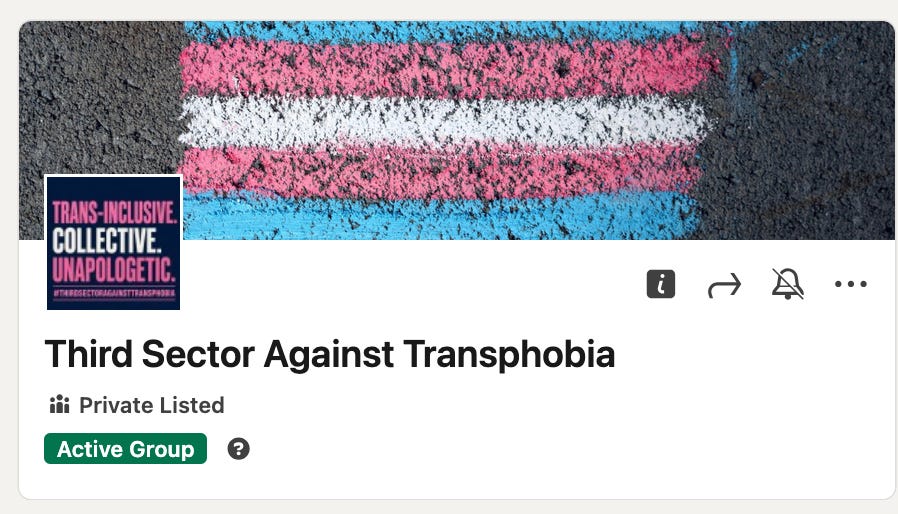
Kevin Taylor-McKnight and several others including Debra Allcock Tyler, Steph Richards, and Penny Wilson (I have had to step aside due to work pressures) have set up a vital group called Third Sector Against Transphobia. This offers support to charity CEOs and others who are being targeted by lawfare, as well as making the case for trans inclusion and influencing key third sector figures.
They have had strong support from some organisations, but notably not from others. Funders have been particularly uninterested; for example, as I understand it, the main funder infrastructure body has made clear that they won’t take a stand. But of course, most of their members are not the large progressive trusts - they are largely private grantmakers, especially family trusts, and are mostly no doubt on the right of the political spectrum. This of course is also why trans and LGBT organisations are chronically underfunded.
Please join TSAT if you can.
More detail on lawfare and charities can be found here in my previous article on the subject.


Mamdani and municipal socialism
And finally, I have so much to say about what Mamdani is doing in NYC. But one particular thing that stuck out to me related to charities was this.
If you ever wondered what could replace ‘corporate donations’ and CSR, here’s an idea from NYC.
Instead of waiting for corporates to name a wing of a museum after themselves to launder their reputation, on May 7, Mamdani announced that $12 million is being directed to seven community organizations across the five boroughs to fund peer-led addiction recovery programmes.
The money comes from lawsuits. NY Attorney General Letitia James secured a $7.4 billion settlement against opioid manufacturers Purdue Pharma and the Sackler family earlier this year.
It’s part of a broader picture: as of last June, NYC had already received $190 million from various pharmaceutical settlements, with that total expected to grow to $550 million by 2041.
The $12M specifically funds peer workers — people with lived experience of addiction leading recovery outreach.1
More of this please, and fewer minuscule handouts to launder reputations.
My friend David P. Stoker has talked about the power of these ‘legible’ reparations for corporate wrongdoing in his blog.
More broadly, take a look at this article from my favourite magazine currently, The Jacobin, the US socialist magazine.
Zohran Mamdani’s 100 Days of 21st-Century Sewer Socialism
Liza Featherstone, The Jacobin, April 10th 2026.
Plug!
And speaking of magazines, you can find my article about Epstein and Philanthropy in the June issue of Alliance magazine - my argument being that he is not a bad apple, he is emblematic of the whole damned thing. It’s in the print issues - I’m not sure if it’s also online. Thanks to Editor Elaine Stabler. I like the fact that Alliance is a ‘critical friend’ to philanthropy. (I’m not sure I’m a friend at all at this stage….) But it does make me think I don’t there is such a magazine I could point to for charities in the UK.

If you can’t access it, you can get some general thoughts from me on Epstein in the article below.

Some notable professional stuff around this week.
Fundraising ROIs
Caroline Richards (who I keep nearly looking up on Linkedin because she has changed her name, and I’m used to her being called Danks, which is inconvenient and confusing, please change it back) of Caroline and Tony and The Nest Egg fame -has produced a fantastic fundraiser’s ROI report which yoi can find here. Check it out - this will really help your fundraising if that’s your bag, and don’t forget to subscribe to the Nest Egg while you’re at it.
IVAR’s Leaky Lifeboat Survey
IVAR, a UK charity research consultancy firm, and progenitor of ‘open and trusting’ grant frameworks, has produced its annual survey of charity funding experiences. Tellingly, it’s called ‘Searching for Life Rafts: The Funding Experience Survey 2026’.
It’s a mixed bag but honestly I find much of it a bit encouraging - full marks to people like Joanna Jeffery and, to hell with it, me, for putting some pressure on funders to change their practices. And credit to them for listening.
Some things have improved. For example, some feel that funders are expecting less in terms of insane applications, and are more willing to do multiyear unrerstricted funding at higher amounts.
What I also note is that people feel finding funding is more competitive than ever, and they feel that funder restrictions are becoming more intensive.
I would suggest everyone in and out of funder circles is honest with themselves here.
If funders offer higher amounts of funding, for longer, that is going to reduce the number of grants. If they reduce the friction of application processes - especially when AI is in the mix - that is going to raise competition and the number of applications.
It’s not so much ‘be careful what you wish for’ - because these are the right things to wish for. But I do think we need to recognise that what is often holding all of this back is the size of the market, and the large-scale disinvestment from the third sector of governments, corporates, and indeed, cash-strapped indidivual donors.
And if we do ask for larger, longer, grants, that does mean fewer grants unless the sheer size of the pot is increased. And easier applications mean more applications.
We’ve also seen strong calls from fundraisers for grantmakers to provide ever-tighter guidelines and rubric to increase chance of success and wasted time. But for me, that also seems to risk chilling creativity and openness to new ideas in funders. And it also means that you will inevitably see funders focusing myopically on whoever their trustees consider to be the deserving poor of the week. It also cuts out most generalist work and the glue of society.
Deeper questions, which I want to pose are all extremely important too. Who gets to decide, how much money should be a minimum spend for trusts, and indeed, what should happen to those growing donor-advised dark money funds? But nobody wants to have those discussions.
Nor, indeed, do they want to ask why the money is held by people who aren’t doing the work, and what this tells us about the asset class and its role in the third sector….
That’s your lot, folks.
Don’t forget to come back next week for a ‘Volunteering Sucks’ special.
Barely Civil Society is about making the nonprofit world braver.
Here are three ways to help.
1. Subscribe! And become a patron!
Barely Civil Society needs patrons to stay active. All the content is free, but if you’re able to support this work, it means a lot if you can buy a paid subscription.
2. Share Barely Civil Society: Lord knows the algorithms are not in our favour.
3. Buy me a periodical!
There are practical reasons to chuck me a fiver: I’m saving up for journals and periodicals/ libraries access so I can keep better track of what is happening in the sector. That improves the blog you get to read, a blog writing the kind of stuff nobody else does, completely in my own time and at my own cost. Can you chip in and buy me a periodical? Or a Jammie Dodger?

I wrote this segment with the help of AI - needs must.
This is an incredible issue
Fantastic issue this week. So many moments of 👏🏻
The thing that rattled around my head reading the TSAT section is that back in the early 90s, it would have been unthinkable not to have a stance on Mandela in prison, for example. Or not to be flying the flag for women’s value in the workplace. It really feels like silence is cowardice.